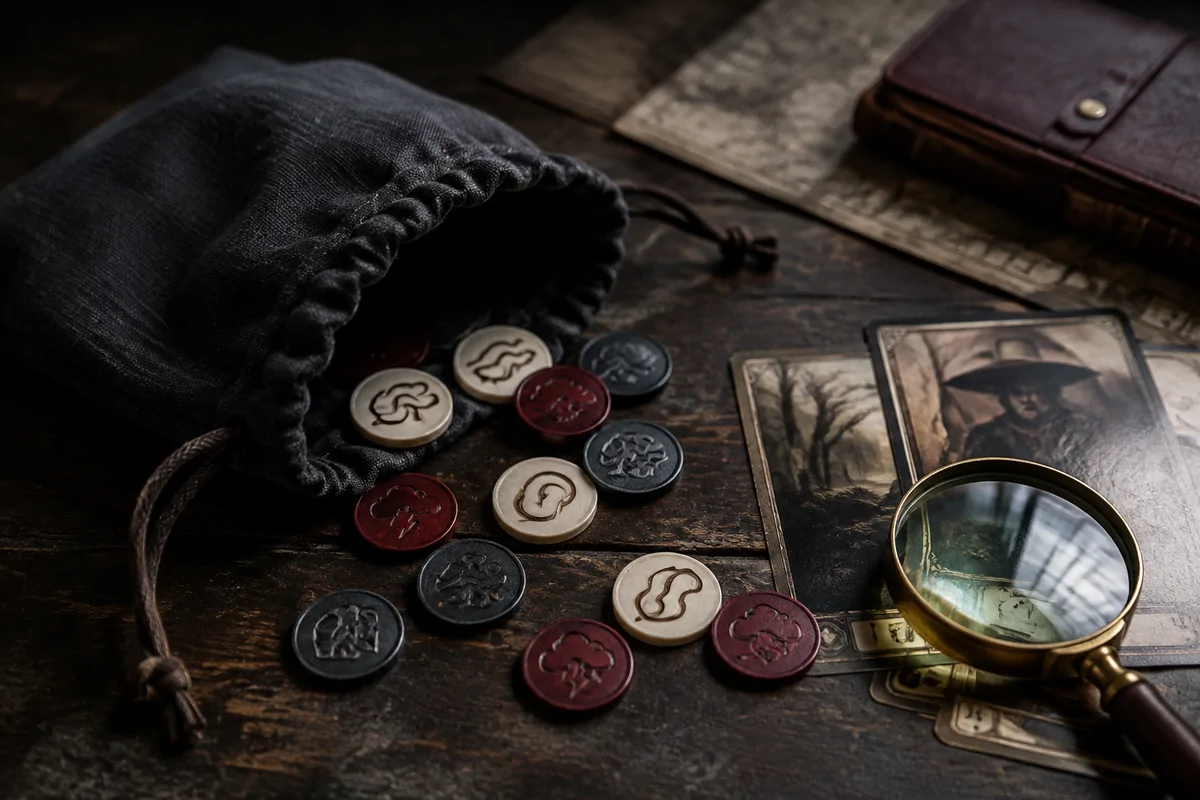
A bag makes uncertainty touchable
Arkham Horror: The Card Game uses a chaos bag as a physical source of modifiers during tests. An investigator commits to a challenge, then a token is drawn to alter the result according to the current rules and scenario. Fantasy Flight Games’ product resources provide the rules materials for those procedures. The bag makes uncertainty tangible: it is a container players can see and reach into, but its next result is hidden until drawn. The game does not make difficulty disappear into a calculator; it gives probability a physical moment at the table.
The metaphor of weather is useful because the bag’s contents can change as a campaign or scenario changes. A token may add or subtract value, carry a special effect, or create a dramatic consequence under the relevant text. The bag is not a universal difficulty scale independent of context. Investigators, scenarios, and campaign choices affect the experience. Players should check the current rules and card text for exact resolution. The design discussion here focuses on how a shared randomizer feels, not on promising a fixed probability for every test.
A test links a declared intention to a threshold
Skill tests turn a player’s intention into a comparison against a difficulty. The investigator chooses an action, uses available skills and modifiers, and then the token result changes the margin. That sequence makes the challenge legible. A player can ask what value they need, what support they can commit, and how much risk remains if the draw is unfavorable. Because the test belongs to a narrative scenario, the consequences may matter beyond a simple pass or fail. The rules and scenario text specify that outcome; the table supplies the interpretation of its dramatic weight.
This process encourages discussion before the token is drawn. A group can decide whether to help, spend a card, or accept the risk. Once the bag is opened, the uncertainty becomes a result everyone can witness. The decision and the draw should remain distinct. A player may make a sound choice and still fail, or take an unnecessary risk and succeed. Reviewing the choice separately from the outcome helps the group learn without turning randomness into blame. The bag creates uncertainty; it does not decide whether the plan was reasonable.
The container becomes a shared memory aid
Because the tokens are physical, players can handle and inspect the game’s uncertainty. The bag also helps the group remember which effects belong to the system rather than to one player’s recollection. If a token has a special effect, its symbol can prompt a lookup in the current reference. This is valuable in a game with evolving scenarios and campaign text. The component reduces abstraction but does not replace documentation. Players still need to read the current rule, especially when a new token or scenario instruction changes how the test resolves.
The group’s relationship to the bag can shape pacing. A dramatic test can pause conversation, concentrate attention, and create a shared reveal. That moment has a social quality distinct from rolling a die in silence. Players may anticipate the result together, then discuss how it changes the scenario. The suspense does not come only from mathematical odds; it comes from a public ritual around an uncertain event. This shows how physical components can structure emotion without changing the underlying rule: the bag turns a probability update into a moment everyone experiences at once.
Difficulty is a relationship, not a fixed label
Calling a test “easy” or “hard” can be misleading when the bag, investigator, and committed cards all affect the result. Difficulty is relational: it depends on the target, the player’s capabilities, available support, and the current token pool. A scenario can also define special modifiers that change the calculation. The publisher’s current materials are the source for these details, and different printings or campaigns can create different conditions. A reliable explanation should name the relevant context rather than claim that one chaos-bag composition represents the game as a whole.
This relational view helps a group discuss risk honestly. Instead of saying that a draw is safe, players can say what margin they need and what failure would cost. The language acknowledges uncertainty without exaggerating it. It also makes cooperative support more purposeful. A player can decide whether helping a teammate changes the result enough to justify spending a card or resource. The bag then becomes a common reference point for the group’s estimate, even though no one can know which token will emerge.
Use the rules reference as part of the kit
For a new group, teach the sequence of a test with a low-stakes example: declare the test, identify the investigator’s relevant skill, determine the threshold, commit support, draw a token, and resolve the outcome. Keep the current rules reference available and distinguish general rules from scenario-specific effects. The sequence gives players a predictable frame while leaving room for surprise. When a token’s symbol is unfamiliar, pausing to look it up protects the shared understanding better than guessing based on artwork.
The chaos bag is an interface between calculation and suspense. It makes uncertainty physical, gives a group a shared reveal, and asks players to evaluate a risk before they know its result. The exact tokens and effects should be checked against Fantasy Flight Games’ current resources and the scenario in play. The design lesson is that a component can do more than store randomness. It can help players feel the moment of uncertainty together, while a well-maintained rules reference keeps that feeling attached to a fair and inspectable procedure.