The factory display is a shared choice
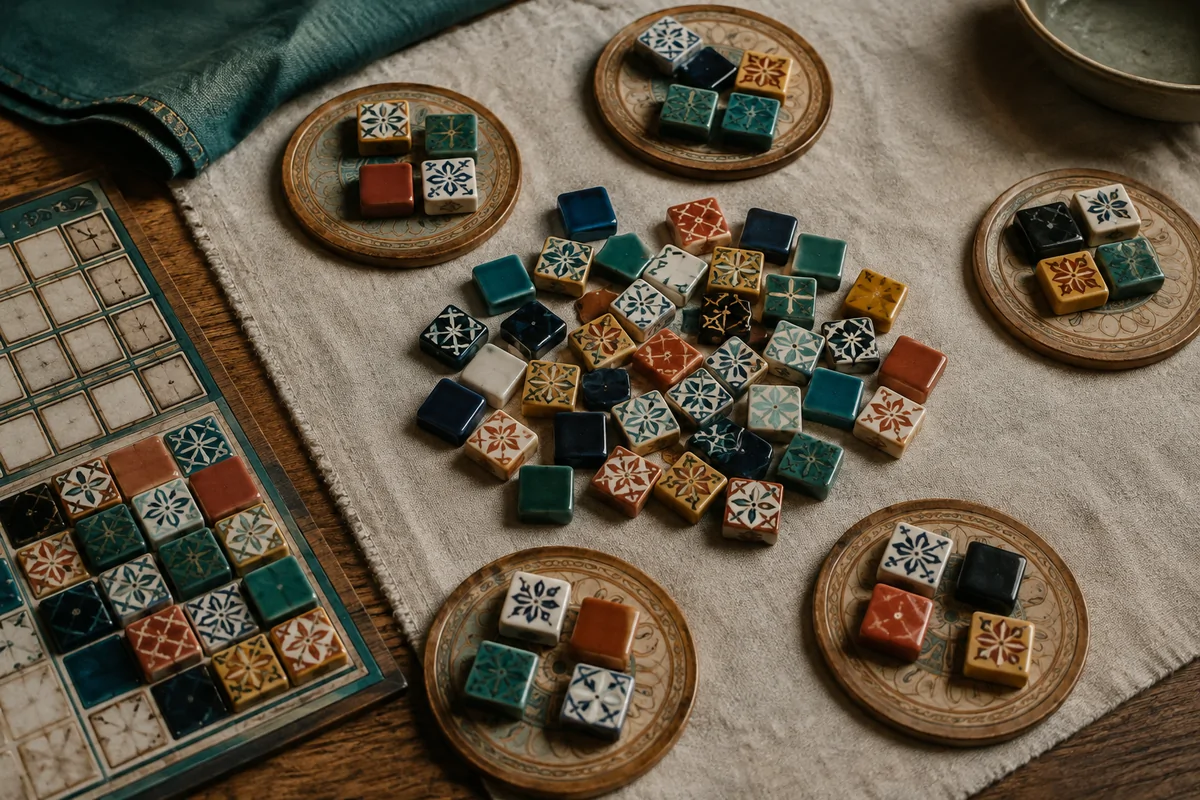
Azul presents a set of colored tiles arranged in factory displays and a central area. On a turn, a player takes all tiles of one color from a chosen display or from the center under the rules, then places them in a pattern line. The official Next Move Games rules define that procedure. The choice is simultaneously private and public: the player is filling a personal board, but the tiles left behind change the next player’s menu. A simple collection action becomes a draft in which taking one resource redistributes the rest.
This is why scarcity feels social even though the tiles are visible. A color can be abundant on the table and still be difficult to take at the right time, because selecting it may create awkward leftovers or fill a pattern line beyond capacity. The player must decide not only which color is needed but where it can fit and what penalty will follow if too many tiles are collected. The factory display supplies an immediate question; the personal board supplies a longer constraint. The turn links both spaces in one physical movement.
Pattern lines turn desire into a capacity problem
The pattern lines on a player board are staging areas for tiles before they move to the wall. Each line has a capacity, and the player’s choices must respect that limit. A row with only one empty place can accept just a small number of tiles, while an empty long row offers room but may delay a desired wall placement. This makes planning concrete. Players cannot simply say they want a color; they must decide where the collected group will be stored and whether that line can be completed without overflow.
Capacity also changes how a player reads the shared displays. A large group of one color might be attractive if it completes a line, but costly if it exceeds the available spaces. Tiles that cannot be placed as planned move to the floor line and can carry a scoring penalty. The exact treatment belongs to the rules, but the design consequence is intuitive: taking more is not always better. Abundance can become a burden when the player’s personal storage is nearly full. The board converts collection into a problem of fit and timing.
The wall rewards placement patterns
When a pattern line is complete, a tile moves to a corresponding position on the wall according to the rules. The wall’s scoring rewards particular spatial relationships, so a player is planning both the current line and its eventual location. A tile’s color has a role in the pattern as well as its individual presence. That creates a second layer of anticipation: the player is not merely completing a set, but deciding which row or column becomes stronger and which future spaces may remain open.
This arrangement discourages treating points as isolated arithmetic. Adjacent tiles can create bonuses, and completing rows, columns, or color sets can matter across a longer horizon. A move that scores well now may constrain a later placement if the wall’s pattern becomes awkward. Conversely, a low immediate score can help establish a line that offers more future connections. These are not hidden strategic secrets; the board displays the relationship. Players improve by looking at the wall before taking tiles, then checking whether the chosen factory group advances a useful pattern without creating avoidable overflow.
The center is a changing remainder
After players take from a factory, the unchosen tiles move into the central supply under the standard procedure. That makes the center a remainder of prior choices. It can grow into a rich source, but it can also carry a first-player marker or penalty-bearing tile, depending on the round’s sequence. The center is not neutral storage. It records what others declined and changes who must take responsibility for the next choice. Players may prefer to draw from it, but that choice can come with a cost the factory did not impose.
The evolving center is a small lesson in shared scarcity. A player’s decision can make a color pile larger, expose an unwanted group, or force someone to take a difficult combination. Because the state is public, the group can see how the remainder came to exist. This visibility supports conversation: a player may explain that they left a color because no line could hold it, while an opponent may interpret the same choice as an opening. The rules create the flow; players give its consequences meaning.
Teach the draft before discussing optimization
For a first game, demonstrate one pick from a factory and one pick from the center. Place the selected color in a pattern line, then show what happens to the remaining tiles. Ask the learner where the chosen group can fit and what would happen if it cannot. This teaches the central relationship without asking the player to calculate a perfect wall. Once the loop is clear, the group can talk about adjacency, future bonuses, and the risk of leaving a difficult center pile for someone else.
Azul’s elegance comes from linking public supply to private capacity. The factory makes options visible, pattern lines limit what can be stored, and the wall gives placement a longer spatial consequence. The official rules are the authority for scoring and penalty details; editions and variants may alter components or procedures. The design lesson is that a draft becomes interesting when a choice changes what remains and when receiving more can create a problem. Scarcity is not simply a lack of tiles. It is the mismatch between a shared offer and the shapes a player is able to accept.