A race with a memory of contact
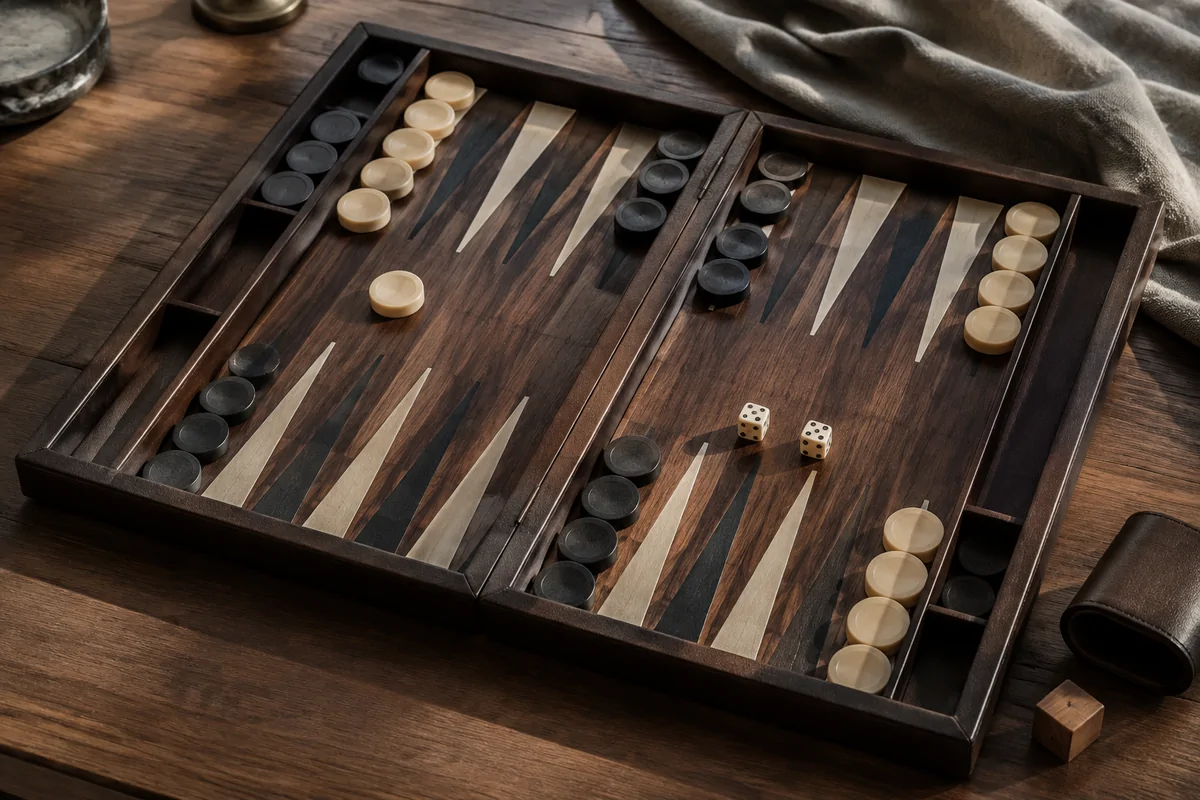
Backgammon is often introduced as a race: move checkers around the board and bear them off before the opponent does. That description is useful but incomplete. The race includes contact, and contact can reverse part of a player’s progress. A checker left alone on a point is a blot. If an opposing checker lands there, the blot is hit and moved to the bar; the player must re-enter it before continuing with other checkers. The United States Backgammon Federation’s beginner guide provides this procedural frame. The board is therefore both a route and a record of risk accepted along the way.
Dice make the race variable, but their uncertainty is not the only source of tension. Players decide how to allocate each roll among available checkers, whether to build points, cover blots, or advance a runner, and how much exposure to accept. The same number can create a safe move in one position and a dangerous one in another. A useful study begins by separating the random input from the choice it enables. Players cannot select the roll, but they can shape which routes remain available when it arrives and how costly a hit would be.
The bar interrupts a plan without erasing it
Being hit changes the order of attention. A player with a checker on the bar must use a legal entry from the opponent’s home board before moving other checkers, when an entry is available. This creates a temporary bottleneck: progress elsewhere may wait while the displaced piece finds a way back. The interruption is significant, but it does not erase the checker or the whole position. It moves the player into a constrained subproblem with a new set of legal destinations. That is a distinctive kind of setback, more specific than losing a piece in a game where captured pieces leave play.
The bar also makes an opponent’s attack easy to read. A blot is not merely a weak point in a defensive line; it is an invitation whose value depends on the roll, the landing point, and what the attacker would expose in return. A hit can delay the opponent but may leave the attacker’s own checker vulnerable. This reciprocal structure helps explain why a tactically attractive move is not always a good race move. The player should ask what the hit buys in time, what structure it costs, and whether the resulting position makes future rolls easier or harder to use.
Points are both shelter and obstruction
A point occupied by two or more of a player’s checkers is made unavailable to an opposing checker under standard play. Building such points can create safe stepping stones and restrict entry. Yet a point is not valuable simply because it is occupied. A checker stack may be secure while leaving other pieces too far behind, and a wall of points may become less useful if it prevents the owner from moving checkers forward efficiently. The board’s narrow lanes mean that safety, mobility, and race pace are connected rather than separate objectives.
This relationship is visible in the distribution of checkers. A player with many isolated pieces has more potential blots, but may also have flexible routes. A player who gathers checkers into a strong block can limit the opponent’s movement, while risking a slow homeward journey. Teaching can make this tradeoff concrete by tracing a single checker’s route and then looking at the points supporting it. The structure is not a static fortress. It is temporary infrastructure that must eventually be dismantled as the player shifts from movement to bearing off.
Bearing off changes the meaning of distance
Once all of a player’s checkers have reached the home board, the objective changes from circulation to removal. Bearing off is the final phase of the race, and it makes the distribution of checkers inside that board matter. A checker near the exit may be easy to remove, while a distant checker can force a player to keep using rolls on movement. Players often talk about “wastage” when a roll cannot be used as efficiently as hoped, but that word should not obscure the actual rule: legal uses depend on which checkers can bear off and the positions still occupied.
This phase also exposes the cost of earlier choices. A player who advanced several checkers evenly may have a smoother finish; another who built points for safety might now need extra moves to bring distant checkers home. There is no single distribution that dominates every match, because the opponent’s position and the dice matter. Still, the finish rewards players who think about the board as a changing route network. A short-term hit or block can be evaluated by the distance it adds, not only by whether it removes a checker from the board.
Risk can be discussed without pretending dice are predictable
Backgammon invites probability talk, but a sound discussion does not need to claim certainty. A player can consider how many dice combinations reach a blot or whether a point is likely to remain open, then distinguish that estimate from a guaranteed result. The role of the dice is to create a range of possible moves; the role of planning is to decide which positions are acceptable across that range. A safer play may sacrifice speed. A faster play may create a high-value attack. Naming the tradeoff is more informative than calling a move lucky or reckless after the outcome is known.
For a first session, demonstrate the sequence of rolling, using both dice where possible, hitting, re-entering, and bearing off. Then ask what a checker’s location means if it is left alone. The physical bar makes the consequence legible, while the track preserves the idea that a setback can still be recovered. Backgammon’s design holds two timescales together: the immediate tactical danger of a blot and the longer race toward the exit. That combination is why each move can feel both local and consequential. The board does not forget risk; it makes the route show where risk was taken.