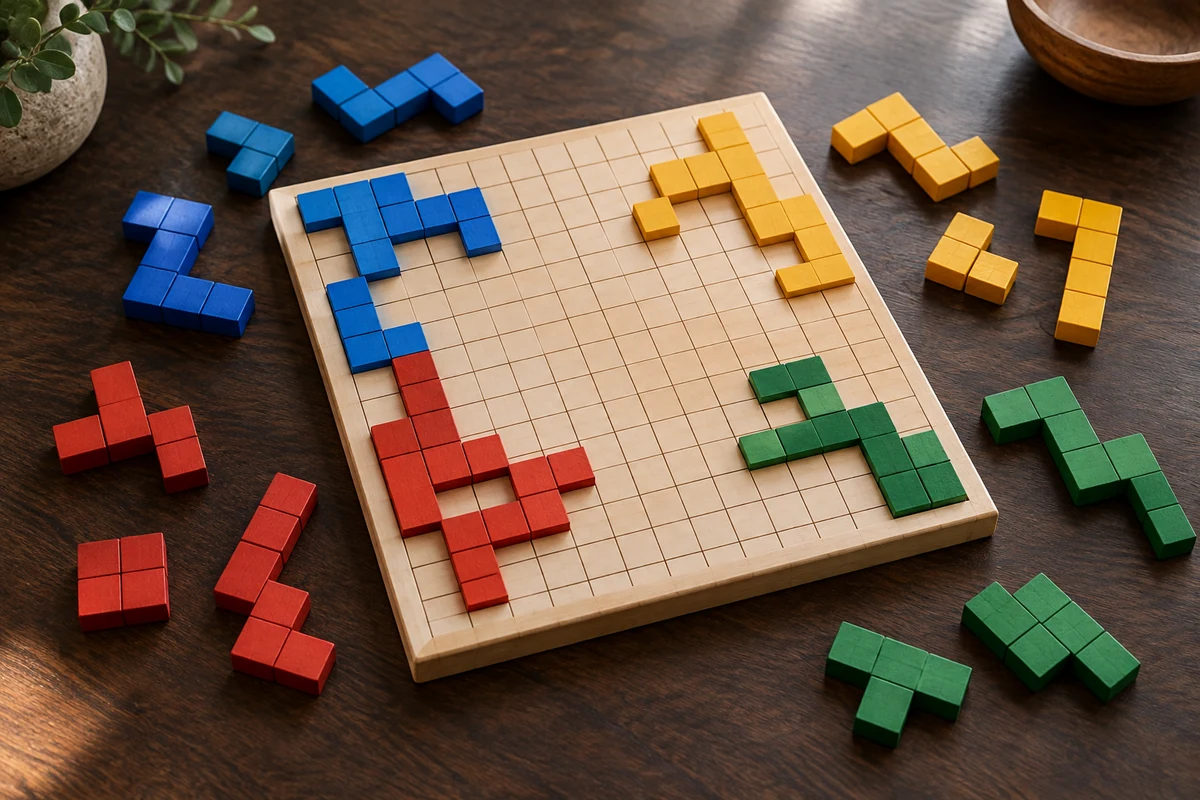
A small geometric exception creates the whole game
Blokus uses a twenty-by-twenty board and four colors, each with twenty-one differently shaped pieces. Every piece is built from connected unit squares, but the shapes do not behave as a simple collection of equal tiles. The longest forms occupy five squares; smaller forms provide different ways to turn, bridge gaps, or fit into narrow spaces. The rules give these shapes a distinctive relationship: a new piece of your color must touch one of your existing pieces at a corner, while the same color may not touch along an edge.
That corner rule is a doorway. It lets a player extend a color through a diagonal relation that leaves side-to-side borders open. A corner connection can reach behind an opponent’s line, make contact across a crowded frontier, or preserve access to squares that edge-connected placement would close. The board therefore rewards looking beyond the immediate empty cells. A legal move is also a claim about where the next legal move might still exist.
Four openings become four changing territories
Each player begins from a different board corner, and the first piece must cover the corresponding corner square. The opening arrangement gives the game a clear orientation without assigning one permanent territory to each color. Players soon push toward the center, where pieces of different colors may touch along edges and corners without restriction. The result is not a partition into isolated regions. It is a shared field where an advancing tip can open a route through spaces the larger body of a color cannot occupy.
Thinking in terms of territory can be misleading if it suggests that the board has stable borders. Blokus positions are more like routes and access points. A small corner of a piece may be the only usable contact for the next extension. A long piece may occupy broad space but leave few new corners available. To evaluate a move, a player can ask not only how many squares it fills, but also which open areas remain reachable from the new edge of the color.
Piece inventory turns timing into a spatial problem
The pieces are fixed once played, so there is no later rearrangement to rescue a crowded plan. That makes timing important. The rules themselves suggest trying large pieces early: a five-square shape can be difficult to place after the board has been carved into pockets. Yet simply spending the largest shape whenever possible is not a complete strategy. A long piece may be the only way to enter a corridor, while a compact piece may be valuable for slipping through a corner route that will soon disappear.
The useful question is whether a piece is doing work that another shape cannot do. Before placing it, compare its outline with the openings you still have. A broad piece placed near the center can create pressure, but it may also consume the narrow route that would have allowed a different shape through. This is a familiar design tension made unusually visible: each resource is not only scarce in number, but scarce in the geometry of the spaces where it can legally fit.
Blocking is an interaction with future options
Because other colors have no contact restriction, an opponent can place a piece alongside yours. That makes the boundary between “my area” and “your area” porous. Blocking an opponent can be useful, yet an early collision may give that player an alternative route around the obstruction. The official strategy advice recommends moving toward the center rather than remaining in the starting corner, while also warning players to preserve ways out around their own color. Those recommendations point to the same principle: access matters more than owning a neat patch of empty squares.
Watching an opponent’s remaining shapes improves this assessment. A narrow opening might look generous until you notice that the rival has no piece capable of entering it. Conversely, a broad gap may be strategically urgent if an opponent can exploit it with several shapes. The printed rules make no claim that every open square is equally useful. Their geometry invites players to distinguish playable space from merely empty space, an idea that gives the board its tactical texture.
The score describes completion as well as coverage
Play ends when everyone is unable to place another piece. The scoring system counts the unit squares left in a player’s unused pieces as negative points. A player who places every piece earns a positive bonus, with an additional bonus if the final piece is the one-square piece. That structure means the final board is not read only as a map of occupied area. It is also a record of whether the player managed to fit a complete inventory through changing access routes.
For a first session, the score can help explain why every piece matters, but the lesson should not be reduced to “get rid of pieces.” A player who spends a useful piece to gain access may create options that make several later placements possible. A player who rushes into conflict can fill many cells and still leave awkward pieces stranded. Blokus turns a simple physical distinction—corner versus edge—into a long chain of consequences. The diagonal doorway is small; the future it permits is not.
A useful post-game review can examine the unused pieces rather than only the colored regions on the board. The official scoring counts every unplaced unit square against a player, so the shape of what remains helps explain how access was lost. Was a large piece held until the spaces it needed disappeared? Did a player spend a compact piece that might have opened a new route? Did an opponent occupy a corner contact that had been overlooked? These questions connect the final score to earlier placement decisions without claiming that the game has one correct strategy. The board preserves enough evidence to reconstruct the route: where the color reached, which corners remained open, and where a connected extension stopped being possible.