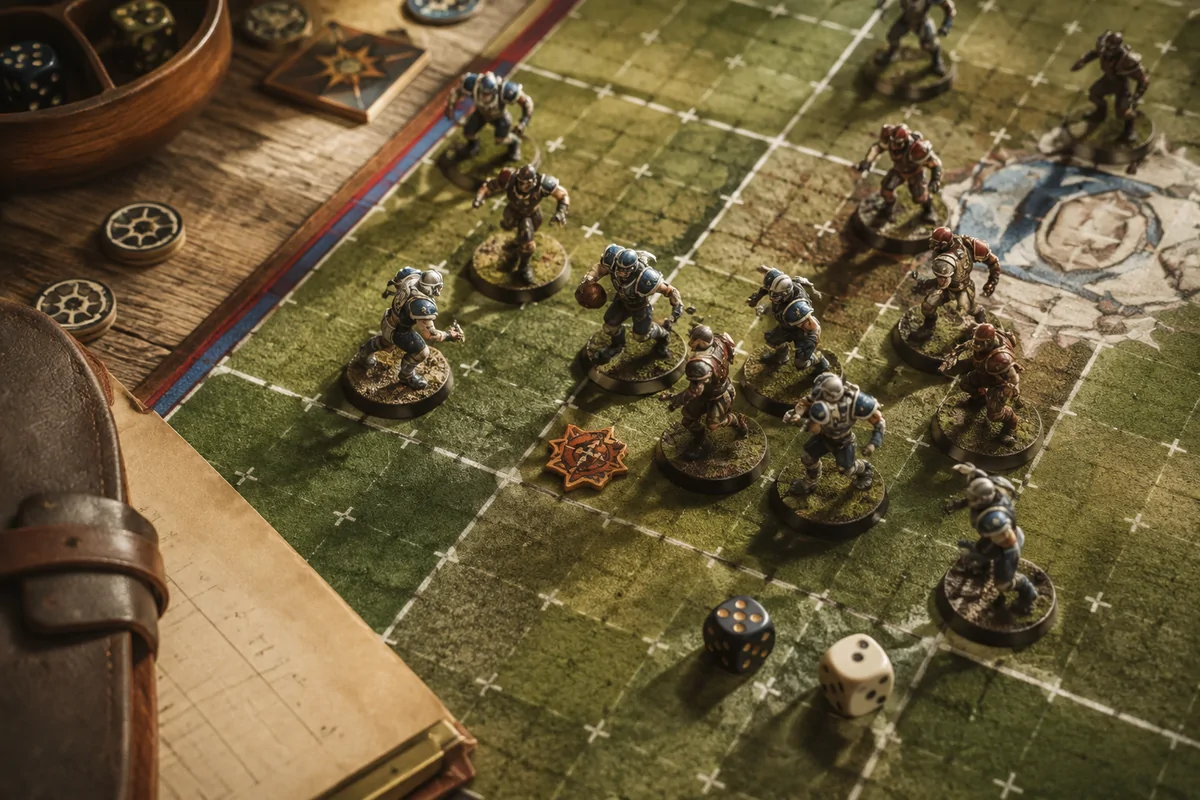
A drive gives the match a dramatic unit
Blood Bowl frames its match through drives: organized attempts to move the ball toward a scoring zone before play resets for the next engagement. Games Workshop’s current download library is the source for the edition-specific rules. The drive gives the fantasy sports setting a familiar rhythm of attack, defense, possession, and restart. Unlike a continuous open field, the board has a clear moment when one attempt concludes and another begins. Players can understand the local objective even when the larger match still has time and consequences remaining.
The reset is not a complete erasure. Relevant injuries, player availability, score, and other match state can persist according to the current edition’s rules. That contrast creates the game’s dramatic compactness: a drive can end, but its consequences can shape the next one. A team may have scored and still be weakened; a defense may have stopped an opponent but lost a key player. The drive is therefore a chapter break, not a new game. Players read both the immediate possession and the longer match story.
The pitch gives geometry a tactical voice
The marked pitch turns movement and contact into visible spatial questions. Players can see lanes, zones, and the relationship between the ball carrier and potential support. The current rules determine movement, blocks, and special actions; the physical board helps the group assess those procedures. A player’s position can protect a route or expose a teammate. The pitch makes that formation legible enough to discuss before dice are rolled, then records what the result changed. Positioning is not a backdrop to action. It is often the condition that makes an action possible.
This geometry also encourages teams to make a plan with contingencies. A route toward the end zone may be blocked, a player may fall, or a risky action may fail. The rules and dice determine what happens, but the coach chooses how much risk to accept. A robust plan includes support and a response if the first attempt breaks down. New players often focus on the ball alone; tracing nearby players can reveal why a seemingly quiet move matters. A teammate who occupies a lane may create an opportunity without ever carrying the ball.
A turn is a sequence of commitments
Blood Bowl’s turn structure constrains how a coach can act and how a turnover or other event can alter the remaining plan. Exact procedures and terminology depend on the edition, so players should consult the current rulebook rather than rely on an old phase summary. The general strategic problem is clear: a coach must decide which actions are safe enough to take first and which risks can wait. A failed roll at the wrong time can interrupt a sequence, so order matters even when the intended endpoint remains the same.
This creates a useful table habit: resolve lower-risk setup actions before a critical high-risk move when the rules and situation allow it. The advice is not absolute, because urgency can demand an early attempt. What matters is recognizing that action order changes the cost of failure. A player who moves a supporting teammate first may improve the chance of a later block, while a player who attempts the block immediately may lose the opportunity to reposition if it goes wrong. The coach is sequencing commitments under uncertainty, not merely choosing a list of attractive actions.
The dice make risk part of the story
Dice can create dramatic reversals, but they do not remove the coach’s responsibility for assessing risk. A risky action may be justified when the drive is nearly lost or when the reward is decisive. A safe action may be preferable when the team has time to build a stronger position. The rules describe which outcomes are possible and what happens when an action fails. Players can learn to state the consequence before rolling: if this fails, which planned actions disappear? That question transforms a roll from a hopeful gesture into an informed commitment.
After a drive, players can review both the dice outcome and the decision that preceded it. The result alone is not enough to judge a play. A reasonable decision can fail, while a poor decision can succeed. Replaying the sequence helps identify whether the coach protected the ball, created support, and considered the remaining actions. This kind of review supports improvement without blaming a player for chance. Blood Bowl is entertaining partly because the dice are public and consequential, but the game remains strategic because players choose when to invite that consequence.
Teach the restart as a change in state
When a drive concludes, take a moment to identify what resets and what remains. Explain the score, the availability of players, and any ongoing state according to the current edition. This helps new players understand why the next setup is not a blank slate. Then make the new drive’s objective clear: which side has the ball, what route is open, and what the opponent is trying to prevent. A visible reset procedure keeps the match moving and gives both players a fair shared understanding of the next chapter.
Blood Bowl uses the drive to make a match feel episodic without making it consequence-free. The pitch externalizes formations, the turn sequence organizes risk, and the restart gives players a new local goal against a persistent larger state. Games Workshop’s current rules library should be used for the edition in play, especially after a new season or revised rules release. The design lesson is that a reset can sharpen drama when it preserves meaningful consequences. A drive ends the immediate attempt; the match remembers what it cost.