The map is built one decision at a time
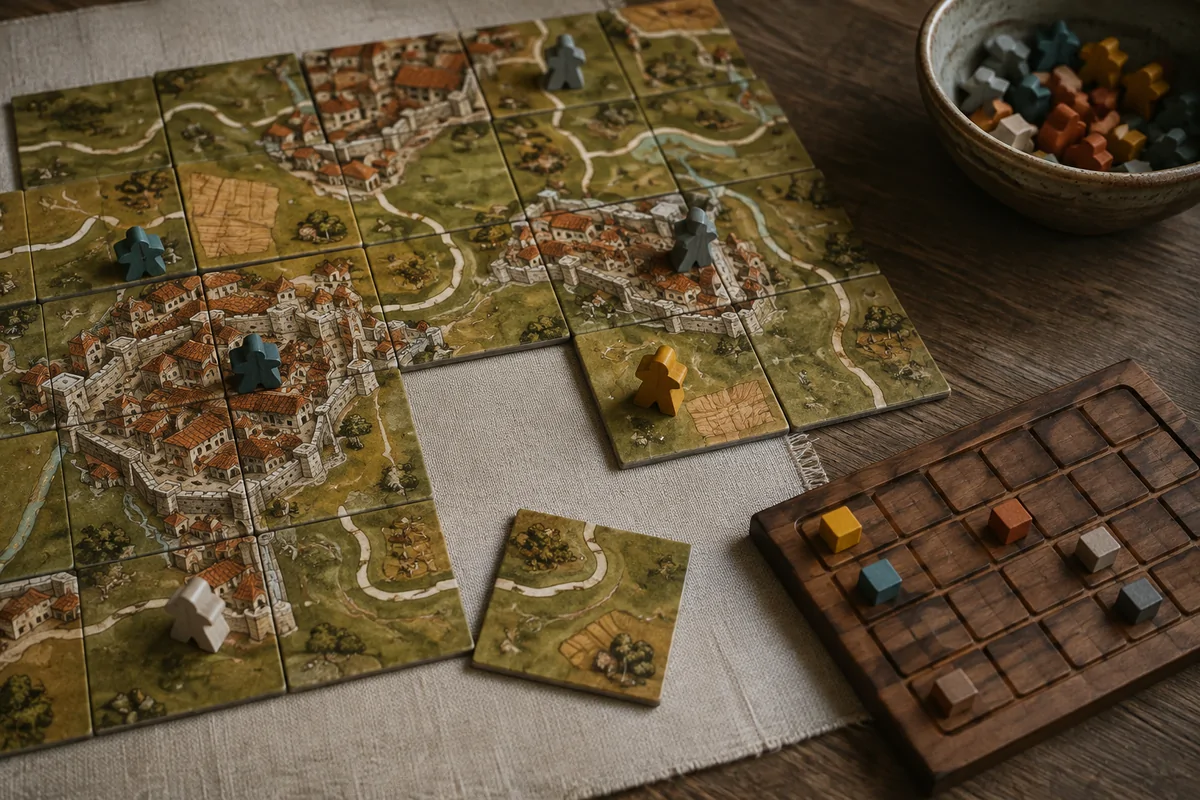
Carcassonne begins with a small landscape and grows as players draw and place tiles. Each tile must connect to the existing map according to the rules, extending features such as roads, cities, and fields. A turn then allows the player to place a follower where the conditions permit, and scoring can occur when a feature is completed. Hans im Glück’s rules describe this sequence. The result is a board that is both a setting and a live score sheet: every new piece changes the geography while affecting who may eventually claim the value created there.
Because the landscape is assembled during play, the map is not merely a puzzle that players solve. It is a shared construction with ownership decisions embedded in it. A road can be extended, redirected, or brought to completion by a later placement. A city can expand around an existing tile. A field can become a broad region whose value is determined at the end. Players see the future emerge from edges and gaps. The open landscape invites a plan, but the next tile can change what a plan is worth.
A tile placement is a rule and a proposal
The placement rule gives the landscape coherence: matching features must meet at the relevant edges. Yet a legal placement can still make several different strategic proposals. It may extend one player’s road, connect two areas, close a city, or leave a junction open. The player choosing the tile determines which pieces of geography become adjacent. This is a small act of authorship within a shared map. The player cannot draw any landscape they like, but they can choose among legal placements and influence which features other people will inherit.
That proposal has an audience. An opponent can see whether the placement seems to help a feature they already occupy or creates a chance to compete for it. A connection can sometimes merge claims, and the rulebook’s follower-placement conditions determine when that is possible. The strategic meaning depends on exact board state, so a broad claim such as “never connect opponents” is too simple. A useful analysis traces the specific features and asks who has a legal claim, what the placement changes, and whether the resulting value is immediate or delayed.
Followers make geography social
Followers assign a player’s presence to a feature. This converts the expanding map into a question of ownership and majority, not just adjacency. A player may place a follower on an unfinished road or city, hoping to score when the feature completes. Another player may later connect into that feature under the rules, creating shared control or a contested majority. The follower is a physical marker of investment. It remains visible while the landscape changes around it, reminding the table that scoring is tied to both location and the history of how the feature grew.
Follower supply makes commitment matter. A player cannot place a marker everywhere, and followers return only when features score according to the rules. Spending one on a low-value feature can leave fewer options for an important opportunity later. The decision is not simply “claim this tile,” since the marker belongs to a connected feature that may span many tiles. Players need to consider how a local placement contributes to a larger region and how likely that region is to finish. The physical board helps the group follow that evolution without a separate ledger.
Completion changes the value of the same feature
Roads, cities, cloisters, and fields have different scoring conditions in the base game, and additions or editions may alter details. A completed city can score at a different moment from an unfinished one; a field may be counted only at the end. This means two features that look similar in size can have different time horizons. Players must distinguish value already realized from value still dependent on future tiles. Hans im Glück’s rule sheet is the source for the specific edition’s scoring steps, and players should check it rather than assume every expansion uses the same procedure.
The changing value creates a productive tension. Closing a feature may release a follower for later use but end its growth. Leaving it open can create more scoring potential while also making it vulnerable to a difficult completion. A placement can therefore be good because it ends a feature, or because it keeps the possibility of growth alive. This is a design example of state-dependent value: the same tile edge matters differently depending on whether the surrounding feature is nearly complete, contested, or strategically useful as an open connection.
Teach the three-part turn as a repeated rhythm
The official turn sequence is a useful teaching scaffold: draw and place a tile, optionally place a follower where allowed, then score features that have been completed. Demonstrate the entire rhythm with one tile so players understand that scoring follows construction. Then point out one legal and one illegal follower placement. This is more effective than introducing every feature and scoring exception before the first turn. The group can learn the map’s vocabulary while seeing how one action creates an immediate result and a future obligation.
Carcassonne’s landscape is compelling because it refuses to sit still. Tiles make geography, followers make that geography social, and scoring makes time visible. The rules explain exactly when a feature scores in the selected edition; the analysis here describes how the growing map changes player options. Readers should consult the current rule sheet for expansions and edition differences. The broader design insight is that a board can keep its own history. The next tile does not merely add scenery. It revises what earlier decisions mean, turning each completed landscape into a public record of shared construction.