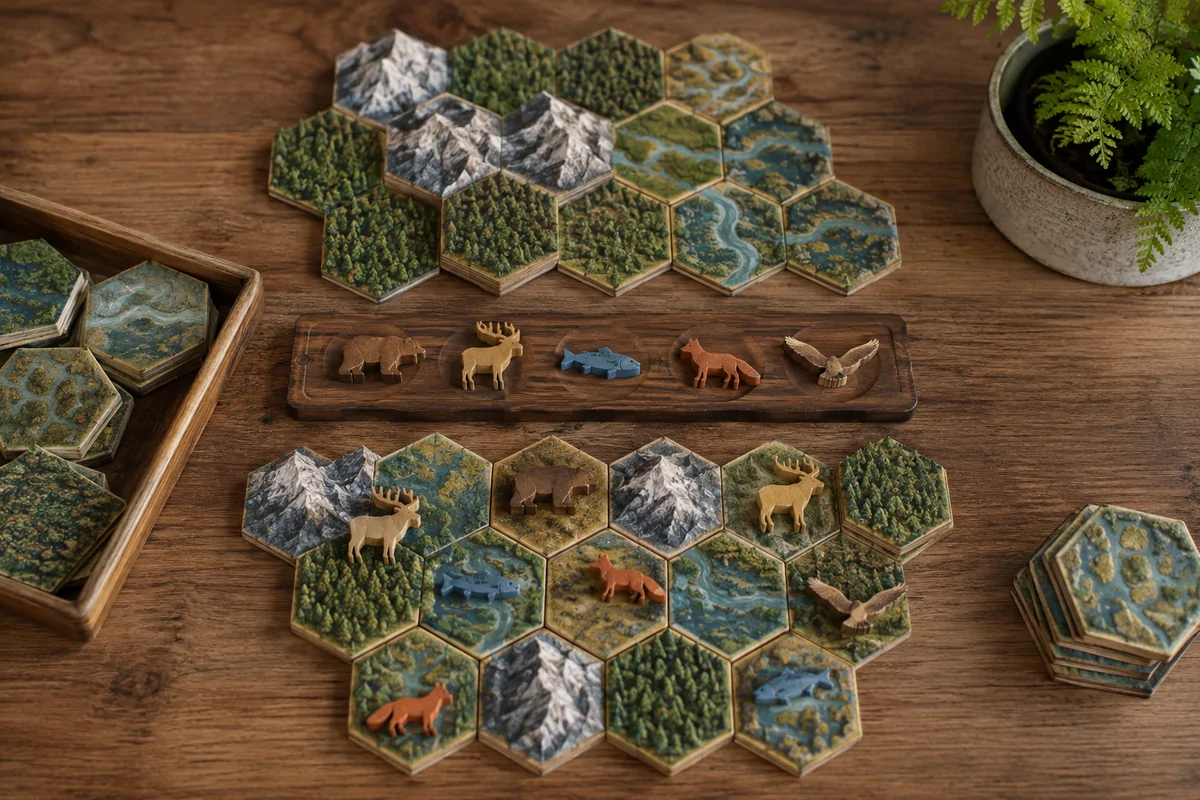
A draft feeds two puzzles at once
Cascadia asks players to choose a habitat tile paired with a wildlife token, then add both to an individual landscape. Flatout Games describes this paired draft and the ecosystem-building task. Each turn therefore asks two questions: where should the habitat go, and which wildlife pattern should the token support? The two choices are linked by the shared offer, but they do not always point in the same direction. A player may want a tile’s terrain for a corridor and the token for a scoring pattern, yet the pair forces a decision about which value matters more.
This dual puzzle makes the draft more interesting than selecting from a single resource row. The shared display creates timing pressure because another player can take a pair first, while the personal landscape gives each player different reasons to prefer it. A tile that is ideal for one player’s map may be less useful to another. The group must read both the public supply and its own private arrangement. The result is interactive without requiring direct attacks: taking a tile changes the options left for everyone else.
Habitat corridors reward spatial continuity
Habitat tiles create a landscape where connected regions can matter for scoring. Players must decide whether to extend a large habitat corridor or place a tile to complete a more local shape. A broad connection may offer future flexibility, while a small isolated patch may be easier to fit but contribute less to a corridor goal. The exact scoring conditions are defined by the rules and current scoring cards. The design question is how a player balances continuity against the need to make room for wildlife patterns.
The physical tile arrangement keeps this choice visible. Players can see where a habitat edge continues, where a biome becomes fragmented, and which placements would connect distant regions. The map is personal, but every turn begins with a shared draft. This combination lets players plan independently while remaining aware of the table’s shrinking offer. A teacher can ask learners to trace a corridor before choosing a tile, then compare what would happen if the tile were used to satisfy a wildlife goal instead. That makes the tradeoff concrete without giving a universal placement rule.
Wildlife patterns change the meaning of a token
Wildlife tokens are scored according to pattern goals shown by the selected cards. Different animals can reward different spatial relationships, so a token’s value depends on what the player is trying to build. A group, a line, or separation may be useful under one goal and less useful under another. The publisher’s materials support the game’s paired-draft framework; the card text and rulebook are the authority for exact scoring. Players should read the goal before treating a token as inherently valuable. Its meaning is produced by the current pattern, not by the animal alone.
This creates a planning tension between immediate fit and future flexibility. A token may complete a pattern now, but the supporting tile may disrupt a habitat corridor. Another pair may improve the landscape while leaving the wildlife goal unfinished. A player has to compare two forms of progress that share a turn. The best decision depends on the remaining supply and the shape of the personal board. A useful review identifies which objective the player chose to favor and what opportunity that choice delayed, rather than labeling one type of scoring universally superior.
The shared display connects private maps
Because each player builds an individual ecosystem, the draft is the main point of direct shared interaction. Players can notice when an opponent repeatedly takes a certain kind of habitat or animal, but they should not assume every choice has the same meaning for every landscape. The display is public; the board state is personalized. This encourages a balanced table practice: watch what remains and what others might need, while still evaluating each pair against your own pattern goals.
Draft interaction also creates a manageable way to learn from others. A newer player can ask why an opponent chose one pair, and the answer may reveal how the habitat or animal goal works. The experienced player can explain the visible relationship without prescribing a move. That conversation keeps agency with the learner. The game’s indirect competition is strongest when players can articulate their reasons and see how a different board would produce a different answer. A shared offer supports comparison without forcing identical strategies.
Build a landscape you can still revise
Early placements should leave enough room for future tiles and tokens to connect. That does not mean avoiding every commitment. A landscape must take shape to score, and a player who keeps all options open may finish with no coherent pattern. The design asks for selective commitment: establish a direction, then retain enough flexibility to adapt to the next offer. Players can scan the personal map for edges that remain usable and compare those edges with their current scoring goals.
Cascadia connects a shared draft to a private spatial puzzle. Habitat tiles give the landscape continuity, wildlife tokens pursue pattern goals, and the pair forces players to weigh both at once. Flatout Games’ current materials and the rulebook are the source for exact scoring procedures. The design lesson is that two systems can share a turn without collapsing into one. Players build an ecosystem by balancing what the land can connect with what the animals can arrange, then use the shared display to decide which opportunity is worth taking before it disappears.