The island is a network of access
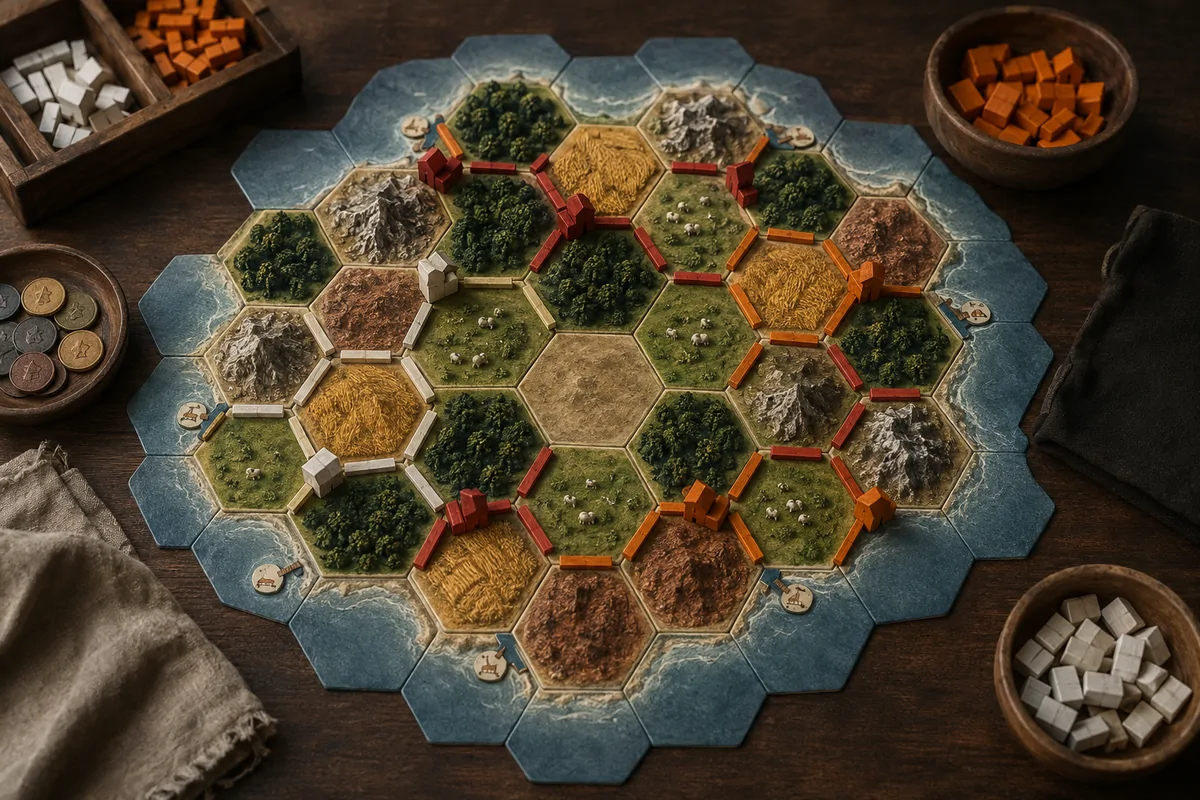
CATAN presents an island made from resource hexes, but the strategic problem is not simply which terrain looks valuable. Settlements connect players to production around their locations, roads connect places, and ports or trades can change how resources are converted. The official rules describe this relationship between hexes, number tokens, settlements, and roads. It is useful to read the island as a network: nodes provide access, links extend reach, and other players’ settlements shape which routes remain open. A location’s value depends on its neighbors and on the rest of the table.
This network view helps explain why a settlement cannot be evaluated in isolation. It may touch productive terrain but leave few ways to expand. Another location may provide less immediate variety while opening a road corridor or a future port. The board’s value changes as dice produce resources and as rivals claim nearby intersections. A good placement therefore has several timescales: what it can produce, where it can connect, and which options it denies or exposes. The rules make adjacency concrete; players interpret that adjacency as an evolving economic map.
Production is shared uncertainty
Resource production depends on the numbered hexes that are activated by the roll. Players may have settlements beside the same productive region, so a roll can benefit several people at once. This makes probability socially distributed. A player is not merely hoping for their own number; they are also tracking who else benefits when it appears. That shared production can influence negotiation and trading, but it does not guarantee that any particular exchange will be accepted. The board and number tokens create an expectation; the dice and players determine how that expectation unfolds.
Because production is intermittent, players build around uncertainty rather than eliminate it. Diverse access can make a player less dependent on one number, while focused access can create a strong return when a favored result appears. The right balance depends on the setup and on other people’s positions. A new player can compare two locations by listing the resources available and the routes they open, without needing to calculate a perfect probability model. The exercise reveals how the board converts a random event into different outcomes according to the network each player has built.
Roads turn ambition into a claim
Roads are links, but in a crowded island they are also claims on future space. Extending a road can reach a new settlement location, connect to a route bonus, or close off a rival’s plan. The same extension may spend resources that could have supported a settlement or development card. That is the central commitment: a road is useful because it changes access, but it costs a turn’s opportunity. Players should ask what destination the road makes possible and how likely that destination is to remain open. A line that leads nowhere useful is only length.
The network metaphor makes interaction clear. A rival can occupy an intersection, split a route, or make a long-term connection difficult. Such interference is not an exception added to an otherwise private economy; it is part of the map’s shared nature. A player’s plan depends on nodes they do not control yet. This keeps expansion legible to opponents and makes timing matter. When teaching, trace a road to its intended node before discussing its point value. The learner can then see whether the move creates real access or merely extends a line on the board.
Trading is an interface between separate economies
Players often need a resource they do not currently produce. Trading lets them negotiate that gap, while ports and the bank provide other exchange procedures under the rules. This turns the table into a small market with asymmetric inventories. A player may have surplus grain while another needs it, but willingness to exchange depends on what the trade enables. A useful discussion asks not just whether an offer is fair, but whose next action it supports. The rules establish permitted forms of exchange; the social context determines whether a particular offer feels acceptable.
Trade is also an information event. An offer can reveal what a player seems to be building toward, though it does not prove the plan. Declining an offer can preserve a lead or change another player’s pace. Players should avoid reading every refusal as hostility; it may simply be a rational choice about the future network. By naming what a trade makes possible, hosts can keep negotiation focused on the game rather than on personal judgments. CATAN’s economy is partly printed on the board and partly produced in conversation.
Read an opening by its future connections
During setup, compare starting sites with three questions: which resources can they reach, how variable is production, and what road connections remain possible? These questions do not promise a winning opening. They help players understand why adjacency matters and why a strong-looking hex can be a poor anchor if every path around it is blocked. As the island grows, repeat the exercise with routes and settlements. New pieces do not erase the old network; they extend it and create additional obligations to defend or supply.
CATAN makes development visible as a set of linked commitments. Hexes distribute resources, number tokens distribute chances, settlements define access, and roads connect plans across contested space. The official rules explain the procedures; the network reading is an analytical lens for seeing how the parts interact. Readers should check the current rules for edition-specific details and variant setup. The central design lesson is that an economy can be drawn spatially. When access has a location and a route, players can negotiate, block, and plan by pointing to a shared map rather than relying on an invisible spreadsheet.