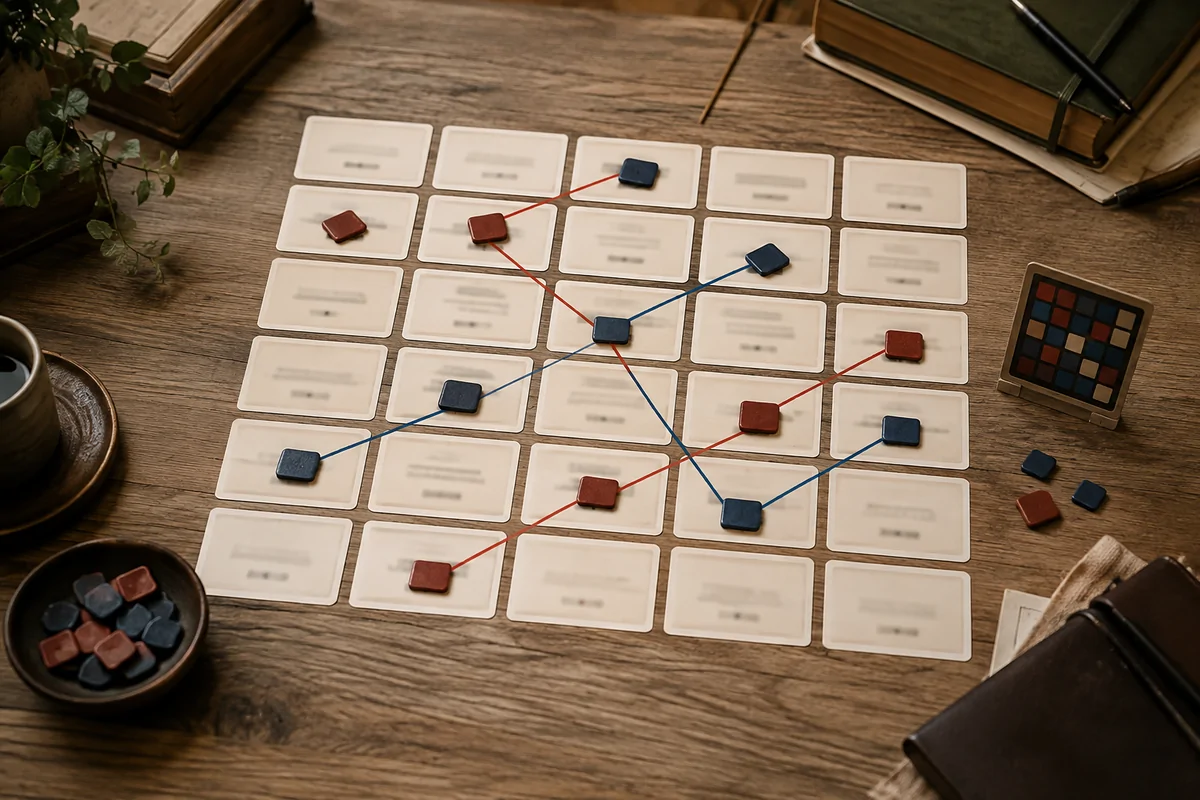
A clue connects two private maps
Codenames places a grid of words in public view while each team’s spymaster sees a separate key that assigns identities to those words. The Czech Games Edition rules define the clue as a word paired with a number, guiding teammates toward one or more words without naming them directly. The clue giver and guessers are looking at the same grid but not the same map. One person knows the intended connections; the others must reconstruct them using shared language and their own associations.
This gap is the game’s central bridge. A clue that is obvious to its author may be ambiguous to the team, because players bring different memories and meanings to the same word. The clue giver must compress a private pattern into a small public signal. The guessers must decide how much confidence to place in it. A strong session therefore depends not on a team having identical associations, but on learning how to calibrate communication under a shared constraint.
One word creates a field of possibilities
The clue is deliberately compact. A single word and a number must point toward a set of words while avoiding dangerous alternatives. The number indicates how many intended connections the spymaster has in mind, but it does not guarantee that teammates will interpret the clue as intended. Players can continue guessing under the rules, but each additional guess carries risk. The group must decide when enough evidence has accumulated. The clue is not a command to select a fixed list; it is an invitation to reason about a field of possible associations.
That reasoning can be playful and disciplined at once. Teammates may compare meanings, notice a shared category, or ask whether a clue could fit an opponent’s word. The discussion should remain within the rules about what the spymaster can say or signal. Too much explanation would collapse the communication puzzle. A good clue giver chooses language that is specific enough to guide and broad enough to cover the intended set. A good guesser listens for that intended boundary rather than simply naming the first word that feels related.
The key makes risk asymmetric
The hidden key assigns words to teams and identifies the assassin. A wrong guess may reveal an opponent’s word, stop progress, or end the game if the assassin is chosen, according to the rules. This means clue design is not only about maximizing the number of intended words. It is also about avoiding an attractive but dangerous alternative. A clue with many plausible associations may be ambitious and fragile; a narrower clue may protect the team while advancing more slowly. The key gives the spymaster a private risk map that the team cannot see.
The guessers share responsibility for managing that risk. They can choose to stop after a safe identification or continue if they believe the clue supports another word. This creates a useful difference between clue confidence and team confidence. The spymaster may know the intended connection, but the guessers must decide whether their interpretation is strong enough. A good team culture allows someone to say “I see another option, but I am not sure.” That modest uncertainty can prevent a confident group from treating a clue as more precise than it is.
Shared vocabulary is a resource that changes over time
Teams build a temporary vocabulary through play. A clue may invoke a book, color, place, or phrase that carries a specific shared association for those players. The rules constrain clue form, but the group’s history influences how a legal clue will be understood. This makes repeat play feel different from a one-off session. A team can discover which kinds of references work well and which routinely create confusion. The experience is social, but it does not require intimate knowledge; the clue giver can choose connections grounded in public words on the grid.
That shared vocabulary should not become an unfair private code. The current rules determine what clues are allowed and what contextual references may be used. Players should not rely on gestures, tone, or prearranged signals outside the permitted clue. The bridge works because it is constrained. If the spymaster can supplement the clue with arbitrary hints, the guessers’ task changes and the game’s uncertainty collapses. A group can still develop familiarity, but it should develop through ordinary language and visible play rather than a hidden signaling system.
Review the clue from both sides
After a round, ask the clue giver what connection they intended and ask the guessers what possibilities they considered. This reveals how the same word traveled across the bridge. It is usually more illuminating than judging a clue only by whether the team succeeded. A clue can be well-constructed and still be misunderstood; a vague clue can sometimes work by chance. Talking through the gap helps a group refine communication while respecting that everyone’s associations differ.
Codenames makes language a shared but incomplete interface. The key gives the clue giver certainty, the grid gives everyone a common reference, and the one-word rule limits how much of the private map can cross the table. The official rules define the clue and the consequences of guesses; editions and variants may add different team structures. The design lesson is that communication can be strategic when it compresses information. A clue is valuable not because it says everything, but because it helps another person act while leaving enough room for interpretation.