A board that asks the hand to become a measuring tool
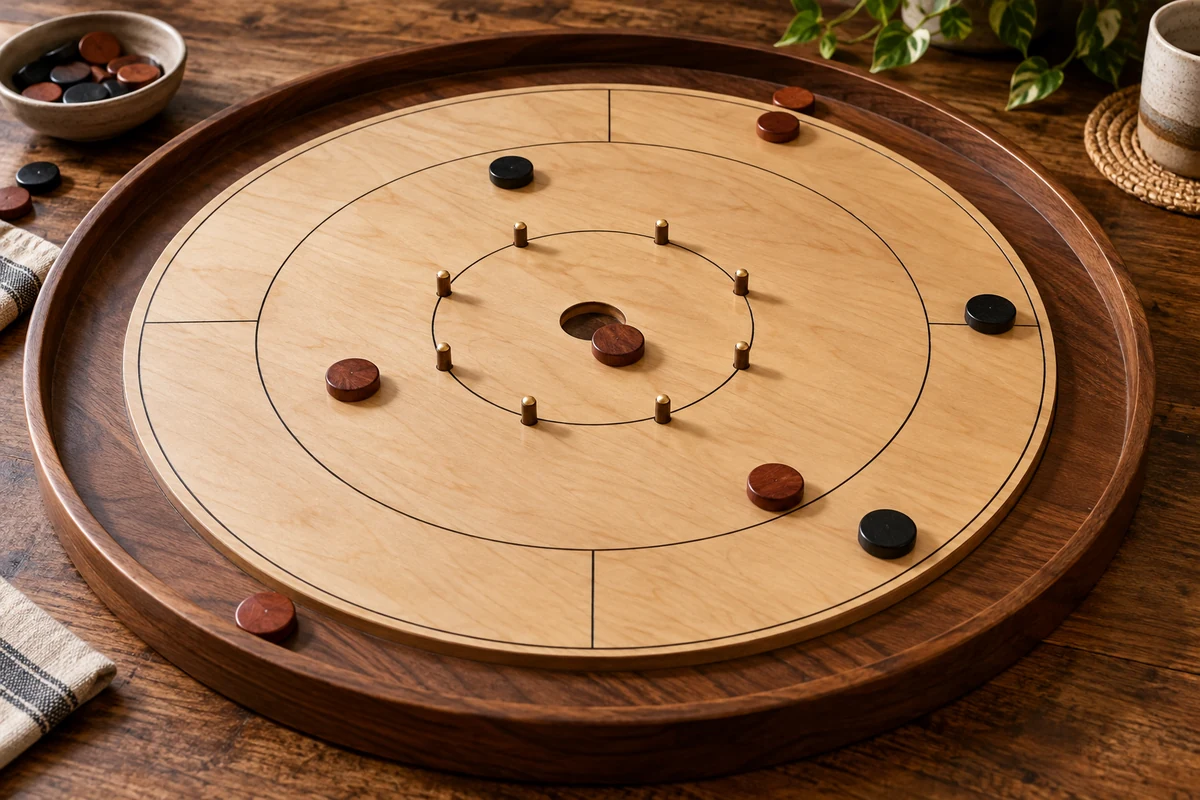
Crokinole is played on a circular board with marked scoring regions, pegs, a central hole, and small discs propelled by a flick. In competitive play, the National Crokinole Association rules organize shots around the board and assign values to regions, with the centre hole counting twenty. A player’s action is not just a decision about where a disc should go. It is also a physical calibration: direction, force, contact, and the surface all affect the result.
That makes the board a small physical world rather than a neutral background. The circular edge contains the motion; the ditch and rail keep pieces in play; pegs interrupt direct lines; rings translate position into score. A disc that stops near a boundary can be worth a different amount from one that travels closer to the center. The table gives every player a visible target, while the mechanics preserve uncertainty in the touch that sends the disc there.
Scoring zones make distance visible
The NCA rules describe the center hole as twenty points, with surrounding regions worth fifteen, ten, and five. They also specify how contact with a line affects a disc’s score: the lower adjacent value applies. These are competition rules, so casual groups may use local procedures, but the official document shows how carefully the board’s markings mediate a close result. Scoring is not a vague judgment about which disc looks nearest to the center.
The value system encourages players to read the surface in layers. A shot can aim to score directly, dislodge an opponent, or leave a disc in a difficult position. When an opponent’s disc is already on the board, the shooter’s choice may be constrained by the rules for a valid shot. The scoring rings thus do more than reward accuracy. They help define which kinds of risk make sense at different moments in the round.
The artifact record is one board, not the whole tradition
The Canadian Museum of History catalog lists a Crokinole board, artifact number 2009.71.1920 a-b, made by the Milton Bradley Company. Its recorded materials are cardboard and wood, and its measurements are 38.5 centimeters square by 2.8 centimeters thick. Those catalog details are unusually useful because they make a specific object tangible. They do not define every board or the full history of Crokinole, and they should not be generalized into a universal standard.
A museum object can show how a game was manufactured and collected, while a tournament association can specify how a modern organized match is played. The board in a collection and the rules in a competition PDF answer different questions. Keeping those sources in view prevents a common historical shortcut: treating one preserved artifact as if it represents every household version, region, or period.
Physical variation invites practical table care
Because Crokinole depends on a disc moving across a surface, table conditions matter. A board should sit level and steady; loose pieces should remain outside the active playing field; a group should agree on the ruleset before a close score is decided. These are hosting observations rather than claims about official equipment requirements. They follow from the fact that the same flick may travel differently if the surface is tilted, obstructed, or treated differently.
A host can also make the game more welcoming by giving each player a few practice shots before scoring begins. This separates learning the physical action from the pressure of the round. The NCA rules describe turns proceeding clockwise, which makes the sequence easy to follow, but a clear seating plan matters when several people are sharing the board. Components can support social clarity as well as accuracy.
Momentum is part of the rule experience
The disc’s momentum creates a kind of uncertainty that dice alone cannot replicate. A player selects a target, but the exact route remains physical and contingent. Peg contact, an opponent’s disc, or a slight difference in the flick can alter the final position. This does not mean the game is random or that skill disappears; it means the skill is embodied in repeated judgment of angle and force. The material object asks the hand to translate intention into motion.
Crokinole makes its central lesson visible without a long rules text: the board is both a scoring diagram and an instrument. Its rings measure outcomes; its pegs shape movement; its surface lets the player act directly on a piece. The Canadian Museum record helps ground that observation in an actual cataloged artifact, while the association rules clarify one competitive framework. The combination shows how physical design can contain a game’s mathematical and social structure in a single tabletop object.
A useful way to teach scoring is to let each player point to one disc and state the ring it occupies before applying the numerical value. The NCA document further specifies that a disc touching a line receives the lower value of the adjacent regions, so close calls can be resolved from the written standard rather than from a top-down guess. Groups playing casually may agree to another house procedure, but they should name it before scoring. This keeps a physical dexterity game friendly after a disputed shot. The board still invites intuition during play; its score marks translate that intuition into a result the table can check together.