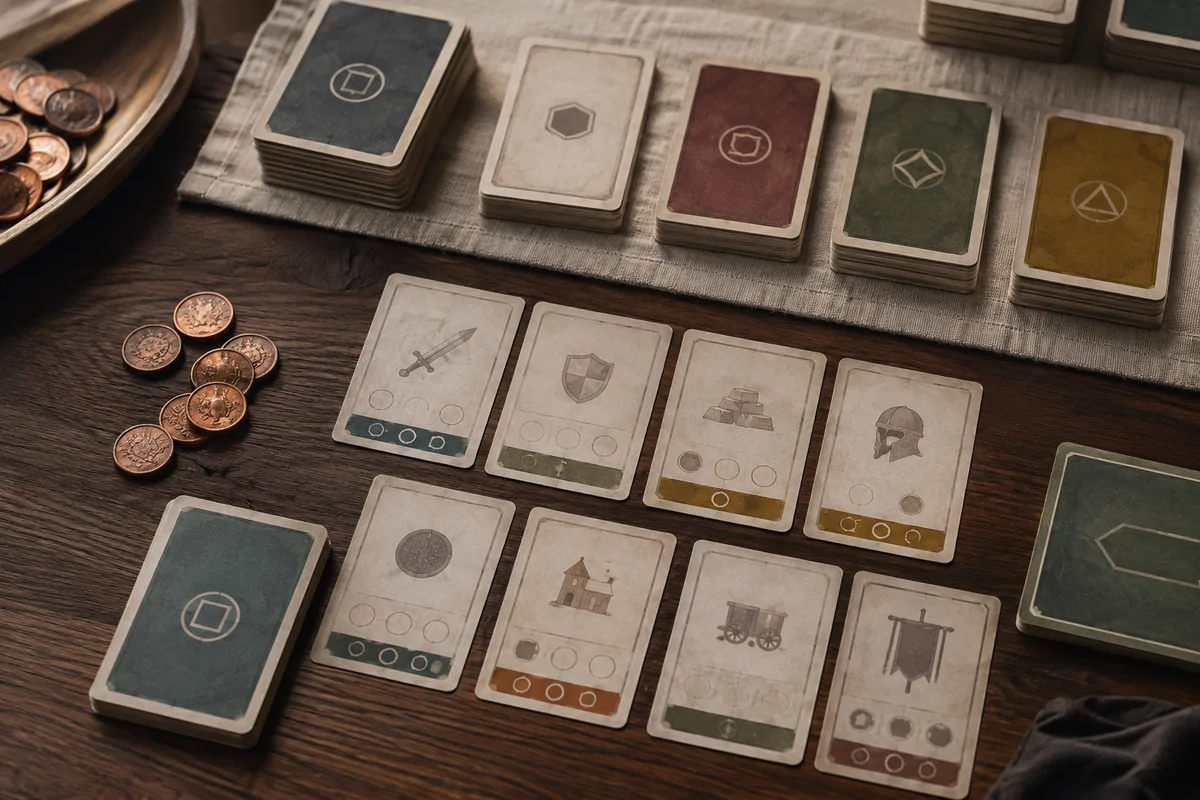
The player builds the engine they will use
Dominion begins with a small personal deck and asks players to improve it during the game. Cards bought from the shared supply enter a player’s deck and can later provide actions, money, draws, or points. The Rio Grande Games second-edition rulebook describes the action, buy, and cleanup phases that structure this loop. A player is not only choosing what to do with the current hand; they are editing the machine that will produce future hands. The deck becomes a workshop where each purchase changes how later turns can function.
That construction creates a tension between power and time. A card may be strong in isolation but arrive too late, fail to combine with the rest of the deck, or dilute the resources needed to buy more valuable cards. A modest card can be useful because it supports a reliable pattern. Players should therefore evaluate a card by the role it plays in a cycle rather than by its text alone. The workshop metaphor focuses attention on compatibility: what does this addition help the deck do repeatedly, and what does it make harder to draw?
The turn structure separates capacity from opportunity
In the base rules, actions, buys, and money interact through distinct phases. Action cards may allow more actions, alter the hand, or produce other effects; the player’s available buys and resources determine what can be gained from the supply. A new player can find the timing confusing if these pieces are taught as one undifferentiated pile of card effects. A clear explanation follows the turn in order and names what can still be done after an action resolves. The phase structure is a teaching aid as much as a formal procedure.
This order also reveals the difference between capacity and opportunity. An extra action is useful only if the player has an action card to use. More money matters only if a desirable card remains available and a buy can be spent. A hand full of possibilities may still be constrained by phase timing. When reviewing a turn, ask what resource the player had and what phase allowed them to use it. This helps separate a deck-building decision from a sequencing error. The system rewards both the engine constructed over time and the order in which its parts are operated.
The supply makes every purchase comparative
Dominion’s supply presents a menu of cards, but the menu is a shared environment. Players often select from kingdom piles that define the particular game. Taking one card reduces a pile and can bring the end closer. Buying a card is therefore a choice among alternatives with different costs, synergies, and timing. A powerful engine card may be less attractive if the game is nearly over; a scoring card may become necessary if the end arrives sooner than expected. The supply is not merely a store. It is a countdown with options disappearing from view.
This makes the question “which card is best?” incomplete. A better question asks which card improves this deck, how soon it can be used, and how it compares with the other available purchases. A player can build for repeated production, buy points, or interfere with the pace by emptying piles. The rules define when the game ends in this edition; the players decide how much of their strategy depends on reaching that endpoint first. The same card can be valuable in a long game and poor in a short one because its usefulness has a time cost.
Victory points can weigh down a working deck
Point cards contribute to the final score, but many are less useful during the turns when they are drawn. That creates a familiar construction tradeoff: a player needs enough points to win, yet filling the deck with cards that do not help its operation can make the engine less consistent. The balance shifts as the game approaches its end. Buying points too early may slow the deck; waiting too long may leave too few opportunities to acquire them. The rulebook establishes how points are counted, while the strategy question is when the deck should change from building to finishing.
This transition is a good teaching moment. Invite players to notice when an engine is functioning well but the score is not yet competitive, or when a player has enough points but can no longer draw them efficiently. A deck has an operational phase and a scoring outcome, and those are not always aligned. The design invites players to measure a machine against a deadline. A turn that generates impressive resources is not automatically progress if it never becomes a winning score before the supply ends.
Review a deck as a sequence of hands
After a game, look at several hands rather than only the final deck list. Which cards arrived together? Which actions were stranded because there was no support? Did a purchase improve the frequency of useful turns or add a card that rarely mattered? This kind of review connects composition to experience. It avoids judging a card only by its printed text and helps players see how reshuffling creates a new distribution. A deck is not a static collection of abilities; it is a schedule of future hands shaped by earlier purchases.
Dominion makes construction and operation happen in the same session. Players acquire parts, shuffle them into a system, and then test whether that system can earn enough points before the game ends. The official base-game rules define the phase sequence and ending conditions; expansions change the available machinery. The broader design lesson is that engine building needs a deadline. A workshop is interesting because it creates capabilities, but the game asks when to stop building and use them. Every purchase should be read both as a tool added and as time spent before the final score is settled.