A campaign remembers what a scenario changes
Frosthaven is structured around repeated scenarios whose outcomes feed into a longer campaign. Cephalofair Games describes a calendar, changing seasons, outpost development, events, and consequences that persist beyond a single encounter. The table therefore has more than one time scale. A scenario asks players to solve an immediate tactical problem; the campaign asks them to manage a community and its resources across many such problems. A victory can open options, while a loss or event may still change the state in ways the group must carry forward.
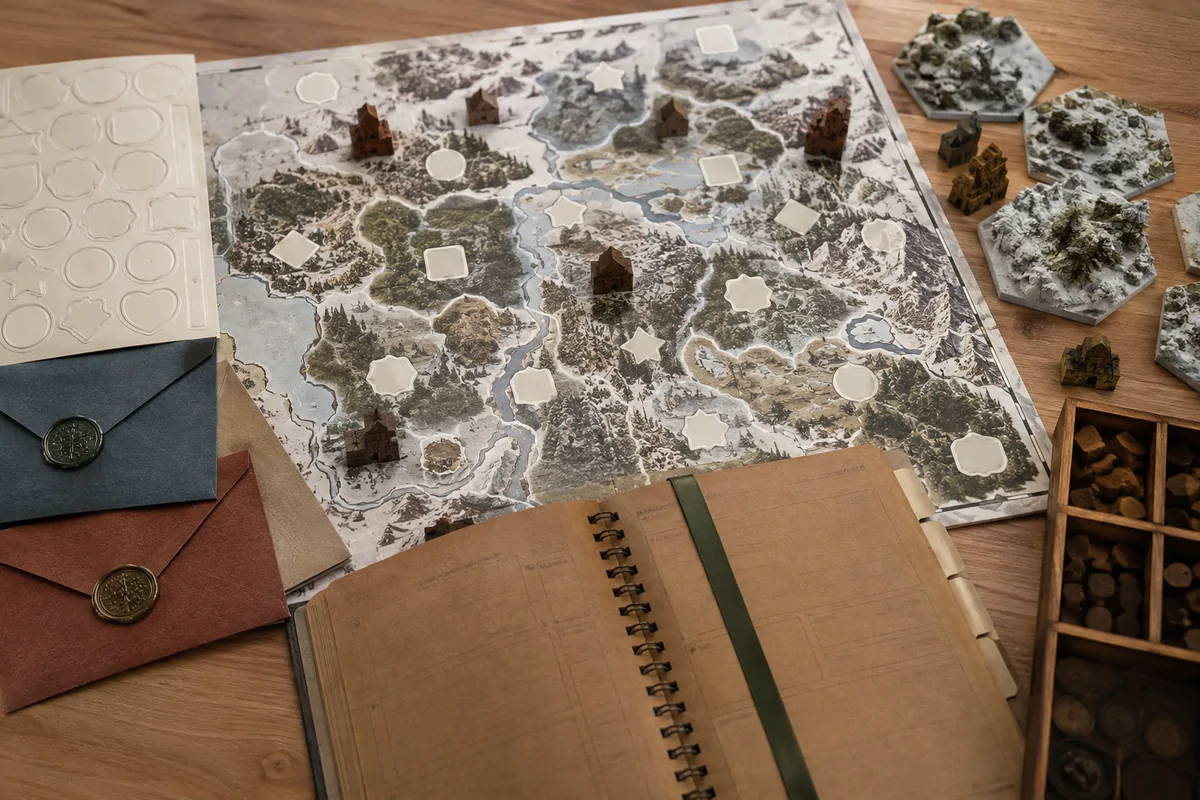
This persistence makes the table itself a record. Players update a map, track unlocked material, and consult campaign components to remember what has happened. The record is not just bookkeeping. It changes which choices are available later and gives the group a sense that previous sessions mattered. A single scenario can be understood as an episode in a changing environment. When players return after a break, the board and campaign materials help them recover the story without relying on one person’s memory of every decision.
The calendar turns time into a resource
The campaign calendar gives events and seasons a place in the system. Time is not merely the number of sessions played; it can determine which materials or circumstances are active. The official product materials describe seasonal changes and the calendar as part of the campaign structure. That design lets the group experience time as a changing condition rather than as an abstract counter. A scenario may be shaped by the season, and outpost development can connect the group’s decisions to what comes next.
Because the calendar advances, players have to think about opportunity cost. Spending time on one activity can mean that another event or development arrives later. A group may prefer to prepare, explore, or move forward, but each choice interacts with the campaign’s schedule. The precise details depend on the rulebook and campaign state; the general lesson is that time has been made visible. A clear calendar helps the group understand why a decision matters now and what kind of future it may make possible or delay.
An outpost makes the campaign social and material
Outpost development gives the group a physical way to invest in a shared home. Buildings, resources, and seasonal procedures can make the settlement feel like a project that grows between dangerous scenarios. This can change how players interpret success. A completed encounter may yield more than an immediate reward; it can support infrastructure that affects later play. The publisher’s campaign materials describe these systems, while the group supplies its own narrative meaning. A building can become memorable because of when the party chose to construct it, not only because of its printed effect.
Shared development also asks the group to negotiate priorities. One player may value a resource or building for tactical reasons, while another may care more about a long-term campaign goal. The decision is cooperative, but not automatically unanimous. A host can make the process smoother by reading available options together and stating the mechanical effects before discussing preference. This keeps the story conversation anchored in the actual choice. The settlement becomes a design interface where the campaign’s abstract progress is represented by a place the players can see and revisit.
Events turn routine transitions into decisions
Road and outpost events can make the passage between scenarios matter. Instead of treating travel or downtime as blank space, campaign systems use cards or prompts to change conditions. The current text determines what happens, so players should resolve it from the appropriate rulebook and edition. The design function is to make transition itself playable. The group may face a cost, opportunity, or new complication before reaching the next scenario, creating continuity between tactical maps that would otherwise feel isolated.
Events also make campaign state less predictable. Players can plan around known calendar structure, but an event may introduce a particular constraint or reward. This is a useful balance between preparation and surprise. The group remains responsible for choices, yet not every consequence can be forecast in advance. Players can review an event by asking what it changed and how the new condition affects the next scenario. That makes the campaign record more than a pile of cards: it becomes a series of decisions that the group can connect across sessions.
Keep the campaign record recoverable
Long campaigns are vulnerable to forgotten details. A simple table routine can help: record the scenario outcome, changes to the map, new unlocks, the calendar position, and any resources that must be carried forward. Use the printed materials as the source of truth rather than relying on a player to remember what was opened. If the game provides stickers or envelopes, follow the rulebook’s instructions so that hidden information and unlock timing remain intact. These habits preserve the campaign’s logic and make it easier for a returning player to rejoin the group.
Frosthaven’s campaign state makes the table a durable record of consequences. The calendar gives time a shape, the outpost gives development a place, and events connect one scenario to another. The publisher’s materials are the reference for the current campaign procedures and printing. The broader design lesson is that persistence works when players can inspect and maintain it. A campaign should not live only in memory. Its components can show what changed, what remains possible, and why the group’s past decisions still matter in the next room.