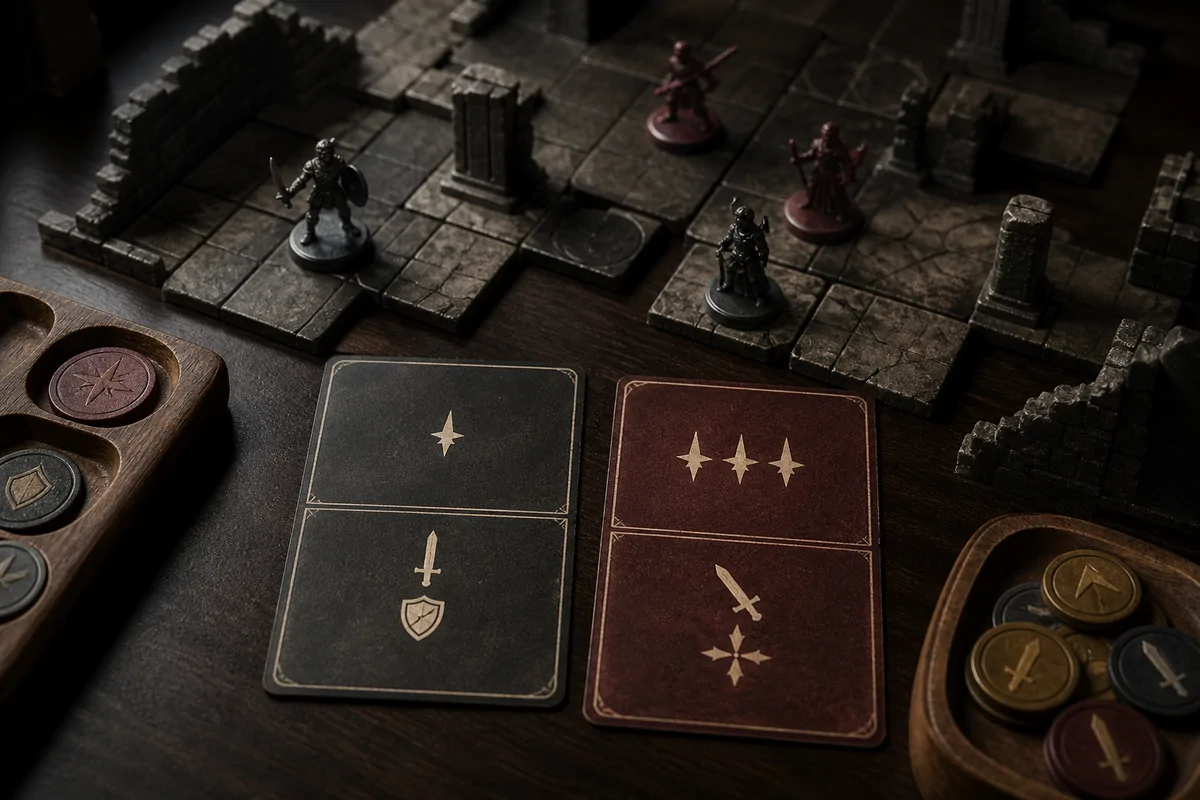
Two cards make a plan and a promise
Gloomhaven asks each player to select two action cards for a round, using one to establish initiative and combining the chosen actions according to the rules. Cephalofair Games’ rulebook explains this procedure. The cards offer more than a menu of attacks and movement: choosing them commits a player to a particular timing and to a limited set of actions. The hand is a planning space, but once the round begins the player must work within what they selected. The decision feels like a promise made before the room’s full response is known.
The system creates a useful tension between power and speed. A player may want a strong action on a card, yet the initiative value associated with the chosen pair can affect when the character acts. Choosing a fast turn can protect an ally or exploit an opening, but it may require giving up a preferred action combination. A slower plan may be more powerful if the character survives long enough to use it. These choices depend on scenario state and card text, so there is no universal rule that early or late initiative is always preferable.
Initiative is a choice, not a fixed stat
Many games assign a stable speed value to a character or unit. Gloomhaven makes timing part of the round’s card selection. Players can choose a different pace from one round to the next, creating a visible relationship between hand management and initiative. Revealing the selected cards allows the group to see the plan’s timing, while monster behavior and other players’ choices can reshape what “fast” means in the actual room. The card carries both an action and a temporal commitment, tying what a player does to when the player expects to do it.
This timing decision can be social. One player might choose to act early so another can move into position afterward, or choose to wait for an enemy to reveal its behavior. The group can coordinate, but each player still owns a separate hand and must preserve their character’s future capacity. Planning together is not the same as guaranteeing the room will behave as expected. A helpful discussion uses conditional language: if the enemy moves first, this action may be safer; if an ally goes early, the slower plan might work. That keeps coordination flexible rather than overconfident.
Top and bottom actions frame a tradeoff
The selected cards offer actions in top and bottom positions, and the player chooses how to use the cards within the round’s rules. This layout encourages comparison between effects that compete for a limited number of opportunities. A card may contain a powerful top action and a useful movement action below, while the other card offers a different pair. The player cannot treat every printed option as available at once. The card selection and initiative choice determine which pieces of the plan can be executed now and which must be saved or lost according to the rules.
That layout also makes the cards physical player aids. The group can see that a character has selected a pair, and the player can orient attention to the chosen action without referring to a separate menu. When teaching, explain how a card’s two halves work before discussing advanced loss or recovery decisions. The exact rules for actions, rests, and card exhaustion should be learned from the current rulebook. A short explanation that treats all card text as freely available can cause confusion later because the cards are an action budget, not a list of abilities that can all be activated in one round.
A room changes the value of a card
The same pair of cards can be excellent in one room and poor in another. A narrow corridor may reward movement; a dangerous enemy may make early initiative valuable; an objective may call for a less dramatic action. Scenario layout and monster intent affect the plan. This means players must read the room before committing their cards. The map supplies distances and obstacles, while the initiative reveal supplies timing. Neither alone is enough. The player is evaluating whether an action will still matter when it resolves, given the expected state at that moment.
Because cards are finite, round planning also carries a longer horizon. Spending a card may solve a present problem but change how many future rounds a character can endure. The official rules explain the specific consequences of card loss and recovery. Strategically, the player is balancing immediate survival and contribution against the campaign’s continued demands. This makes a seemingly local choice meaningful beyond the current room. A good review asks what the player gained, what future flexibility they spent, and whether the scenario made that exchange necessary.
Reveal plans without pretending they are guarantees
Before a round, players can share broad intentions: who expects to move, who plans to protect a teammate, or which enemy should be addressed first. Then they select and reveal cards according to the rules. The table should treat these plans as coordination aids rather than contracts that override the game state. If revealed initiative order changes the opportunity, players may need to adapt. Naming this expectation prevents frustration when a well-meant plan no longer fits the actual turn sequence.
Gloomhaven makes the initiative decision part of a player’s hand management. Two selected cards communicate what might happen and when, while the scenario tests whether that commitment remains useful. The Cephalofair rulebook is the source for exact action and exhaustion procedures; edition, campaign, and class materials can add detail. The design lesson is that hidden planning can create social coordination without removing uncertainty. Players reveal enough to make a shared plan, then discover whether the room gives that plan the timing it needs.