The player is missing the information everyone else can see
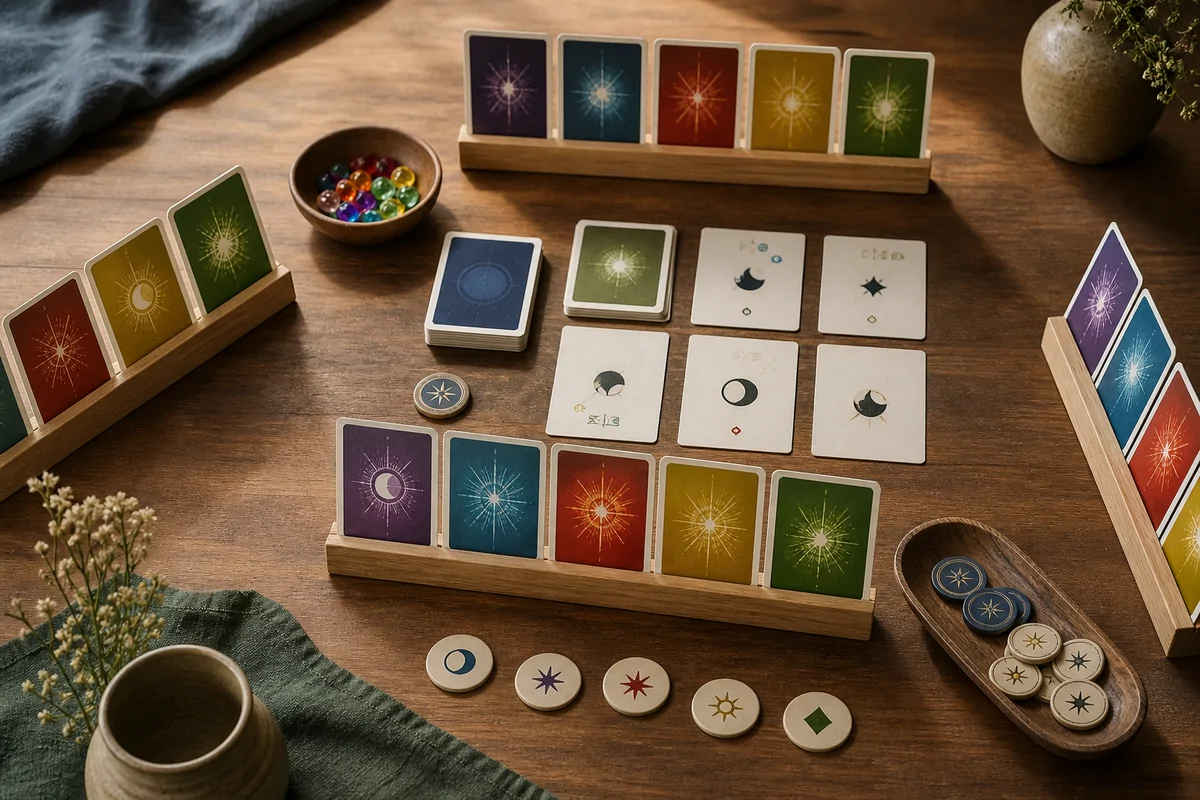
Hanabi reverses a familiar card-game arrangement: players hold their cards facing outward, so other people can see a hand that its owner cannot. R&R Games’ rulebook describes this information structure and the cooperative goal of building ordered fireworks. Each player must act using clues from teammates and the visible state of the table. The game asks participants to treat information as a shared resource. A player’s decision depends on what others know, what has already been played, and what the current clue is allowed to reveal.
This reversal changes how a hand feels. Players cannot simply inspect their own options and calculate privately. They must remember clues, infer which cards have become useful, and decide whether to ask for more information or take a risk. The table’s knowledge is uneven but complementary. One person may know that a card is playable, while its owner remains uncertain; the clue becomes a carefully rationed transfer of that knowledge. The structure makes attention visible because players can observe the cards they need help interpreting.
A clue has a cost and a limited shape
The rules constrain what a clue can identify and spend shared clue tokens when information is given. That cost turns communication into a strategic action. A clue can prevent a mistake or advance a useful card, but it uses a resource the group may need later. Players must decide what information is worth sending now and what can wait. A vague hint may be affordable but ineffective; a precise hint may save a card while consuming an important token. The exact clue procedure should be learned from the rulebook, especially for players familiar with other editions.
Because clues are public to the group, they also create memory obligations. A player has to track what was revealed about their hand as cards move and new cards are drawn. The clue’s original meaning may change as the hand changes. A card identified by color or position can later become the only playable option, or a formerly useful card can become irrelevant after another tile is played. The group is maintaining a distributed record. A careful table can repeat a clue aloud within the allowed procedure, helping the card owner connect the information to the current hand without inventing extra signals.
Fireworks make order part of cooperation
The shared goal is to build sequences of cards by color and number according to the rules. A card can be playable only when its predecessors are in place, so the group must coordinate the order of contributions. Discarding a needed card can make a sequence impossible, while holding a card too long can reduce the team’s flexibility. The visible play area helps everyone track what has been completed. Players can compare the current stacks with their hidden hands and decide which information is urgent.
This goal links communication to timing. A clue may be most valuable when it lets a player play a card now rather than simply know something for later. Conversely, spending a clue too early can leave the group without a way to identify a critical card. The rules define the consequences of a misplay and the limits of available clue tokens. The strategy question is how the team distributes information across the remaining turns. A useful review asks which card was protected, which was enabled, and what risk the clue left unresolved.
Restraint prevents helpfulness from taking over
Cooperative games can invite one player to direct everyone else. Hanabi’s hidden hand structure makes that habit especially tempting: an experienced player may see an obvious move for another person. But the rules limit what may be communicated, and those limits preserve the challenge. A player should offer a legal clue and let the recipient interpret it. If the group adds extra tone, gestures, or coded messages, the information design changes. The game’s restraint is not a barrier to cooperation; it is what makes each permitted clue meaningful.
New players benefit when the group explains its reasoning after a round rather than dictating each action during it. The debrief can show how a clue was intended and how the receiver interpreted it. This helps the table develop a shared language while respecting individual decision-making. It also lowers the pressure to guess perfectly on every turn. A card can be lost despite a sound clue, and the group can learn from that without assigning fault. The objective is to improve the information system together.
Teach the hand orientation before the scoring
Start by showing how each player holds cards so that everyone else can see them. Then demonstrate one legal clue and ask the recipient what they learned. Continue with a single play and a new draw so the group can see how the hand and its information record change. Only after that loop is clear should the host add longer-term scoring or advanced strategies. This sequence makes the unusual orientation feel purposeful instead of confusing and gives players a concrete sense of what information they do and do not possess.
Hanabi turns information into a shared resource that must be given with restraint. The outward-facing hand redistributes knowledge, clues spend a limited supply, and ordered fireworks make timing consequential. R&R Games’ rules are the reference for clue and turn procedures. The design lesson is that communication can be strongest when it is constrained and remembered. A clue is not a command or a complete explanation; it is a carefully chosen piece of evidence that allows another player to make a decision they otherwise could not make with confidence.