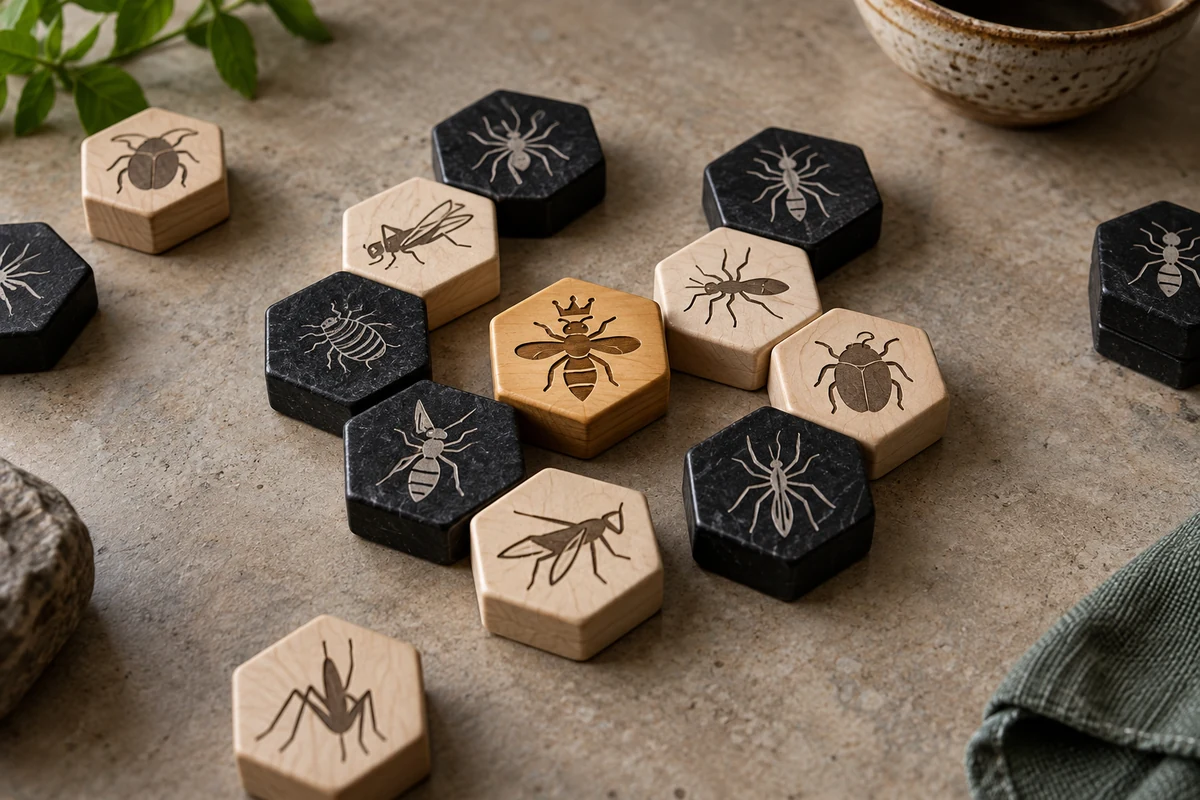
The board is an accumulated arrangement
Hive is played with hexagonal insect pieces and no separate board. Gen42 describes the absence directly on its product page: the pieces themselves form the playing area. That makes the board an outcome of play rather than a fixed grid prepared before the first move. Each placement changes the shape of the connected cluster and the open perimeter around it. The visible state is portable and compact, yet its geometry is continually being made by the players.
The official rules require the pieces to remain connected as one hive. A player cannot place a tile so that it separates the cluster into disconnected parts. This restriction gives the growing shape a social property: a piece belongs to a shared structure even though each tile is owned by one player. The rule protects the continuity of the game’s central object while leaving its outline open to change.
Placement makes the perimeter meaningful
A fixed board gives every player the same set of locations at the beginning. Hive does not. Players add pieces next to the existing structure, so new placement options depend on the edge of the cluster and on the color relationships allowed by the rules. The opening is therefore not a march across a preprinted grid. It is a negotiation over where the shared field can expand and which pieces can approach the opponent’s Queen Bee.
This makes the edge function as a kind of temporary interface. It is the current list of places where the hive can grow, but it is not an independent resource track. As a tile is placed, one opening may disappear while another opens around it. A player can shape the perimeter indirectly by choosing a location that changes the next player’s legal attachments. The absence of a board does not mean an absence of spatial rules; it makes those rules visible in the growing object.
The Queen Bee is a condition inside a connected whole
The official objective is to surround the opponent’s Queen Bee with pieces. The hive must remain connected, so surrounding is a local pressure within a global constraint. A player cannot simply isolate the target by disconnecting its neighborhood from the rest of the cluster. Every attempted enclosure is part of the same shared structure, which lets one move address an attack while also changing access elsewhere.
Because pieces have different movement rules, position and identity are linked. The product materials identify different insect pieces, and the rulebook explains how they move. A cluster can appear to block a Queen Bee, but the tactical meaning depends on which pieces can reach or escape from that area. For a first teaching, it helps to establish the continuity rule before explaining each insect’s movement. Otherwise players may memorize piece abilities without understanding the field in which those abilities operate.
A portable surface changes table practice
The physical format makes Hive easy to set down without arranging a conventional board, and the connected pieces themselves tell players where the action is. That convenience also asks for care. Tiles need enough room around the cluster so a legal attachment can be identified; players should avoid nudging neighboring pieces when placing one. A tray or small mat can help keep the arrangement stable, but it is a hosting aid rather than a game component required by the core idea.
When the hive becomes crowded, a group can pause and check the connection structure before resolving a move. That brief verification is especially useful for new players who are still learning to read the hex edges. It keeps the spatial rule public and avoids turning a minor placement question into a dispute about intention. The board’s material clarity depends on how carefully the group handles its pieces.
The changing board is a design argument
Hive demonstrates a particular answer to the question of what a board must do. It does not need to be printed, folded, or contained in a rectangle if the pieces themselves can establish adjacency and continuity. The players create the limits that shape their next moves. This is not merely a minimalist production choice; it changes how spatial information arrives. A board normally tells players what locations exist. Hive asks them to infer the active field from the current arrangement.
The result is a shared surface that behaves like a growing diagram. Each tile is both a game piece and part of the map on which later pieces will act. The no-board format works because the one-hive rule preserves a single readable object and the surrounding objective gives that object a clear pressure point. Gen42’s rules and product description support those mechanics; the broader interpretation is that the physical components become the board by carrying the spatial rules in their edges.
A table can make the evolving perimeter easier to read by placing the cluster where everyone can see its full outline. The active edge matters because new tiles attach around the connected group, and a crowded corner can hide a possible route from one player. It helps to rotate seats or slide the arrangement before beginning if any participant has a blocked view. This is not a special Hive rule; it is a practical condition for applying the published placement and movement rules fairly. The game’s portable form is strongest when the pieces are treated as a shared map, not as separate personal piles.