A clue can disappear before it is read
Just One asks a group to help one player guess a mystery word by writing clues. Before the guesser sees them, identical clues are removed under the rules. Repos Production’s new-edition rulebook defines the round procedure. The erasure is the game’s central design move: players are not rewarded simply for producing the clearest word. They must anticipate what others may write and find a clue distinctive enough to survive the comparison. A familiar clue can be accurate and still vanish because another player had the same idea.
This creates a cooperative puzzle about coordination without conversation. Each clue giver works privately, yet the group shares a broad goal. Players need to balance clarity and originality. An obscure clue may be unique but fail to help; a common clue may be useful but duplicate someone else’s. The game asks players to imagine the group’s vocabulary and choose a signal that is both legible and uncommon. That tension gives the clue a social cost: the player’s understanding of the target must be translated through the likely habits of the others.
Redundancy is useful until the rules remove it
In ordinary collaboration, repeated information can reassure a listener. If three people independently say the same thing, the group may become more confident. Just One removes matching clues before the guesser sees them, so redundancy cannot serve as reinforcement. The remaining clues are a compressed set of distinct perspectives. That changes what players should optimize. Instead of trying to make one clue maximally obvious, clue givers can contribute complementary angles that together point toward the answer.
This rule is not a claim that redundancy is always bad in communication. It is a deliberate game constraint that makes the group distribute its attention. Players can choose a category, a context, or a near-association rather than repeating the most direct synonym. The guesser then interprets the surviving clues as a small evidence set. If two clues are related but not identical, their overlap can be more informative than two copies of the same word. The design turns difference into a resource and makes the group’s diversity useful.
The simultaneous write protects the puzzle
Clues are written before the group compares them, which prevents early suggestions from steering everyone else toward the same phrase. This simultaneous step preserves independent judgment. If players could negotiate freely before writing, the task would become a group brainstorming session rather than a test of distinct signals. The restriction is what makes erasure matter. Each person must commit to a clue without seeing the others’ choices, then accept that the group’s combined set may be narrower than expected.
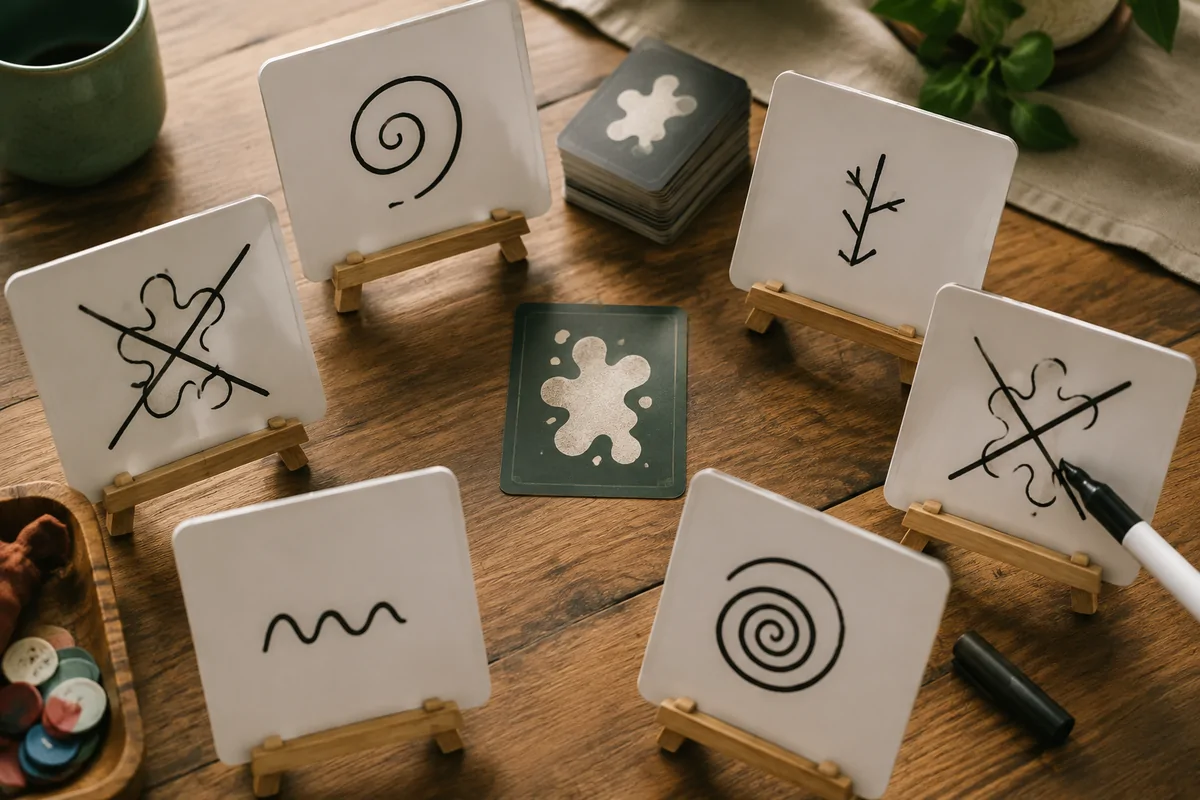
The physical clue boards or writing surfaces support that separation. Players can hide their words until the reveal, then compare and remove duplicates according to the rulebook. Good hosting keeps the writing private and ensures every clue is revealed at the right time. If a player sees a neighbor’s clue too early, the information structure changes. The component is therefore an information boundary. It helps the game create fairness with ordinary materials: write, conceal, reveal, compare, erase, and guess.
The guesser interprets a set, not a vote
After duplicate clues are removed, the active player sees a set of surviving prompts and makes a guess under the rules. That player is not simply counting how many clues point to one answer. They must infer the relationship each clue giver intended. One clue may be a category, another a use, and another a cultural association. The set is useful because its members differ. The guesser combines those hints and decides what shared target best explains them.
This makes the group’s feedback after a round valuable. The clue giver can explain an intended connection, and the guesser can describe what they thought the word meant. A mismatch reveals where the communication broke down. It should be treated as information about the group’s associations rather than evidence that someone was careless. A very direct clue may have disappeared because it was common; a subtle surviving clue may have been too obscure. The debrief helps players discover a useful middle ground for the next round.
Teach distinctiveness without rewarding obscurity
New players sometimes overcorrect after seeing duplicates and choose clues that are too cryptic. A host can explain that originality matters only when the guesser can still make a reasonable connection. Encourage a clue that is specific, concise, and tied to a recognizable feature of the target. Then discuss how other players might approach the same word. This makes the task about predicting shared associations rather than trying to invent the strangest possible hint.
Just One demonstrates that useful group communication depends on both common ground and difference. The rules remove identical clues, simultaneous writing preserves independent contributions, and the guesser recombines the remaining signals. The official new-edition rulebook is the authority for the round and scoring procedure. The design lesson is that redundancy can be managed rather than ignored. A small erasure rule changes the group’s incentives: each person becomes more valuable when they add a distinct but understandable perspective. The empty space left by a removed clue is part of the message the team learns to send.