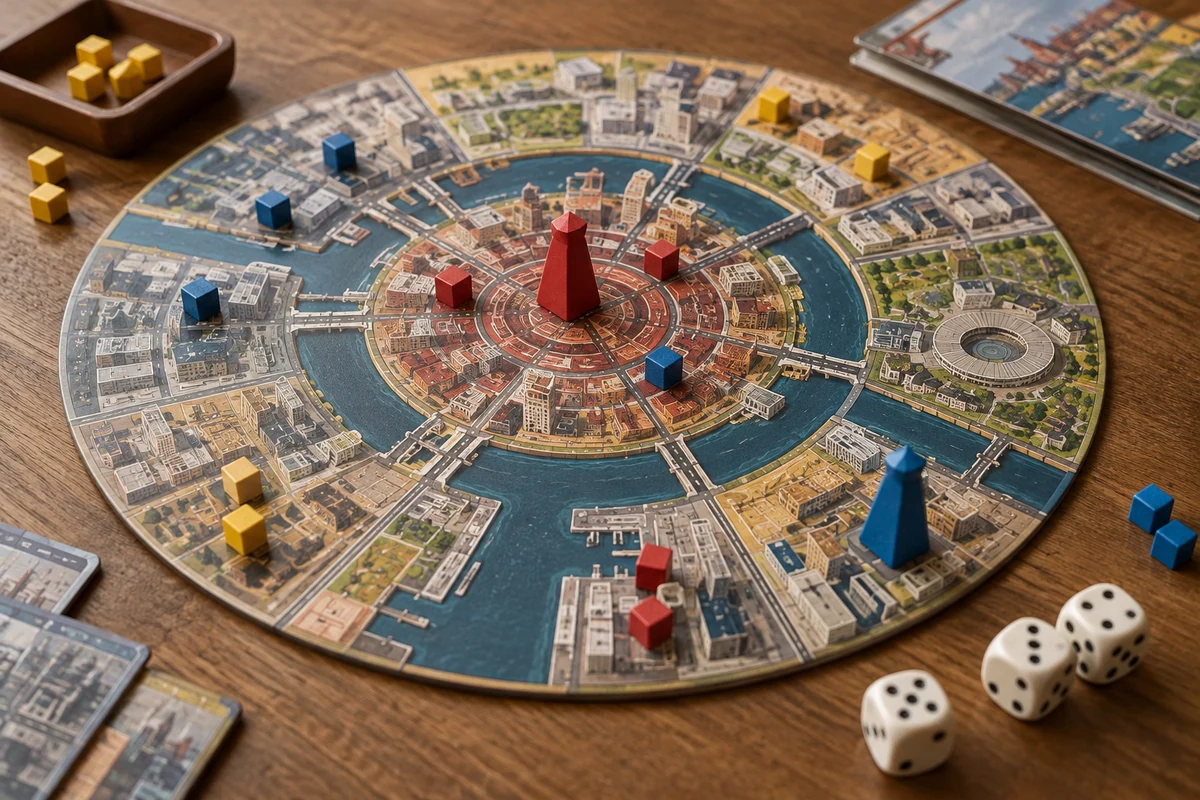
The city is an exposed seat
King of Tokyo asks players to roll dice, choose which results to keep, and resolve combinations that can heal, attack, gain victory points, or buy cards. Its central spatial choice arrives when a monster enters Tokyo. The official rules make occupancy consequential: a monster in the city can score victory points, but it also becomes the target of attacks from everyone outside. It cannot use hearts to heal while occupying Tokyo. The city is therefore a position with both an advantage and a vulnerability, not a neutral scoring square.
That trade is easy to explain with a physical distinction. The player in Tokyo is visible and exposed; the players outside it can coordinate their attention through their dice results. When a monster is attacked, its owner must decide whether the accumulating risk is tolerable. Leaving the city can reduce that exposure but gives up the occupancy reward. The rules make this choice public, so opponents can read a player’s threshold through the decision to stay or yield.
A dice pool becomes a statement of priorities
The dice do not simply produce a random outcome that the active player accepts. During a turn, results can be rerolled and kept across the available rolls, so choosing what to preserve shapes the final combination. Hearts may matter to a player outside Tokyo who needs to recover. Claws become more urgent when attacking an occupant. Numbers can build a score. Energy supports card purchases. The exact value of a face changes with the board state, which is why the same roll can suggest different plans to different monsters.
A host can make this legible by asking players to describe a reroll in terms of the choice it preserves. “I am keeping this heart because I am outside and injured” teaches more than listing the symbols. “I am holding these claws because the city is occupied” connects the dice to a target. The components offer several action types, but the location rule helps players prioritize them. Tokyo turns a roll from a private calculation into a public response to who is currently exposed.
Two ending conditions produce different clocks
The publisher’s rules describe two ways to win: reach twenty victory points or be the last monster alive. One is a visible score race; the other is a survival contest. A player who is close to the point threshold can make the city seem like a shorter route. A player under heavy attack may instead focus on staying alive. Because both conditions are active, players cannot assume that the leader on the score track is necessarily the only immediate threat.
The two clocks also affect how people interpret risk. An attack that is small early can matter if it makes a later elimination more likely. A point gained while holding Tokyo can move a player closer to one ending while making them vulnerable to the other. This is not a promise that one strategic style is always correct. The game’s pressure comes from the fact that the table’s attention can switch from scoring to elimination without changing the formal objective.
Cards add a market to the dice decision
The official product description includes buying cards as one outcome supported by dice results. Cards give players an alternative use for collected energy, so a turn can invest in an effect rather than convert every useful die directly into immediate score or damage. A market row of available cards changes the decision: the value of energy depends on what is offered, and another player may purchase a card before the opportunity returns.
This layer supports a useful teaching sequence. First explain the dice symbols and where healing is allowed. Then introduce card purchases as a separate path for energy, using one available card as an example. A new player who tries to calculate every card before understanding the city commitment is likely to lose the game’s central rhythm. The city makes the risk immediate; the market makes longer-term options tangible. The group can add those layers one at a time without inventing extra rules.
Staying is a decision worth revisiting
A city occupant’s first decision to enter is not the only important one. Each following turn changes the relevant context: health totals shift, the point race advances, and other monsters may acquire effects that alter the cost of confrontation. A player who stayed safely for a turn can become the obvious target as soon as a rival sees a chance to finish the game. The city should be treated as a temporary position that is reassessed, not a trophy that guarantees security.
King of Tokyo turns a simple location marker into a shared negotiation about risk. The player in the city chooses how much pressure to accept; everyone else chooses whether to apply more. Its dice invite selective commitment, while the occupancy rule gives those selections direction. A good table will read the city aloud: who is inside, who is hurt, who is near twenty points, and which ending condition is most urgent. That shared reading is part of the design, because the decision to stay only matters when everyone can see its cost.
When explaining the choice to leave Tokyo, avoid presenting it as a retreat that is automatically good or bad. It changes the position and the available healing option, while another monster may have to enter under the rules. The value depends on the current health, score, and threats at the table. A player near the victory-point threshold may accept exposure for one more scoring opportunity; a player close to elimination may value survival more. Those are examples of how to read the state, not strategic guarantees. The rule creates a meaningful decision precisely because neither side of the trade is free. The city rewards occupancy and invites attack at the same time.