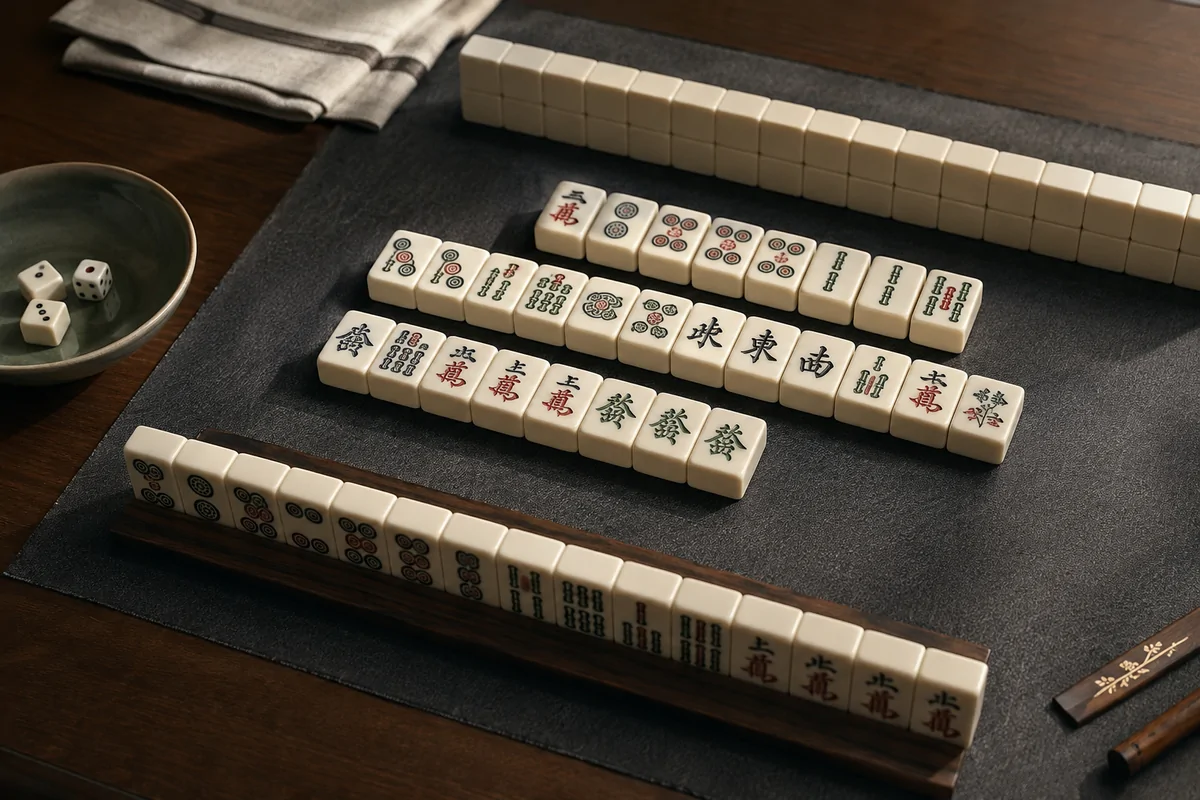
A hand is private while its history is public
Mahjong asks each player to shape a hand from tiles drawn from a shared supply, while discards and calls create a visible history around the table. This article uses the World Mahjong Organization’s 2021 Mahjong Competition Rules as its reference point. Mahjong is a family of games, and regional variants differ in tile sets, hand structures, calls, and scoring. The MCR frame is one organized ruleset, not a claim about every game called Mahjong. Within that frame, the contrast between a private hand and a public discard area gives the table a distinctive informational architecture.
The wall makes the shared supply physically present. Players draw from it, arrange their own tiles, and decide what to release. Each discard changes the public record and may become an opportunity for another player under the applicable call rules. A tile is therefore more than a piece of a private pattern. It is also a message about what the player has chosen not to keep, although that message is incomplete. The reason for discarding remains hidden, and many hands can explain the same choice. Public information narrows possibilities without revealing the plan.
Discards turn attention into a changing calculation
Reading discards is not the same as knowing an opponent’s hand. A visible tile may be unwanted, redundant, or strategically released; the rules do not make it a transparent confession. Players infer from sequences, calls, and the pace of the game, then revise those inferences as new tiles appear. This is a useful distinction for teaching probability. The public record can make some possibilities more or less plausible, but it does not remove uncertainty. A confident story about an opponent’s hand should remain a hypothesis until the game supplies stronger evidence.
Calls change that information landscape. When a player takes a discard under an allowed call, part of the private hand becomes public and the player’s available options change. The move may help complete a structure sooner, but it also tells the table something about the hand and can affect which tiles remain safe to discard. A call is thus a trade between speed and concealment. The best choice depends on the scoring rules, the hand’s shape, the visible tiles, and the stage of play. Avoid treating any call as automatically aggressive or automatically beneficial.
The tile set is a vocabulary, not a universal alphabet
Mahjong tiles are organized into suits and other categories, but the exact set and use vary between forms of the game. The MCR source provides a defined competition frame with its own scoring patterns and procedures. That specificity is a strength: players can discuss a hand against a named standard rather than assuming that every household tradition uses the same combinations. Readers who know another form of Mahjong may notice familiar pieces alongside unfamiliar rules. The article’s purpose is not to rank variants; it is to make one documented system legible while acknowledging that its boundary is real.
The physical tiles help carry that vocabulary. Their repeated faces let players scan a hand quickly, while the table layout distinguishes what is concealed, exposed, discarded, or still in the wall. Good arrangement reduces memory work. A player can see which tiles are available publicly and which melds have been revealed without asking everyone to narrate the whole hand. Components do not solve the strategic problem, but they organize the evidence. In a game built around partial information, the clarity of the display can be as important as the richness of the hidden possibilities.
A winning hand is a rule-defined finish
The route to a winning hand depends on the selected ruleset and its permitted combinations. Under MCR, the scoring structure gives players a framework for evaluating not only whether a hand is complete but what makes it qualify. That distinction prevents a common teaching shortcut: calling any collection that looks orderly a finished hand. Learners need to know the formal pattern and any minimum or scoring requirements before deciding which tiles to pursue. The source rules are the authority for those requirements; memory from another variant may not transfer cleanly.
Because the wall is finite, a plan can become impossible as tiles are exposed or claimed. Players must balance a preferred structure against the evidence that remains. This is not a puzzle with one fixed answer, because opponents also draw and discard and the supply changes over time. A useful review asks when the player changed course and which public clues informed that decision. Such a review is more precise than saying that a hand was lucky. It describes the relationship between a rule-defined goal, a changing supply, and a player’s willingness to revise a private plan.
Teach the table as four zones of information
A clear introduction can identify four zones: the wall, a player’s concealed tiles, exposed melds, and the discard history. Show how a tile moves from one zone to another and what the move reveals. Then explain the selected call and winning rules for the chosen variant. This order makes the information system visible before introducing strategy terms. It also helps experienced players from different Mahjong backgrounds compare expectations. If a familiar word or combination has a different meaning in MCR, the distinction can be discussed with the rulebook open rather than treated as a personal mistake.
Mahjong’s visible wall does not make the game fully knowable. It gives players a shared record to interpret while leaving the most consequential piece—the shape of each concealed hand—private. That balance sustains attention across many small decisions. A discard can protect a plan, expose a route, or help another player, but its meaning depends on a context that no one sees completely. The design lesson is about evidence: show enough of the state for players to reason together, keep enough hidden for inference to matter, and name the ruleset so that everyone knows what a completed pattern means.