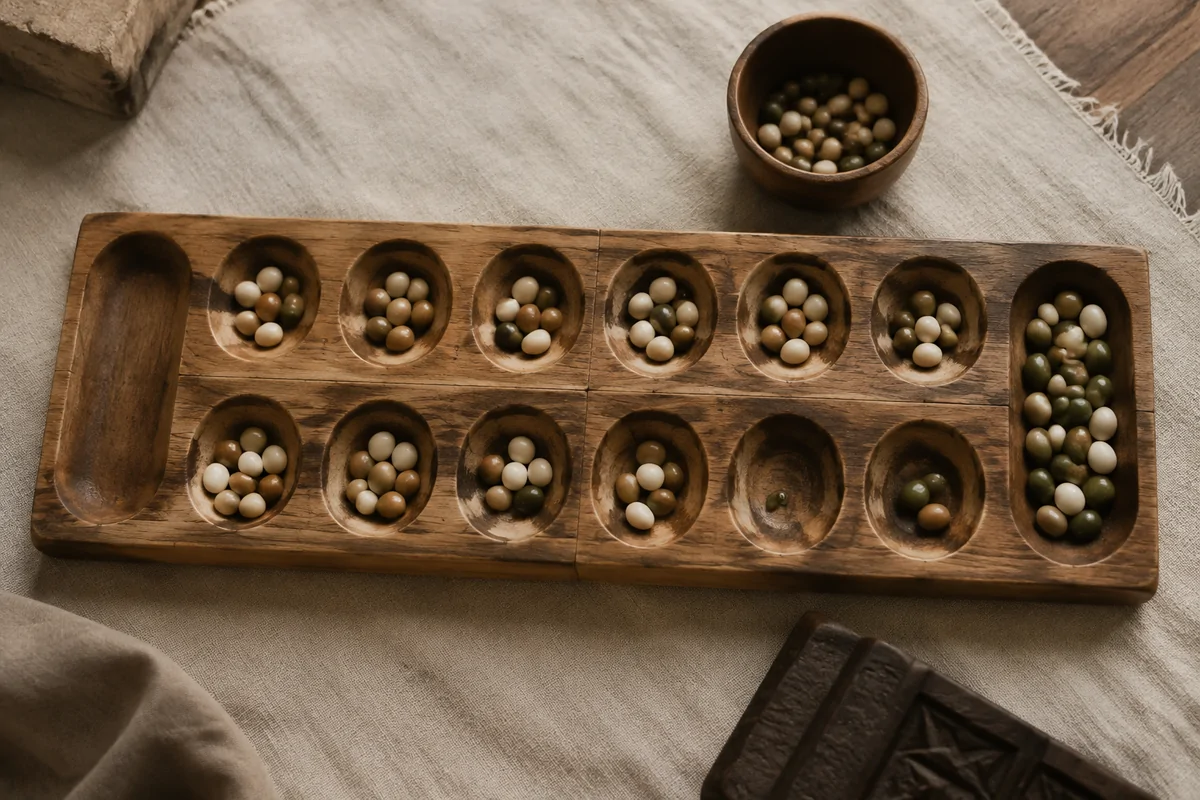
A board of pits makes counting physical
Mancala is a broad family name for games played with seeds or counters moved among pits. The British Museum’s collection record for a Wari board documents one particular object, with rows of pits and end stores. That object is useful evidence for the material form, but it should not be mistaken for a complete account of every mancala game. Rules, board shapes, and names differ across traditions. This study focuses on what the physical arrangement does: it turns counting into movement that can be seen, touched, and checked by the people around the board.
The pits are a simple storage system. A counter in a pit can be counted individually, while a handful moved through a sequence changes several locations at once. Players do not need a written score sheet to see that the state has changed. The board holds the arithmetic in public. A turn is therefore both a calculation and a physical procedure: pick up a group, distribute its pieces, and observe where the sequence ends. The objects make an abstract count concrete, while the repeated rows give that count a direction and a rhythm.
Sowing turns a hand into a route
In many mancala-family games, players pick up counters from one pit and distribute them along a route, a process commonly described as sowing. The exact direction, capture condition, and treatment of the final counter depend on the variant. The central design effect is still visible: a player’s hand becomes a path through the board. Instead of moving one piece from origin to destination, the player disaggregates a group across successive locations. That makes counting inseparable from navigation. The route is not a line printed on the board; it is enacted by the player’s hand.
Because a sowing move affects several pits, its consequences can be difficult to assess at a glance. A player must count enough pieces to know where the distribution ends and then notice what changed along the way. This creates a distinctive tempo. The physical act can be slow enough to follow but compact enough to invite repeated calculation. A good introduction should model the route without rushing, then ask the learner to name the ending pit and the new distribution. That practice makes accuracy a shared table skill rather than a test of private mental arithmetic.
Storage geometry shapes strategic questions
Rows, stores, and side ownership create an architecture for decisions. A pit can be viewed as a local supply, a step in a distribution route, or a potential source of a future capture, depending on the selected game. A store may hold accumulated value or mark one player’s end area. The board’s shape therefore influences what counts as near, available, or vulnerable. The same number of counters can create a different problem when arranged in different pits. Spatial organization gives counting its strategic context.
This relationship is a valuable design study. A digital game might represent tokens as a single number, but a physical mancala board spreads that number across locations. Players can scan and compare the supply directly. The arrangement encourages them to ask not just “how many?” but “where?” and “what sequence would move them?” Storage becomes a kind of architecture because the spaces define how resources can circulate. That does not mean the board itself explains every strategy. It provides the grammar that lets players notice the distribution and propose a route.
Captures and endings belong to a named variant
Descriptions of mancala sometimes summarize the family with one capture rule or one finishing condition. That shortcut can mislead. A rule that is familiar in one form may not apply to another. The British Museum object identifies Wari as a specific game board; the collection record is an object source, not a universal rulebook. Players should use the instructions associated with the board or community they are playing. Naming the variant is a small but important step toward accurate teaching and respectful discussion of traditions.
Once the local rules are known, captures can be understood as a change in ownership and distribution rather than merely a bonus. A player may manipulate the route so that a final seed lands in a strategically important pit, but whether that produces a capture depends on the rules being used. The game’s arithmetic can therefore carry social consequence: moving a handful can transfer counters, shape future availability, or hasten the end. A review should connect the physical sequence to the actual rule condition instead of praising a move in vague terms.
The hand is part of the interface
The act of lifting and distributing counters is not incidental presentation. It is a part of the interface that helps everyone follow the turn. A player who picks up a group signals an origin; the sequence of placements displays the route; the final arrangement records the result. This creates an accessible memory trace that can be checked by another player. If the movement is too fast or the counters are obscured, the game becomes harder to audit. Good hosting keeps the board visible and lets each transfer be seen rather than asking other players to trust an invisible calculation.
Mancala’s board shows how a compact set of objects can externalize a repeated calculation. The pits organize storage, the route organizes movement, and the counters make quantity tangible. A museum record helps anchor one board in a collection history, while local rules explain how that board is played. Together, they let readers distinguish material evidence from family-wide claims. The lasting design lesson is that counting can be spatial. When numbers have places and movement, the table can reason with them collectively, and a player’s calculation becomes part of a visible shared process.