A carved line is evidence, but not a complete rulebook
The National Museum of Ireland describes remains of Nine Men’s Morris boards carved into stone and wood dating to Viking Ireland and medieval Ireland, with examples on display in its Archaeology museum. Its activity sheet presents the game as a medieval pastime and offers a printable board and counters for play today. This is a valuable connection between a physical trace and a playable practice, but the two forms of evidence should not be treated as interchangeable.
A board carved into a surface can show that someone marked or used a pattern of lines. By itself, it does not record every rule, the exact materials used for counters, or the full social context in which people played. A modern activity sheet serves a different purpose: it makes a consistent version teachable to contemporary visitors. Keeping these roles separate allows the artifact to remain interesting without pretending that it tells us more than the museum documents.
The diagram makes relationships more visible than decoration
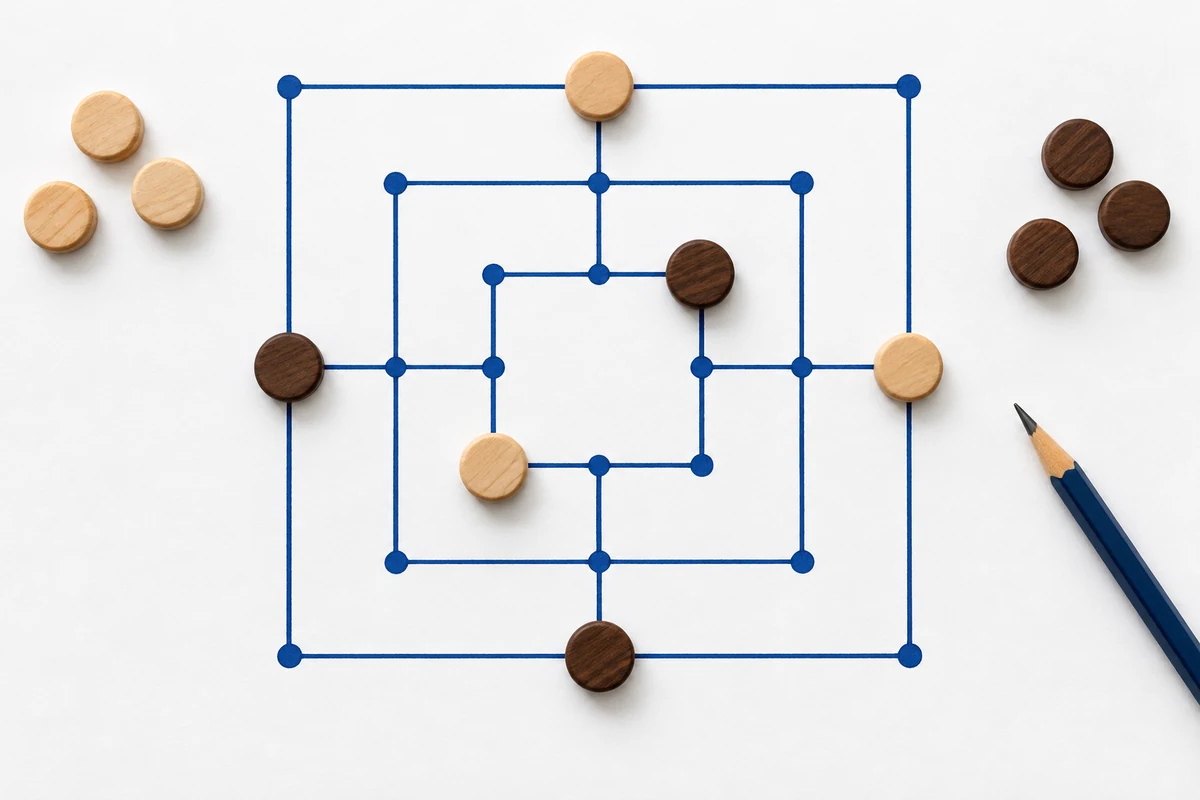
In the familiar teaching version, the board consists of three nested squares connected at their midpoints, with positions marked along the lines. Two players begin with nine counters each. They first place their counters on unoccupied points; after placement, they move counters along a line to an adjacent point. Forming a row of three, a mill, permits the player to remove an opposing counter under the stated rules. These procedures turn the drawn network into a sequence of claims and restrictions.
A diagram can be reproduced with chalk, paper, or a traced line, which makes the game’s material requirements unusually light. The geometry carries much of the rule information: lines show where a counter may move, and intersections show where it may stop. Counters can vary, but the relational structure must remain legible. That distinction helps explain why the museum offers a printable board alongside suggestions for using everyday objects as pieces.
Placement and movement are distinct phases
The Ashmolean teaching sheet makes a useful distinction between the opening placement phase and the later movement phase. Players place all their counters in turns before moving them one point along a line. In the movement phase, a player cannot move onto an occupied point. A newly formed mill allows a counter to be removed, subject to the rule that protected counters inside an opponent’s mill are not taken unless all of that opponent’s counters are in mills. The version’s end condition is also stated: a player wins when the opponent cannot move or has only two counters left.
These details matter because the board’s static drawing can make the game appear simpler than it is. During placement, players shape a network of future options. During movement, they operate within that network, trying to form rows while avoiding immobilization. The same lines have different practical meanings across the phases. A teaching sequence that names this transition helps newcomers understand why a board with no movement arrows still encodes a movement rule.
Use careful language around historical continuity
The museum evidence supports a cautious historical statement: boards associated with Nine Men’s Morris have been found carved into stone and wood in contexts described by the National Museum of Ireland as Viking and medieval Ireland, and the game was popular across medieval Europe according to that source. It does not establish that every example was used under the exact rules printed in a modern activity sheet. Similar-looking boards may also be interpreted through later knowledge of familiar game forms.
This caution does not diminish the artifact. It makes the distinction between object history and rule history clearer. A carved pattern can invite comparison with a present-day game while leaving questions open about who used it, how counters were supplied, and which variant was played. The best museum writing treats those questions as part of the record rather than filling the gaps with an attractive story.
Recreating a board is a form of access, not proof
A contemporary printable board translates the pattern into an activity that visitors can try. That is a form of access: people can experience how lines become routes and how three aligned counters become a mill. It should not be described as a replica of an archaeological board unless its dimensions, material, and source object are documented as such. The illustrated cover for this article is likewise an editorial diagram, not a photograph or reconstruction of a museum artifact.
Nine Men’s Morris therefore sits at an instructive boundary between a durable mark and a living rule system. Stone preserves a pattern longer than a conversation, but the pattern alone does not preserve the whole conversation. A modern rulesheet can make play repeatable, but it is still an editorial and educational choice about how to present the game. Reading both sources together lets us examine what survives, what has been interpreted, and why the humble diagram remains playable.
The museum’s printable activity is also a reminder that access and authenticity are different goals. An educational board makes it possible to try the game without handling a collection object, and substitute counters lower the material barrier further. Those choices are generous and practical, but they do not claim to duplicate an excavated surface. A museum can preserve the artifact, describe its find context, and offer a playable interpretation while clearly distinguishing those tasks. For readers, that distinction provides a model for discussing historic games: cite the institution for what it reports, identify a modern ruleset as a teaching version, and leave unresolved details unresolved where evidence is limited.