Movement is a hand of temporary permissions
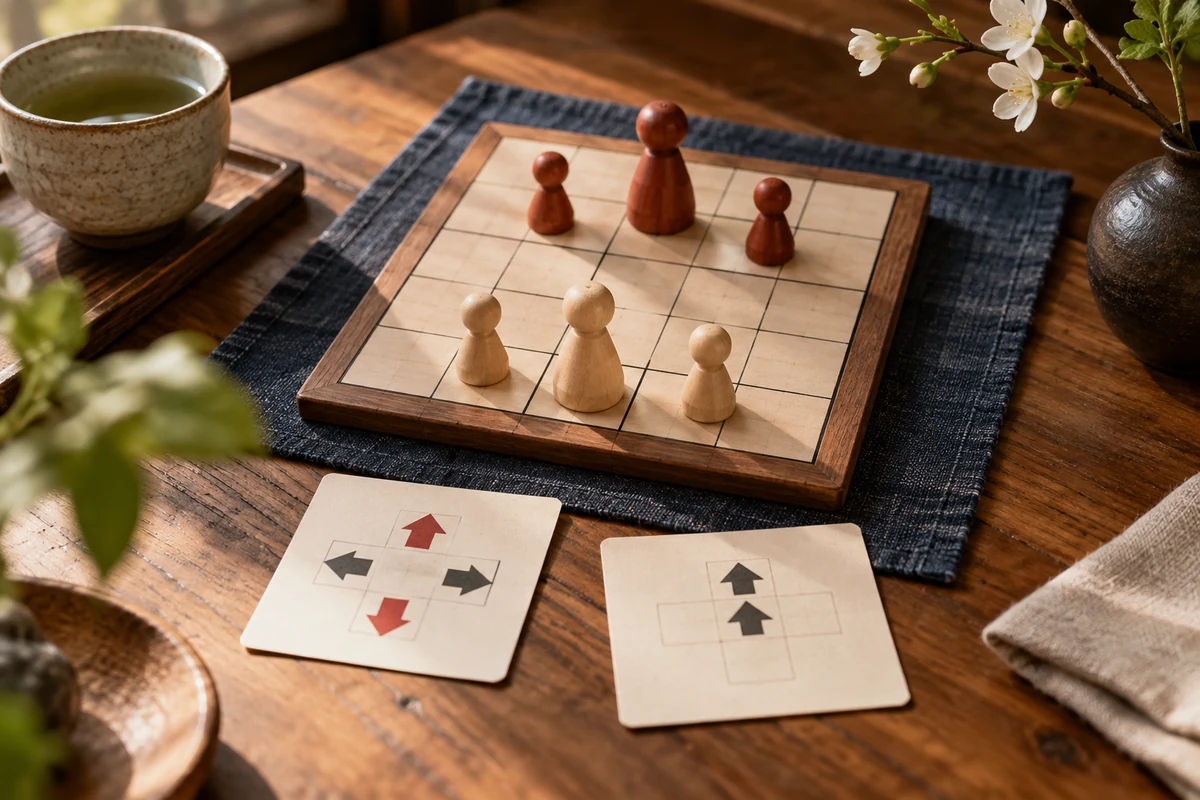
Onitama is a two-player abstract game in which a small hand of movement cards defines which pieces can move and how. The official rulebook describes a set of sixteen Move cards. At setup, players receive two cards each and one further card is placed face up beside the play area; the remaining cards are set aside for that game. The cards are public. Each player can see not only their own current choices but also the movement pattern that will become available when a card is exchanged.
The important design move is what happens after a card is used. A player selects a card, moves one piece according to it, and trades that card for the face-up card on the side. The used pattern does not simply disappear; it crosses the table and can later enter the other player’s hand. A card therefore describes both a present permission and a future possibility for an opponent. The exchange makes a routine action carry a visible consequence beyond the moved pawn.
A tactical choice has a second audience
In many movement games, players focus on the destination square and the pieces that can reach it. Onitama adds a second question: which movement pattern will this action hand over? A card may create a direct threat now but also give the other player a useful approach on their next turn. Another pattern may be less dramatic but keep the opponent from using a particular line. That is not hidden information or a bluff; the choice is legible to both sides. The tension comes from having to select among open futures.
This exchange also prevents a static reading of the cards. A player should not think of two movement cards as a permanent character ability. They are a short-term set of permissions in a cycle. A move that seems modest can be strong because it rotates an awkward card out of the opponent’s reach. A spectacular jump may be costly if it passes a powerful pattern into the other hand. The game asks players to account for the destination and the changing inventory at once.
Two win conditions give the board two centers
The official rules allow a player to win by capturing the opposing Master or by moving their own Master onto the opponent’s starting position, called the Temple Arch. Those goals place pressure on two different parts of the board. Capturing asks players to confront a moving piece; the Temple Arch route asks them to think about a destination that remains fixed. Because both are valid, a defensive response to one threat can expose the other.
That dual objective is useful in teaching because it discourages a narrow account of the board as a simple battle for pieces. A Master can be endangered even when it is not surrounded, because the opponent may have a movement card that reaches the Temple Arch. Conversely, a player trying to rush the central destination may offer a capture opportunity. The rules make both threats concrete, and the cards make their timing contingent on which movement patterns are currently in rotation.
Public information does not remove uncertainty
Once the initial cards are dealt, the movement vocabulary is visible, but that does not make the game mechanically predictable. A card in the side position may be more or less valuable depending on where the pieces stand. Players must estimate whether a pattern will remain useful after the board changes, whether an opponent can exploit the card they are about to pass, and whether a current threat demands immediate attention. The uncertainty is about the opponent’s priorities and the evolving position, not about what a card says.
This is a helpful distinction for designers. Hidden information is one way to create uncertainty, but it is not the only way. Onitama shows how fully visible options can still support surprise when those options circulate between players and interact with changing spatial relationships. The card exchange serves as a shared memory: the group can track where a pattern went, while still needing to judge when it will matter.
Teaching through one complete exchange
A clean introduction should demonstrate a full turn instead of describing the card system in isolation. Name the allowed movement on a card, move one piece, then physically place the used card where the opponent can see it and take the waiting card. That sequence makes the rule’s economy visible: movement and transfer are a single procedure. After one demonstration, ask the learner which card the opponent now has. This checks the central loop without adding strategy language too early.
Onitama’s elegance is often described through small rules, but the exchange is more than a tidy component trick. It links present action to future agency. The card a player uses becomes part of the opponent’s planning environment, while the side card records a pattern that neither player controlled moments earlier. Reading a move means reading where the card will go next. That design makes the shared state unusually compact: the board shows location, and the cards show how the next locations might become reachable.
The face-up exchange card also gives a group a useful way to pause without losing track of the system. If players are unsure why a move matters, they can identify the card leaving one hand, the card arriving, and the squares each pattern reaches from the current position. This is a concrete explanation rather than a prediction about who should win. Onitama’s official rules establish the transfer; the board supplies the context that gives the transfer meaning. After a complete cycle, the group can see that the card economy is neither a random draw nor a private power set. It is a visible circuit. Every move advances a piece and rotates that circuit, so a small action changes both position and the menu of future actions.