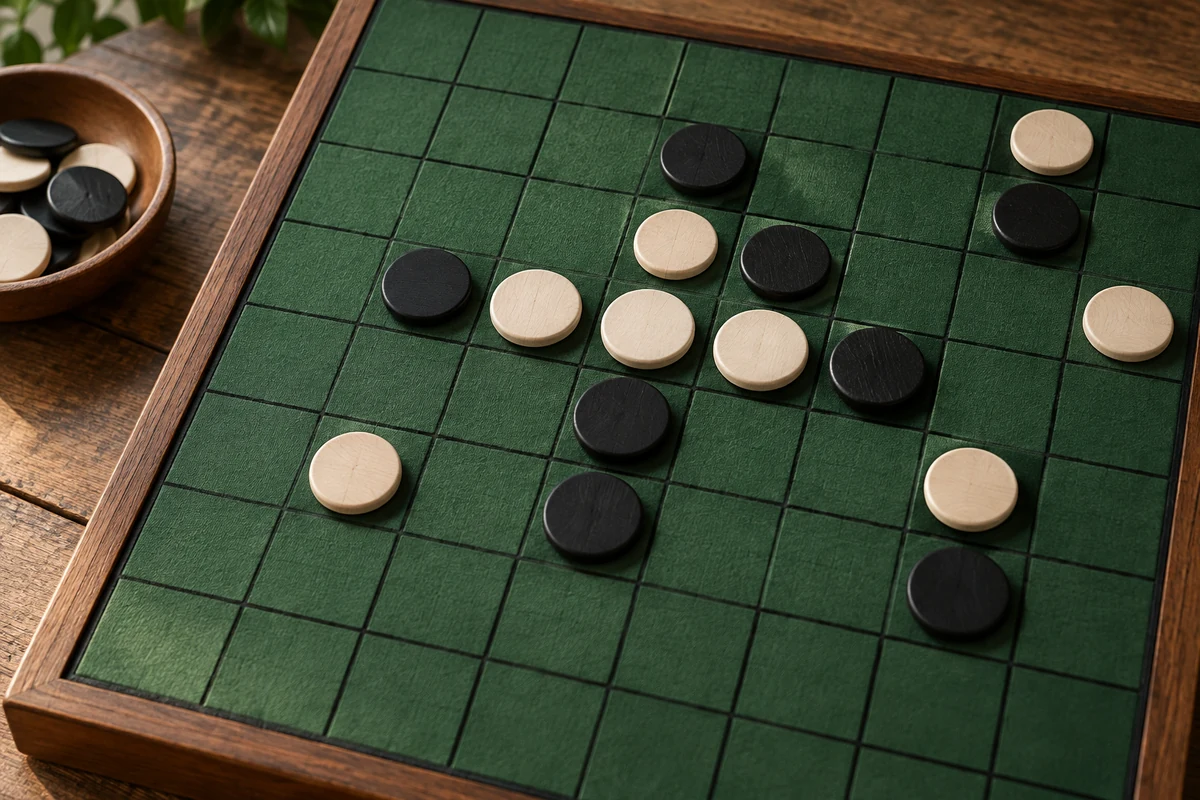
A placement changes the color of existing pieces
The World Othello Federation defines a move as placing a disc so that one or more rows of opposing discs are bordered at both ends by the player’s color. The discs between those endpoints are flipped. A move must outflank at least one opposing disc, and all discs outflanked by that move are flipped. Once a disc has been placed on a square, it cannot later be moved elsewhere. These rules make a placement do two jobs: add a disc and rewrite part of the board’s existing history.
That reversal explains why counting the current visible colors is not a reliable way to judge the whole game. A player may hold a numerical majority on the board and still give the opponent access to a move that flips several lines. The rules do not say that the largest present cluster is safe or strategically valuable. They define local transformations, and each transformation can alter which placements are legal next.
The legal move rule narrows the next question
Black always moves first under the official rules. If a player cannot outflank and flip at least one opposing disc, that player must forfeit the turn; if a legal move exists, passing is not allowed. This creates a useful contrast between Othello and games where a player can decline an available action. Here the board decides whether the turn can happen at all, and the player must search for a square that satisfies the outflanking test.
For a new group, the clearest way to explain legality is to trace a line from the proposed placement. The line must run through opposing discs and terminate at a disc of the active player’s color. Players may not skip over their own color to capture an opponent’s farther disc. This procedural explanation is more dependable than saying a move “traps” a line, because the actual boundary conditions determine which discs flip.
The empty square is a future permission
The board has sixty-four squares, but not every empty square is immediately playable. An empty location matters only if it produces a legal outflank. This means the board is best read as a set of possible lines rather than a simple count of available spaces. A square near the edge can be important because it may begin a line with few alternate continuations; a central square can be less useful if it exposes a long row that the opponent can reverse.
The rules create this structure without requiring special terrain or movement abilities. Every disc occupies an ordinary square, and the same directional test applies in any of the eight straight lines through it. Players learn to scan in multiple directions, checking whether an opponent’s color can be bracketed. The intellectual work is not merely to find a legal move but to anticipate the pattern of legal moves that the new color arrangement will permit.
Passing is an event the table must recognize
When a player has no legal move, the turn is forfeited and the opponent plays again. The process can repeat if the second player also has no legal move. The game ends when neither player can move, and the rules note that this may happen before all sixty-four squares are filled. An empty space at the end is not evidence of incomplete play; the legal-move condition, rather than board fullness, controls the ending.
This ending condition is worth emphasizing when teaching because many players assume that a grid game must fill every cell. In Othello, the board can reach a state where unused locations do not support a permitted bracket. Passing should be announced and understood as a consequence of the position, not as a discretionary pause. The turn structure stays clear when the group asks, in order, whether the current player has any valid outflanking placement.
The final majority belongs to the ending, not every moment
The object is to have a majority of discs of one’s color facing up when the game ends. That is an end-state measure. It does not instruct players to maximize their visible count after every move. Since discs can reverse color repeatedly, a short-term count can be strategically unstable. A board with many of one color may contain lines that are easy for the opponent to bracket, while a smaller number can still support future legal placements.
Othello is a precise example of a delayed majority. Its components make reversals visible, its legal-move rule keeps the contest grounded in geometry, and its ending condition postpones judgment until neither side can act. A host can help players distinguish current count from final objective by asking what a move changes in the next legal-move landscape. That question does not promise the best strategy. It points attention toward the rule that actually governs what can happen next.
The official rules also make the final count unambiguous: when neither player can move, the discs showing each color are counted and the majority wins. This can occur while empty squares remain. A group should therefore avoid using board fullness as a shortcut for deciding whether play is over. If one person believes a move exists, they can trace the required bracket line and check it against the rule; if no legal move exists, the pass is part of the state. That procedure keeps the end condition objective while preserving the strategic uncertainty that came before it. The majority is the final measurement, not a reliable forecast at every intermediate position.