A cross is a route diagram, not a decoration
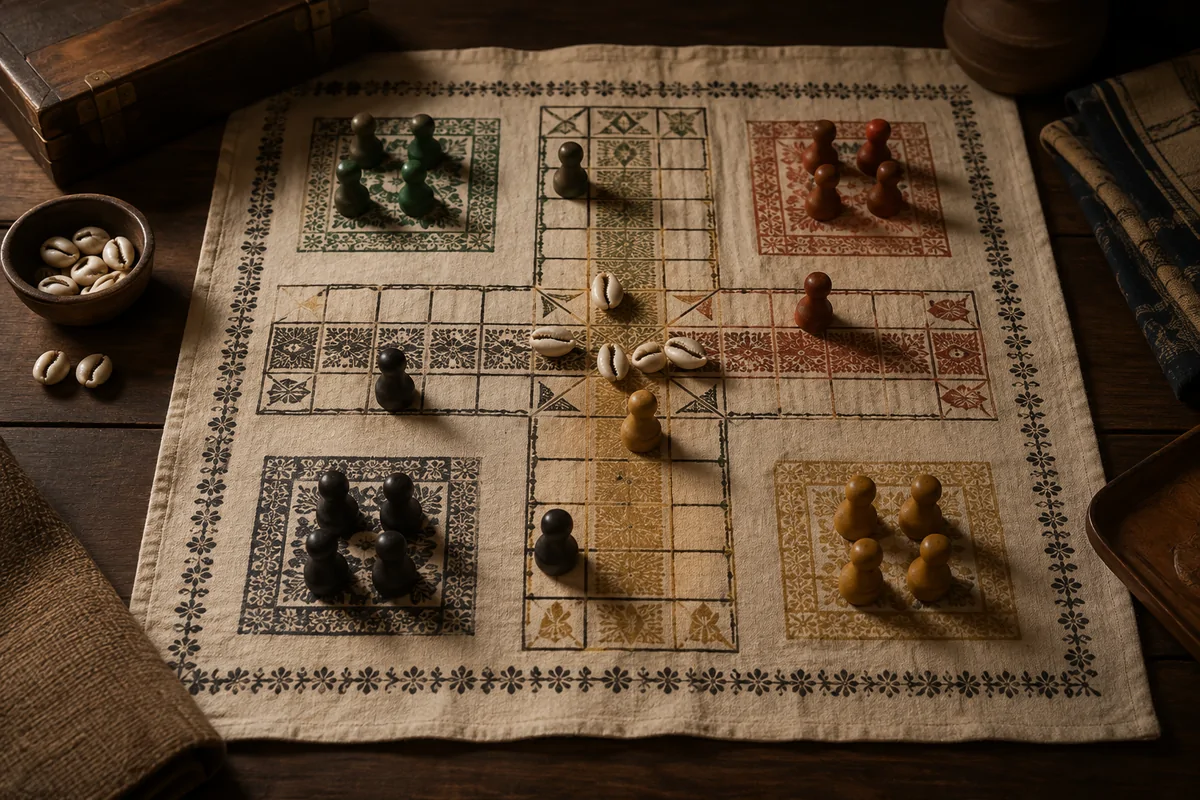
Pachisi is associated with a cross-shaped playing field in which pieces travel along a route toward a shared destination. The shape makes movement visible before a player learns every procedural detail. It presents arms that lead away from a central area and a path that eventually brings pieces home. The Victoria and Albert Museum places Pachisi within the history of board games in India and discusses a historical example. That institutional context supports a careful account of the game as a material tradition, not a claim that every region or household used the same board and rules.
The cross form gives the table an immediate orientation. Players can see their starting areas, the shared route, and the points where paths become socially relevant. A route is never only distance: it is time spent exposed to other players and a sequence of decisions about which piece should move. The board’s symmetry makes positions comparable, while the shared track creates contact. A player who has advanced one token far may still be vulnerable, and a player with several pieces near home may have more options than a single leader. The map shows progress but not security.
The journey turns movement into a public commitment
Moving a piece advances a visible story. Each step places the token closer to its goal, but it also reveals which route the player has invested in. That public commitment can invite an opponent to interfere or encourage the player to protect a vulnerable piece. The effect is different from a game where pieces remain hidden until an endpoint. Pachisi’s journey is on display for the whole table, so the social reading of progress becomes part of play. Other players can respond to a leader before the journey is finished.
This visibility makes the piece a kind of travel ledger. Its location records a sequence of past outcomes and narrows its immediate future. The player must decide whether to keep moving the same token, bring another into play, or use a safe opportunity when one appears. The precise movement and capture rules vary across published and local forms, so this article does not present every commonly repeated detail as universal. The more durable observation is that a shared route turns locomotion into a series of public commitments under changing risk.
Safe places give the route a rhythm
Many cross-and-track race games distinguish ordinary spaces from protected or special spaces. Pachisi variants have their own conventions for safe points and entry, and those conventions should be checked against the particular rule set in use. The design role of a safe place is easier to discuss generally: it interrupts the exposed route with a location where a token is less vulnerable or where a transition becomes possible. Such points create rhythm. Players do not experience every step as equally dangerous, and the map’s landmarks help organize their attention.
Safe points also change the emotional pacing of a race. A move toward one can feel like shelter, while a token leaving it may re-enter a contestable stretch. The board makes these transitions tangible because players can see where the protection begins and ends. A teacher should name the local rule before using a historical or modern board; a familiar shape does not guarantee identical rules. That caution is especially useful when playing with relatives or communities who learned different versions. The shared object can host several traditions, but the group should agree which one governs the current session.
A historical object carries more than its rules
Museum records offer a different kind of evidence from a modern rule sheet. They can document an object’s date, materials, geography, or collection history, but they do not automatically settle how every player in the past used it. The V&A’s context is valuable because it places Pachisi within a wider material history. It is not a complete transcript of all historical play. A responsible article keeps those claims separate: the record identifies a particular object and institutional interpretation; the analysis asks what a cross-shaped route makes possible at a table.
That distinction prevents a board game from being flattened into a timeless “ancient” curiosity. Objects move through families, workshops, markets, museums, and later adaptations. Rules can be taught orally and changed as the game travels. When a modern reader sees a cloth board or counters, they encounter both a play system and a material artifact. The game’s significance can be discussed without pretending that one museum object represents every place, period, or practice associated with Pachisi. Specificity is more respectful than a sweeping origin story.
Compare routes by asking what they expose
To study the board, trace one token’s route and mark the points where its safety changes. Then compare a player who moves one piece far with one who distributes movement across several pieces. The comparison does not require a claim about optimal play. It shows how the same route can reward both concentration and flexibility, depending on the state and local rules. Ask when a move becomes visible to opponents, when a safe point changes the calculation, and what it costs to bring a new piece into the journey.
Pachisi’s cross-shaped board offers a clear way to think about progress as shared space. The route tells players where a journey can go, but it does not promise that the journey will be smooth or identical across versions. The V&A source supports the historical context of a documented example; the rules used at a table should come from that edition or community’s own instructions. Read carefully, the cross is both image and interface. It helps players coordinate movement, compare risk, and see that reaching home is a social process performed in public.