The problem belongs to everyone
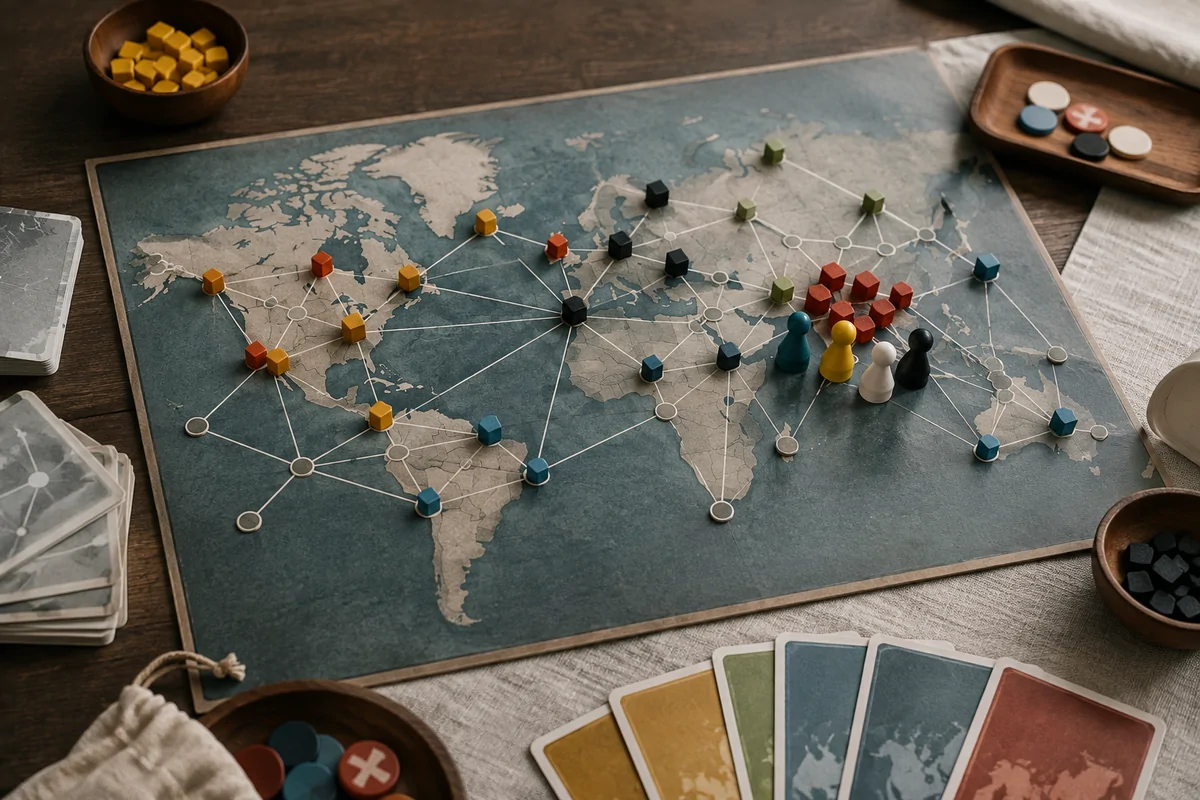
Pandemic makes the central challenge shared: players work together to manage disease outbreaks and find cures before a loss condition ends the game. Z-Man Games’ rulebook defines the action system, infection sequence, roles, and victory conditions. The open cooperative frame changes the usual table conversation. Players do not need to conceal their intentions from one another, so discussion can focus on coordinating actions across the map. The tension comes from the schedule of threats and the limited actions available, not from guessing which teammate is secretly working against the group.
Open information does not make the problem easy. The board can deteriorate while players move, treat disease, exchange cards, or prepare research. A useful choice depends on where the team is now and what the system will do after the players finish. The table must weigh immediate response against long-term progress. Moving toward one outbreak may leave another region exposed; gathering the right cards can delay a rescue. Cooperation means sharing the same pressure, not agreeing that every local need can be addressed in the same turn.
Roles distribute kinds of help
Player roles provide different abilities, which can shape how the team approaches the shared objective. They are not simply character flavor. A role can make one type of action more efficient or change where a player is most useful. The rulebook gives the current abilities; the strategic interpretation depends on the board and the other roles in play. A team should look at its role mix before distributing tasks. One player may be better positioned to move cards or travel, while another can address an emergency with fewer actions.
Role differentiation creates a challenge for teaching. If one experienced player knows every role and directs all moves, the group may technically cooperate while one person makes every decision. A better table practice is to invite each player to explain what their role can contribute, then ask how that contribution fits the shared plan. This preserves expertise without taking agency away from the group. The game’s open information is most valuable when players use it to coordinate rather than when one person converts it into a command list.
The action budget makes discussion concrete
Players receive a limited number of actions in a turn. That budget forces the team to prioritize. A sequence might include movement, treatment, card exchange, or a step toward a cure, with the exact legality and cost defined by the rules. Describing the plan aloud can reveal whether a proposed turn is possible before the player spends it. Instead of saying “we should save that city,” the group can ask who can reach it, how many actions are required, and what other task must be postponed.
This action-level conversation helps prevent quarterbacking and confusion. It also teaches the game’s pace. If a move consumes most of one player’s turn, the team sees the real cost; if another role can perform the same work more efficiently, that opportunity becomes visible. The table should not treat every action as equal just because the rules count them in one currency. Travel distance, card needs, and upcoming system pressure make some actions more urgent. The budget gives a common unit, while the board supplies context.
The infection sequence is a clock the table can read
Pandemic uses a sequence of events that introduces new pressure after player actions. The infection deck, outbreaks, and escalation rules form a clock, though not a perfectly predictable one. Players can inspect some parts of the future and must manage uncertainty in others. The rulebook’s sequence should be taught as a loop: take actions, resolve the relevant deck steps, update the map, then reassess. When the table understands this rhythm, it can plan around the next system response instead of treating every new cube as an unrelated surprise.
That shared clock also makes risk discussable. A team can compare the consequences of leaving a region untreated with the benefit of completing a research step. The calculation is imperfect, but the group can name its assumptions. A player may say that an outbreak is possible rather than certain, then explain what the team gains by accepting that risk. This language keeps review grounded. A bad outcome does not necessarily prove a poor decision, and a lucky draw does not make a careless plan good. The sequence provides evidence for evaluating choices after the turn.
Debrief the plan, not the person
After a loss, a useful debrief follows the state changes: which threat rose, which actions were spent, and what option disappeared? Avoid assigning blame to the player who made the final move. Cooperative games are systems problems, and hindsight makes uncertain choices look more obvious than they were. A short record of the plan can help the group see whether it prioritized the right pressure, whether information was overlooked, or whether a role’s ability could have changed the route. This turns failure into a shared model rather than a personal accusation.
Pandemic’s design gives a group a legible common problem, a constrained action budget, and a schedule that keeps shifting. The official rulebook supplies the precise procedure and current role text; edition variants may differ. The table practice is to keep decisions collective without erasing individual agency. Ask each player what they see, expose the costs of a proposed plan, and revisit the map after the system responds. Cooperation becomes meaningful when everyone can understand the pressure and contribute to deciding what the group is willing to leave at risk.