A patch has two different prices
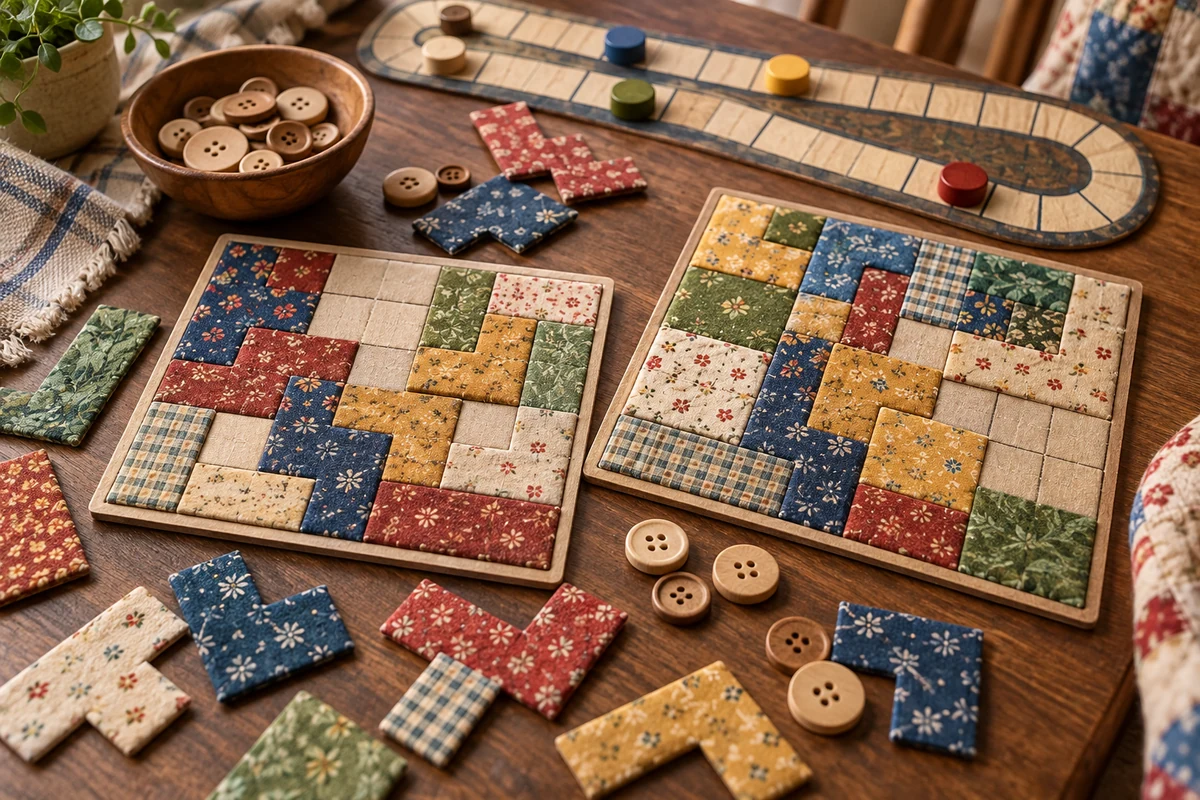
Patchwork is a two-player spatial puzzle built from irregular pieces that fill a quilt board. Each available patch has a button cost and a time cost. The official rules describe a shared time board and a rotating offer of patches; a player chooses one of the next available shapes, pays its button price, places it on a personal board, and advances a time token by the indicated number of spaces. The two prices are related but distinct: one spends a currency, the other spends turns of future position.
The time track creates a turn order that does not simply alternate. The player whose marker is furthest behind takes the next turn. A player may therefore act multiple times in succession if the other marker remains ahead. This rule makes a patch’s time cost a scheduling decision. A cheap shape can still move a player far enough forward that the opponent takes several actions before the next choice.
Buttons connect the economy to the quilt
Buttons are both the currency used to buy patches and part of the final score. Under the rules, certain spaces on the time board provide button income as a player passes them. A player must therefore consider whether a purchase leaves enough money for a later, potentially more useful patch, while also recognizing that moving forward can trigger income. Buttons are not an isolated score track; they circulate through purchase costs and scheduled rewards.
This connection gives each patch a compound value. A shape can fill a difficult gap, advance the player to an income space, and change the turn sequence. It can also consume buttons that might have paid for a future tile. The board encourages players to evaluate how a purchase affects both their quilt and their place on the shared clock. Looking only at the piece’s area misses the time and money attached to it.
The market is a short, moving horizon
Players choose from a limited set of patches near the neutral marker on the time board. Selecting one moves the marker and changes which shapes are closest to the next purchase. That market is not a full inventory displayed for free choice. It is a short horizon; a player may take what is currently accessible or decline that action and move forward to receive buttons until reaching the other time token.
The rules turn refusal into an active alternative. If the nearby patches are too expensive or do not fit the quilt, the player can advance instead and collect buttons for the spaces traveled. That movement may sacrifice a desired shape but improve future liquidity. In a teaching session, this option is important because it shows that a poor market is not always a forced bad purchase. The player can convert time into money and alter when the next choice occurs.
Empty spaces remain part of the result
At the end, the player with the most buttons adds the value of any special tile and subtracts points for empty quilt spaces, according to the official rules. A special tile is awarded to the first player to completely fill at least a seven-by-seven area of the quilt board and is worth seven points. The scoring rule gives both coverage and cash a clear role. A nearly full board can still lose points for gaps, while a wealthy player may have to accept empty space.
This end scoring makes spatial planning more than a visual goal. A tile that fits neatly may preserve options for later, but an empty cell can become a penalty if no suitable patch appears. The player must consider the shape of the remaining holes, not just the total area occupied. Small spaces are especially awkward because irregular pieces may not match them, yet the time track might force a player to pass through several decisions before an answer appears.
Two personal puzzles share one clock
Each player has an individual quilt to complete, but both players act around the same time board and shared patch supply. The personal puzzle is therefore not isolated. Taking a shape may remove a piece the opponent could have used; advancing may let the opponent shop again; a movement choice can change who has the next action. The game links private spatial planning to public scheduling without requiring players to negotiate or trade directly.
Patchwork’s central design idea is material in a literal and mechanical sense: space costs time and buttons. A patch is a shape, a price, and a movement along the clock. The official rules establish the procedure; the analysis follows from watching how those costs interact. A strong host should keep the time markers and nearby offer easy to see, and explain that the lagging player acts next. Once that relationship is clear, the puzzle’s unusual tempo becomes part of its appeal rather than a surprise.
A finished quilt can be reviewed as a record of trade-offs. Which gaps came from an ambitious patch that could not be completed? Which purchase earned button income by moving past a marked space? When did one player receive several turns because their marker remained behind? The physical board preserves those decisions even after the final score is tallied. This makes Patchwork a useful game to discuss after play: the group can connect time spent, currency spent, and geometry gained without reducing the result to luck. Each patch left a trace in more than one system, so an apparent spatial mistake may have been a deliberate tempo or economy choice.