The active player is not the only decision-maker
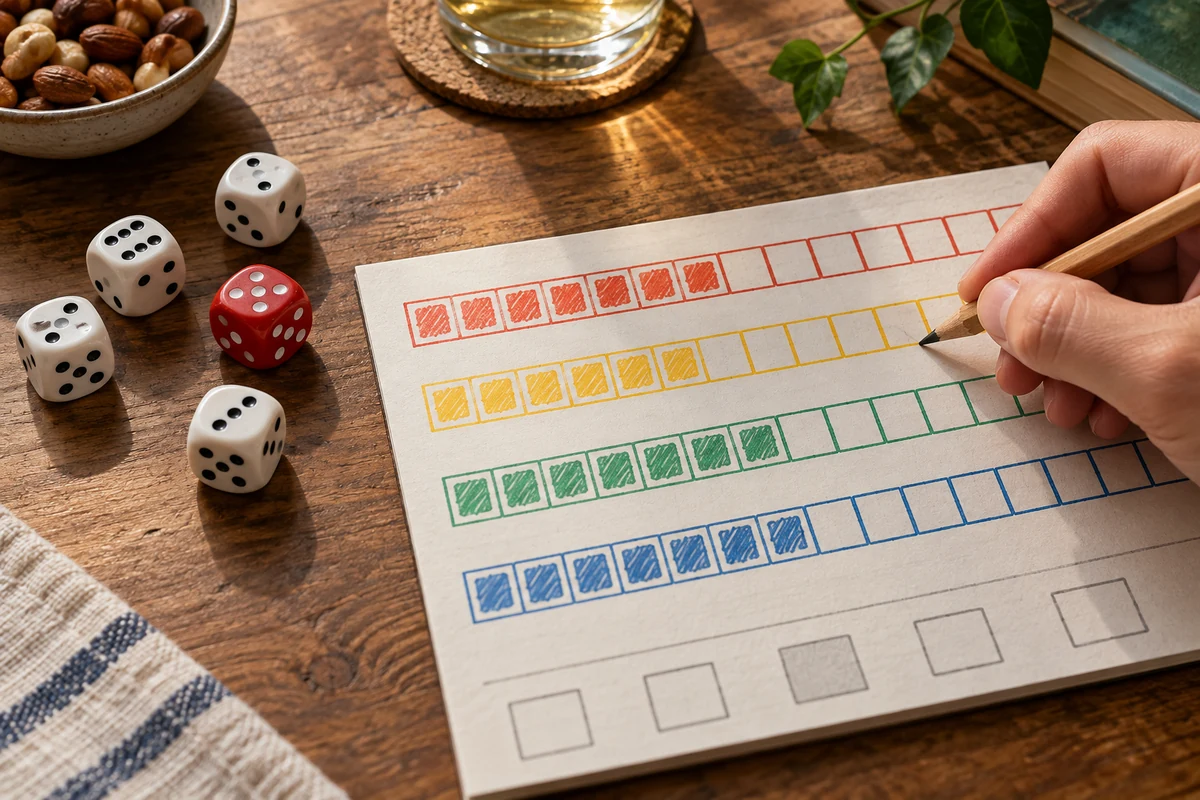
Qwixx uses six dice—two white and one in each of four colors—alongside a score sheet. On a turn, the active player rolls all six dice. The sum of the two white dice is announced, and every player may choose to cross that number in one color row. Then the active player has a separate option to combine one white die with a colored die and mark the resulting number in the row matching that die’s color. The two-step sequence means everyone watches each roll, even when it is not their turn.
That participation changes the social shape of a dice game. Waiting players are not passive audience members: the first shared sum may be useful to some and irrelevant to others, while the active player gets an additional color-specific opportunity. A roll has a public interpretation phase before it becomes an individual mark. The dice are therefore a shared event, but each score sheet records a different history of choices and missed numbers.
A row records what you declined as well as what you chose
The four color rows must be marked from left to right. A player need not begin with the leftmost number, but any number skipped over cannot be marked later. This is the score sheet’s central constraint. It turns every cross into a boundary behind which some future values have been abandoned. Two players can watch the same sequence of rolls and end with very different options because their earlier marks create different starting points in each row.
The sheet works like a compact memory of irreversible choices. When a player crosses a high number early, the empty spaces before it do not remain open possibilities; the printed rule closes them. For learners, it helps to draw a line through skipped numbers as the rulebook suggests. That visual reinforcement can prevent accidental marking and help a player understand the direction of each row. The interface carries the game’s past forward instead of asking memory to reconstruct it.
A lock closes one color for the whole table
To mark the far-right number of a row, a player must already have at least five crosses in that row. Marking that final number also locks the row and removes its matching colored die from play. The rule turns an individual scoring decision into a shared change in the dice pool. Other players may be able to lock the same row during the first shared action if they also qualify, but afterward nobody can add more marks to that color.
A row lock is not merely the end of one player’s collection opportunity. It shrinks the future menu for everyone. The table must reconsider the colors still active and the likely sums available from the remaining dice. This gives players a reason to notice how many marks others have, even though their score sheets are private. Qwixx sits between personal optimization and shared timing: you choose what your own sheet needs, but the game can remove an entire route while you are waiting.
Passivity can be correct, but the active player pays for it
Non-active players are never required to mark a number when a sum does not fit their rows. The active player, however, receives a penalty if neither action produces a mark. Each penalty subtracts points, and four penalty marks end the game immediately. This asymmetry gives the person rolling a particular responsibility: even an awkward outcome can force a choice between accepting a penalty or marking a number that may close off smaller values.
Teaching this distinction prevents a common misunderstanding. “Everyone can mark” does not mean “everyone must mark.” The active role adds a consequence to an empty turn that others do not share. That small exception makes turn order matter without giving the active player exclusive access to all useful dice. The first action is democratic; the second is personal; the penalty binds the person who initiated the roll.
The paper interface is a design component
A score pad may seem like bookkeeping, but in Qwixx the printed arrows, colored bands, and terminal lock symbols teach the system. The sheet displays both available numbers and the direction in which each row closes. It lets players compare the public dice result with private constraints at a glance. Because the game uses one shared dice pool and individual paper states, the most important board is the set of sheets arranged around the table.
The game ends when a player marks a fourth penalty or when two color rows have been locked. Scoring then rewards more marks within rows and subtracts penalties. Those rules reinforce the sheet’s role: it does not only total a result after play, it shapes the decisions that bring play to an end. Qwixx demonstrates how an inexpensive paper component can hold a changing state, guide legal choices, and make an otherwise transient roll part of a lasting record.
After a few rounds, players can compare how different sheets responded to the same dice. One person may have marked a shared sum in red while another used it in blue; later, those choices leave the two rows with different futures. The dice did not create separate information, but each sheet translated the public result into a private constraint. This makes the score pad a useful object for discussion after play. Instead of asking whether a player was lucky in general, a group can trace which opportunities were taken, which values were skipped, and when a color became unavailable. The result remains grounded in the visible record rather than a vague memory of the rolls.