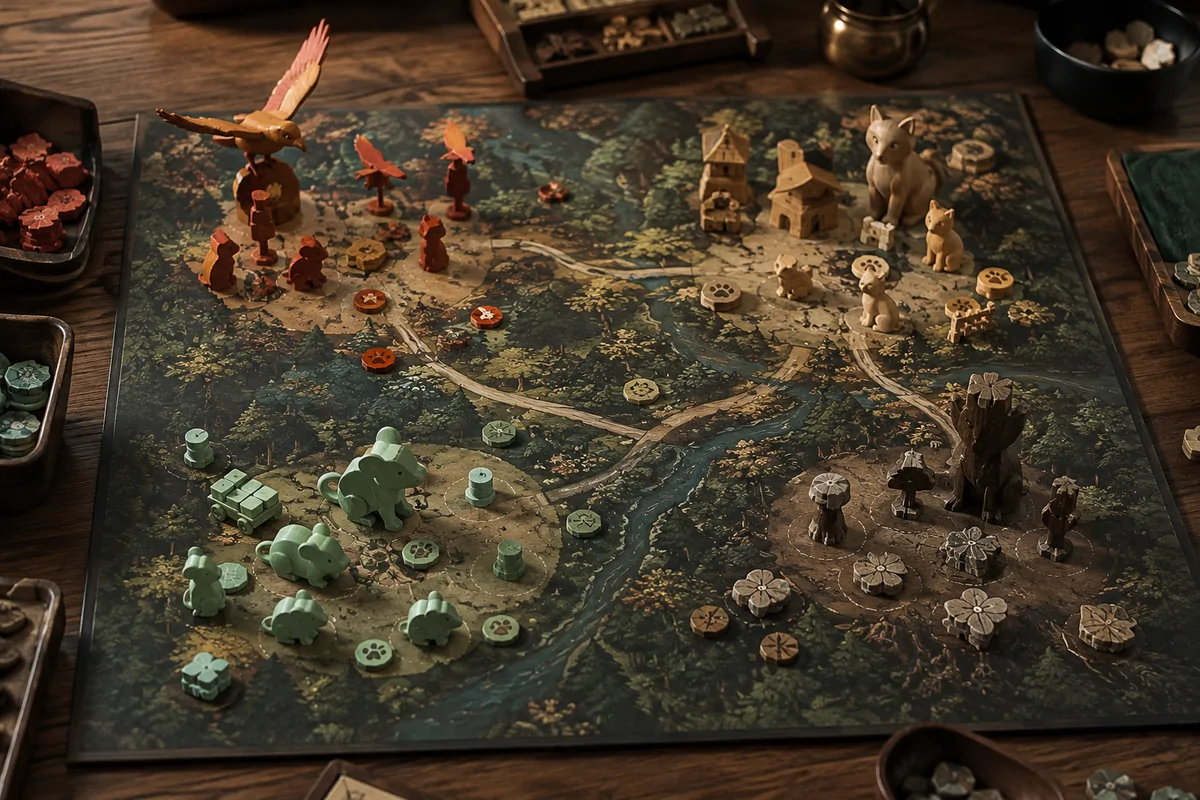
One map supports several rule grammars
Root places factions on a shared woodland map, but the factions do not all pursue the same economy or use the same turn structure. Leder Games’ Law of Root provides the procedures for the selected printing, including common rules and faction-specific instructions. This asymmetry is more than a difference in character abilities. Each faction teaches players to read the same clearings, paths, and pieces through a different grammar. One player may focus on movement and control, another on producing pieces or completing a private sequence. The table is learning several related systems at once.
The shared map keeps the game from becoming several solitary puzzles. Factions compete over locations and respond to the same visible changes, even when they create those changes through different actions. A clearing that looks safe to one player may be a critical resource for another faction’s plan. This means learning Root involves translation: what does this faction need from the current state, and how does that need affect the others? The board provides a common reference, while the player aids and rule text explain why each side interprets it differently.
Faction knowledge is part of table fairness
Asymmetric play can create a knowledge gap. A new player may understand their own actions but not recognize why an opponent’s move is urgent. If the experienced player is the only person who can interpret the map, the game’s social burden becomes uneven. A good host can explain the broad goal and the most important trigger for each faction before the first turn. This does not require teaching every edge case. It gives everyone enough context to notice when another player is approaching a meaningful threshold.
That table practice is not a substitute for the rules. It is a way to distribute relevant information so players can make informed choices. A short faction briefing might name how the player gains points, what piece or location they need to protect, and which action changes the map most. Then the group can consult the current Law of Root for exact timing and exceptions. Because printings and expansions can alter faction materials, players should identify the version in use before importing advice from an older guide or remembered game.
The map is a common language with local accents
Clearings and paths let players point to the same spatial facts. A piece occupies a location; a path connects spaces; control may matter to an action or scoring rule. Yet the significance of those facts depends on the faction. One player may see a route as an opportunity to spread, another as a line that must be defended, and a third as a source of resources. The same map feature carries different strategic meanings. This makes the game a study in shared semantics: a term is public, but its consequence is not uniform.
Players can make these differences easier to follow by narrating intent in game terms. “I need this clearing for the next step of my faction board” is more useful than a vague claim of strategic importance. It gives opponents a chance to understand the pressure without revealing every future choice. The faction board, cards, and pieces work like a second vocabulary layered over the map. When players use consistent terms, they can compare plans without assuming that everyone’s action economy is the same.
Interaction emerges from incompatible priorities
Because factions have distinct routes to progress, conflict can emerge even when no player is trying to target a particular rival. One player may need to occupy a location that another must keep open; a third may benefit from the clash. The shared board makes these interactions visible, while asymmetric goals keep them from being reducible to a single race. A player should assess not just who controls a clearing now but which faction has a reason to change that control next. The game rewards observation of opponents’ systems as much as operation of one’s own.
This is why table talk can be a strategic tool. Players can ask what an opponent’s faction needs, negotiate temporary space, or warn that a visible threshold is close. The rules still determine whether a move, battle, or craft is legal. Conversation changes what players notice and how they coordinate expectations. A facilitator can preserve agency by asking players to explain their own faction, then inviting questions from the group. The aim is not to solve the board collectively but to make the competing grammars understandable enough that competition feels informed.
Teach one faction loop at a time
Root is easier to introduce when each player learns a compact loop: what resources or pieces their faction uses, which action advances the objective, and what state must be protected. Then show how that loop touches the shared map. A practice turn can be narrated from a player’s perspective and followed by another faction’s response. Avoid trying to explain every faction at once as if the game had one universal turn. The current rules are the reference for the edition; the table’s task is to make each player’s responsibilities legible.
Root’s design succeeds by making a common woodland mean different things to different factions. The map supplies a stable place to negotiate and contest, while faction rules give each player a distinct way to act. The rules reference should be consulted for current details, especially with expansions or revised printings. The broader lesson is that asymmetry needs translation tools. A game can ask players to learn unlike systems and still feel coherent when they share a visible world, clear terms, and enough information to understand why an opponent’s next move matters.