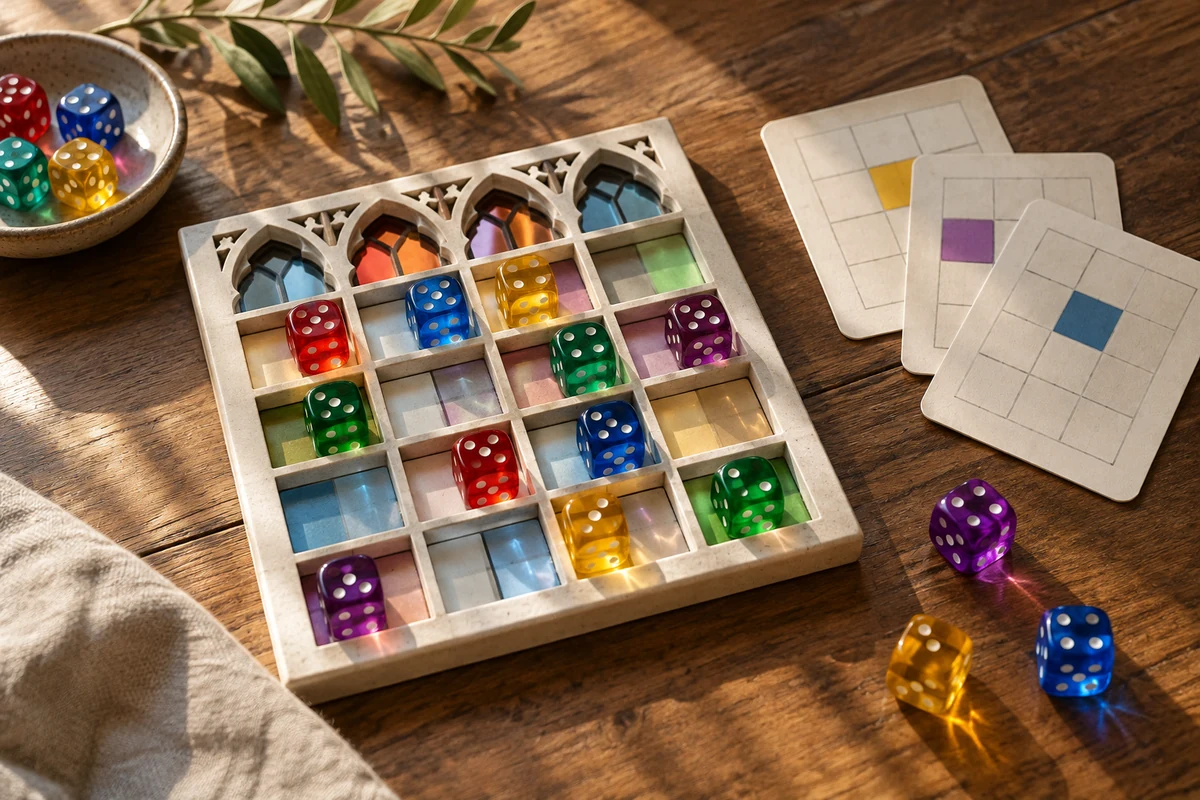
The theme is carried by a working grid
Sagrada asks each player to build a window from colored dice placed into a personal grid. Floodgate’s official rules treat each die as having both a color and a shade, represented by its value. A window pattern constrains the spaces where dice may go, while shared drafting makes the dice available to more than one player’s plan. The theme of assembling stained glass is therefore connected to the mechanical work of selecting, comparing, and fitting small colored objects.
The grid provides a stable frame, but the pattern card makes each personal window different. Restrictions can apply to color, shade, or neighboring placements, so an apparently attractive die may be unusable in a particular cell. This relationship between visible object and legal location is central to the game. The die does not have one fixed value in every context: its color and pip value must be read against the player’s remaining spaces.
Drafting is only the first half of a placement
A player can select a die from the shared offering and still face a second puzzle: where can it legally fit? The decision to draft should anticipate its destination, but the grid may already contain neighboring constraints that narrow the options. A die with a useful color can be difficult to place because of its shade, and an open cell can be less helpful than it appears if adjacent dice restrict it. The shared pool connects personal plans to the choices of others.
This two-stage action is a strong teaching opportunity. Ask a learner to identify a possible legal cell before taking a die, then check the placement rule after it is selected. That sequence keeps drafting from becoming a vague preference for a favorite color. It also makes the group’s public information useful: everyone can see the dice supply, while each player’s window reveals which objects may become scarce or especially valuable.
Rules create texture without forcing a picture
A window pattern gives players a target arrangement, but the rules do not require every finished grid to form a literal image of glass. Instead, the pattern and the dice produce an abstract composition under constraints. This is a helpful difference between theme and objective. A player may want a balanced-looking window, yet legal placement and scoring priorities decide which options are productive. The visual pleasure emerges from the rule-bound arrangement rather than a picture that must be copied.
The dice carry tactile and visual information at once. Color helps a player compare categories, while pip value distinguishes shades. The grid cells make those properties spatially consequential. A careful table should use even lighting and keep dice turned so their values remain readable. These are practical observations about accessibility and shared attention, not special scoring rules. When the components communicate clearly, players can focus on choosing among constraints instead of repeatedly asking what a die shows.
Scoring asks the window to be read twice
Sagrada’s rules include public and private objectives, with different ways to evaluate the finished window. The official rulebook’s examples show players adding points for objective patterns and deducting points for open spaces. This means the grid is read first as a set of legal placements during play, then as a completed arrangement during scoring. A move can be locally legal yet fail to help an objective, while a deliberate gap may reduce the final score even if it preserved access earlier.
The distinction between construction and evaluation is worth making explicit for new players. A placement should satisfy the immediate restrictions, but the strategic question is whether it supports one or more scoring goals. A private objective creates a different reason to value a color from the public goals shared by the table. The same physical window is therefore interpreted through multiple scoring lenses, none of which changes the legality of the original placement.
Constraints can make beauty legible
Sagrada’s design shows how an aesthetic theme can become part of a rule system without turning every turn into free decoration. The dice are attractive objects, but their color and shade are also data. The window grid is evocative, but it is also a constraint surface. A player sees a possible composition and a set of restrictions at the same time. The pleasure of fitting a die comes from resolving both readings in one action.
This makes the game a useful case for designers who want a tactile metaphor to do real mechanical work. The source supports the specific rules about dice, grids, objectives, and open spaces; the wider claim is an interpretation of their relationship. Each component carries meaning and procedure together. A stained-glass window is not just a backdrop for points. It is a structure whose cells tell players what they can place, whose colors matter for scoring, and whose unfinished spaces remain visible at the end.
During a first game, players can avoid an overload of icon reading by checking each candidate die in a fixed order: confirm that the target cell is open, check the cell’s printed restriction, compare the die with any relevant neighbors, then place it and update the window. This sequence is a teaching aid, not a replacement ruleset. It makes errors easier to locate because each question has a visible reference. Once the group understands the grid, it can think about objective cards and the shared pool more fluidly. The central lesson remains that a die’s usefulness is relational: it depends on the window it enters and on the pattern the player is trying to complete.