A word is a placement with an audience
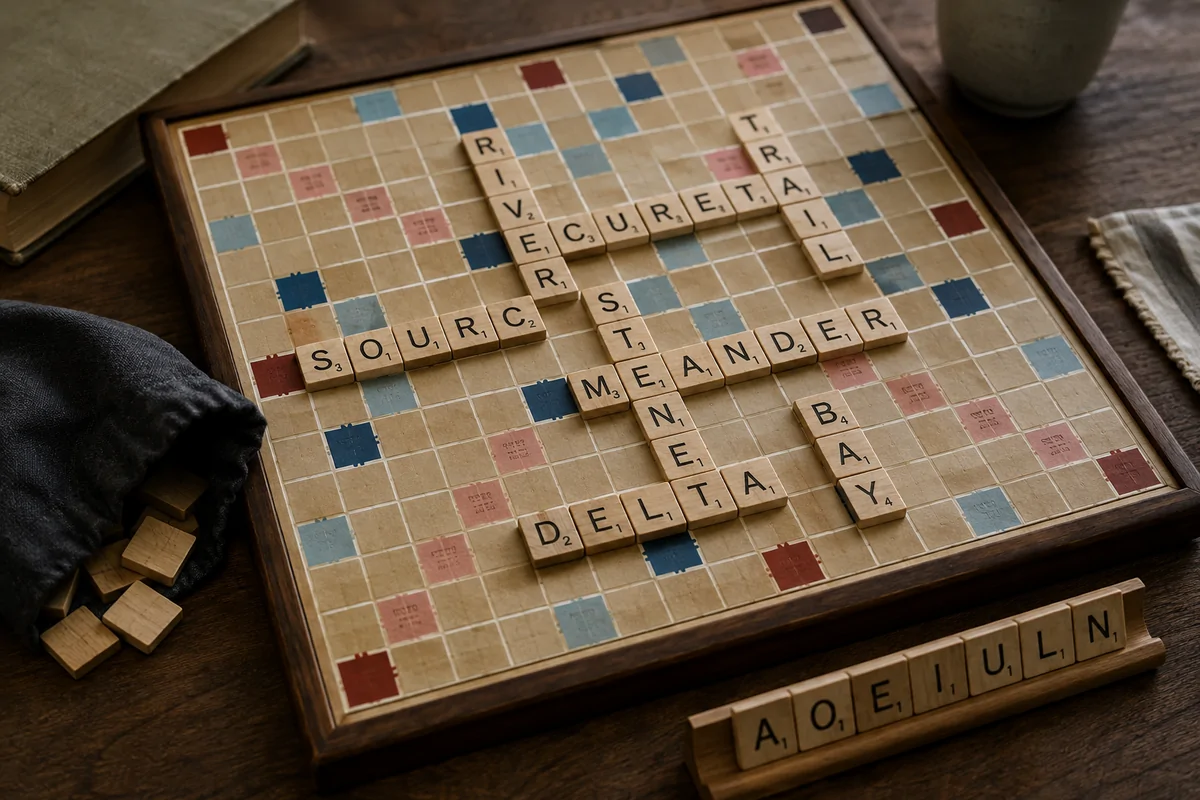
Scrabble asks players to make words from a limited rack of letter tiles, but the board makes every word a public event. A placement uses available letters, connects to the existing pattern after the opening play, and can create new cross-words that also need to be valid under the chosen word authority. The board’s premium squares change the value of where a word lands. A high-scoring placement is therefore not only a vocabulary achievement. It is a transaction with the shared board: the player spends tiles and space now, while changing the opportunities the next player can see.
The market metaphor is useful because each placement creates both value and exposure. A premium letter square can multiply a tile’s contribution, and a word square can change the total for a word that crosses it. Yet those special spaces are scarce and their use may open a reply. A player who takes a large score might give an opponent access to another premium line. Evaluating a move involves current points, rack quality, board geometry, and what remains available afterward. None of these factors guarantees a best play in every position; they describe the resources that the board makes visible.
The rack is a small inventory under pressure
The rack limits what a player can do at a particular moment. Letters that look awkward in one combination may become useful after a draw, while a balanced rack can offer many plausible placements. That makes tile choice a problem of inventory management. Spending a letter can score now, clear an unhelpful tile, or preserve a more flexible group for the next turn. Holding everything for a theoretically perfect word can be costly if the board closes or the game ends before those tiles are used. The decision is temporal: how much value should be realized now, and how much should remain available?
The bag and the public board create two different kinds of uncertainty. Players cannot see all future tiles, but they can examine the letters already played and the spaces still open. In tournament or club play, the source of authority for acceptable words and challenge procedures should be agreed in advance. NASPA’s rules serve organized North American play; casual groups may select a different dictionary or challenge style. Naming that standard prevents a lexical dispute from becoming an argument about which player’s memory is better. The rules define the transaction; the chosen word list defines what may be traded.
Premium squares make geography consequential
The board is not a neutral sheet on which words happen to be written. Its letter and word premiums concentrate value in particular locations. A placement that reaches a premium can turn an ordinary set of letters into a much larger score, while a nearby play can block or preserve access to the same area. This creates an economy of position. Players do not own a square simply because it is useful, but a word can occupy the route that would have allowed an opponent to use it. The board’s geometry turns placement into temporary control over future options.
That control is fragile. A short word may open a triple-word line; a longer word may cover it or create a safer parallel route. A player often has to weigh the score of the current play against the quality of the replies it invites. This is why simple tile counting cannot fully describe strategy. A placement can be valuable because it denies a strong response, even when its immediate score is modest. Conversely, maximizing a visible bonus can be unwise if it leaves an easy extension. The design makes space part of the word’s value, and the next player’s access is a central cost.
Challenges make language a shared rule question
When a word is challenged, the dispute moves from personal knowledge to a defined procedure. The chosen rules specify what happens when a play is found unacceptable, and tournament settings may provide adjudication tools. This is important because Scrabble combines language, memory, and competitive pressure. Without a shared process, the player who speaks with the most confidence can dominate a lexical question. A transparent challenge rule gives both sides a way to test a play and return to the game. The procedure should be taught before the first difficult word appears, not improvised under stress.
Word authority also has limits. A dictionary records editorial decisions about spelling, inflection, and usage; it is not a universal inventory of every meaningful expression. Organized play depends on a designated list so that players face the same standard. A family game can choose a more permissive approach, but it should make that choice explicit. The interesting design question is not whether one dictionary contains all language. It is how a game turns contested vocabulary into a consistent action rule while preserving the pleasure of forming surprising combinations.
The ending audits the inventory
As the tile supply shrinks, the value of keeping a flexible rack changes. The end-of-game procedure accounts for unplayed tiles, and the player who empties a rack can affect the final score according to the applicable rules. This makes the finish an audit of inventory as well as score. A rack that looked promising early may become a burden if its letters remain unplayed. Players must notice when the market is closing: the number of remaining tiles, opponents’ racks, and the board’s open lanes all affect whether a long-term plan still has time to mature.
For a first lesson, teach the placement and scoring procedure, then show how one word creates cross-words and changes a premium square for everyone. Ask learners to describe what the next player could now do. That question reveals the board as a shared market rather than a private word puzzle. Scrabble’s design rewards language, but it also rewards timing, inventory judgment, and spatial reading. The strongest explanation of a move is therefore not only “this word scores.” It is “this is the value I take, the tiles I spend, and the opportunities I leave behind.”