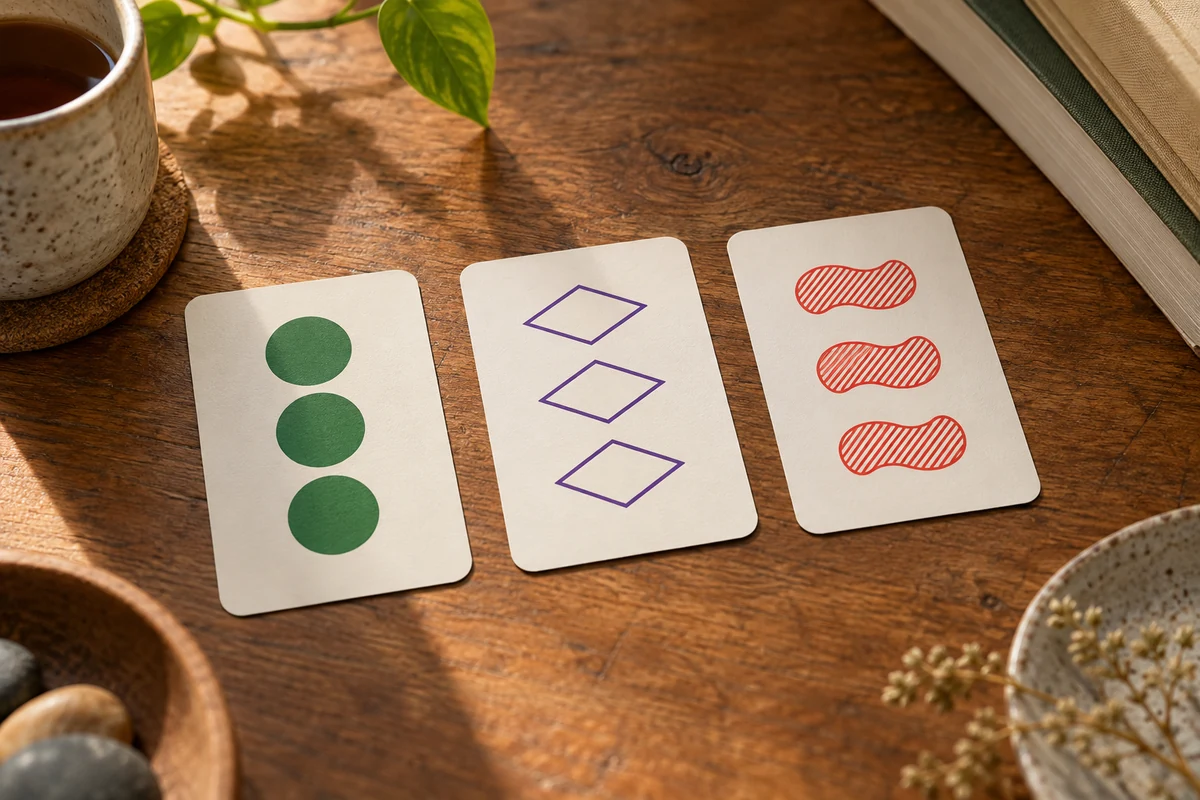
A rule that can be checked one feature at a time
SET looks like a free-form search because everyone studies the same exposed cards at once. The search is bounded by a precise test. A card varies in shape, color, number, and shading; for any proposed group of three, each feature must be either identical across all three cards or different on all three. The test applies independently. Three cards may share a color while differing in shape, for example, but one feature that appears twice in one form and once in another makes the proposed group fail.
That local test is the game’s strongest teaching tool. Rather than asking a new player to trust an impression that a group feels balanced, a host can compare one feature at a time. Look at number, then shape, then color, then shading. The order is not a rule; it is a way to slow perception until the rule becomes visible. This is also why a mistaken call is informative. The group can identify the single feature that broke the pattern instead of treating the whole decision as mysterious.
The table becomes a shared field of attention
The standard deal places twelve cards face up where all players can see them. There is no turn order in the search phase: a player calls “SET,” claims the moment, and identifies three cards for the table to check. A successful claim is scored and the cards are replaced from the deck. Those details create a public rhythm. Everyone shares the same information, but not the same instant of noticing it. The physical act of calling before collecting helps mark who found the combination first.
Because a correct group is removed, a solution changes the problem for every observer. The replacement cards may create several new relationships, erase a tempting near-pattern, or leave the table temporarily harder to read. It is useful to teach this as an evolving display rather than a puzzle with one fixed answer. Players are not merely scanning a static arrangement; they are responding to an arrangement that the group continually edits through successful recognition.
Near-matches are the important teaching material
The most useful examples for instruction are not always valid sets. A group with two red cards and one purple card makes the “all the same or all different” rule concrete: neither condition is met for color. Likewise, a pair of matching shapes and one different shape fails even if number and shading work. Showing a near-match makes the boundary inspectable. It also prevents a common teaching shortcut, where players remember examples but cannot explain what property makes a new example valid.
A careful host can ask a learner to describe the evidence before confirming a call. That small pause need not become a test of speed or vocabulary. It lets the learner practice the method that makes speed possible later: choose a candidate triple, compare each feature, and reject it as soon as one feature has a two-to-one split. The group should keep the language neutral. A wrong call is a visible hypothesis, not a character flaw or a reason to rush the next one.
The display itself is part of the interface
SET’s cards work as information carriers because each feature is both visually distinct and repeated across the deck. Their symbols have a count, their contours identify shapes, and fills separate shading states. At a crowded table, the same repetition that enables comparison can become visual noise. Keep the layout in a clear rectangle, leave a little space between cards, and replace removed cards without covering neighboring ones. These are hosting choices rather than extra rules, but they protect the comparison the official rule asks players to make.
The official instructions also offer a reduced-feature way to begin, using the solid-symbol deck so shading is removed from the task. That is a useful example of simplifying a system by temporarily reducing its vocabulary rather than changing its central logic. A teacher can first let players practice the three remaining features, then bring shading back once the same-or-different test is familiar. Any such adjustment should be named as an introductory setup so that nobody confuses it with the full deck.
Speed should follow clarity
The competitive atmosphere comes from simultaneous looking, not from a timer that forces every group to hurry. A session can remain thoughtful while still feeling lively: the first caller gets the chance to demonstrate a claim, the table checks it, and the display changes. For children or mixed-experience groups, a host can leave out a timer and let explanation remain part of play. For experienced players, the same public field rewards practiced visual comparison without requiring a separate turn structure.
SET is a compact study in how a rule can make an open-ended perceptual task fair enough to share. Everyone can inspect the same evidence, and the result can be checked by repeating the same feature-by-feature procedure. The design does not promise that everyone notices at the same pace. Instead, it gives the table a common language for deciding whether a noticed pattern counts. Its simplicity lies in the test; its depth for teaching lies in how many ways players learn to apply that test.
A useful review after a round is to revisit one card trio that produced disagreement and identify exactly which feature settled it. That keeps the discussion attached to evidence instead of to who called first or who is usually fastest. It also reveals whether the group has confused a visual resemblance with the formal rule. Two cards can look close while the third completes an all-different set; three similar cards can still fail because a single attribute splits two-to-one. Returning to the displayed cards gives the group a calm, repeatable method for resolving uncertainty. It is a small facilitation practice, but it mirrors the design itself: notice, test, verify, then update the shared field.