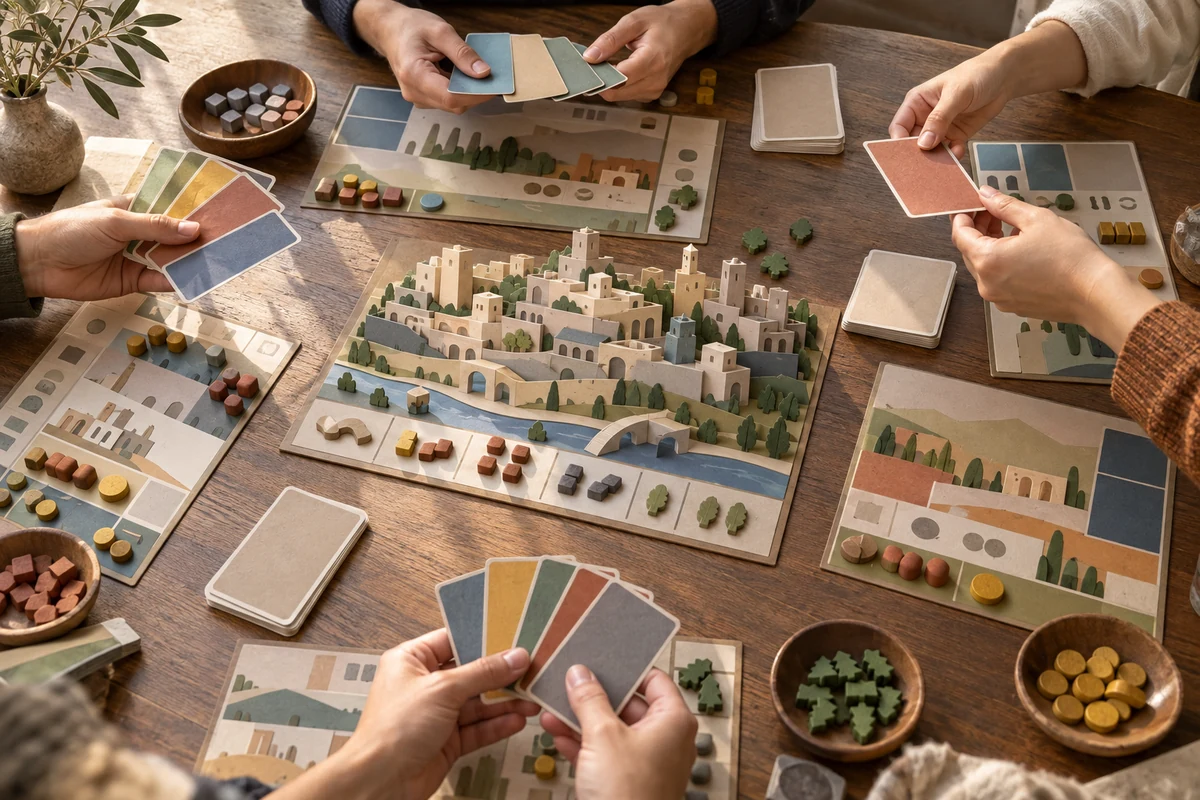
A hand of cards becomes a temporary city plan
Repos Production describes 7 Wonders as a game played over three rounds called Ages, with cards that offer increasingly powerful effects. Its publisher-verified rules explain that players look at a hand, choose one card, place that card face down, and then reveal and perform actions simultaneously. The remaining cards pass between neighbors. That repeated selection-and-passing loop makes a private hand temporary: every card kept is one the next player will not receive, and every card passed may help or constrain someone else’s development.
The cards represent different paths of development, including military, scientific, commercial, and civic structures on the official product page. A player is not simply collecting a set from a static market. The choice is made in relation to what remains in hand and what the neighboring cities may want. The pass direction also changes between Ages under the publisher-verified rules, so the flow of information and opportunity shifts as the game progresses.
Simultaneous resolution compresses a large table
Once everyone has selected a card, players resolve their actions at the same time, according to the verified rules. That procedure allows the game to support three to seven players without requiring every participant to wait through every other player’s full turn. A player can still watch neighbors’ development and interact through resources or military comparisons, but the primary rhythm is parallel rather than a long series of isolated turns.
Simultaneous play also changes the kind of attention the table needs. Players must choose without knowing exactly how neighbors will resolve their cards that step. They can read what has already been built and infer what a passed hand might contain, but they cannot pause the whole group after every selection. A clear reveal moment gives everyone a shared point of synchronization. The table’s pace comes from agreeing when decisions are final and then resolving them together.
One selection supports several kinds of action
The publisher-verified rules describe three actions for a selected card: build its structure, build a stage of the player’s Wonder, or discard it for coins. That choice gives a card value beyond its printed effect. A structure may strengthen a city; a Wonder stage may advance a longer plan; discarding may solve an immediate need for currency. The same card can therefore be evaluated through several possible uses, even before accounting for the way it travels through the draft.
A player must consider both what a card does now and what denying it to a neighbor might accomplish. This does not mean every selection is a direct attack. Sometimes a card is chosen because it neatly supports one’s own plan; sometimes it is removed because its effect would be especially useful next door. The draft creates an interaction through circulation, while the action options keep a card from being worthless simply because its main effect does not fit.
The passing hand is an information object
The hand passed to a neighbor is a partial record of decisions. Cards removed from it reveal what other players valued or found useful, while the cards remaining become the next person’s possibilities. Because selection and reveal happen around the same time, players cannot always identify each other’s reasoning immediately. They can, however, compare the city tableau after resolution with the cards that continue to circulate.
A teaching group should make this flow explicit before explaining every icon. Physically pass the remaining hand only after the chosen card has been placed face down and resolved. This avoids mixing a discarded card, a built structure, and a passed card into one confusing action. The procedure is simple, but it coordinates several players at once. An agreed rhythm—choose, reveal, resolve, pass—keeps the card economy legible.
Parallel play is a timing design
7 Wonders shows that simultaneous turns are not merely a way to shorten a game. They create a particular relationship among individual planning, neighbor awareness, and group tempo. Everyone makes a private choice, then the table reveals those decisions together. Players act on their own city boards while watching the shared effects emerge. The three Ages provide chapters in which the card pool changes and development can become more powerful, according to the publisher’s description.
The design works because the card hand has a clear lifecycle. It arrives, is examined, yields one selection, resolves in parallel, and continues to the next player. The official source supports the rules and categories; the analysis is that this lifecycle acts like a pacing device for a larger multiplayer group. A good host protects the synchronized reveal and the passing direction. Once those transitions are clear, the civilizations can develop in parallel without the table losing its shared sense of time.
After an Age, the surviving tableau also gives the group a compact review surface. Players can see which categories each city developed and how neighbors’ choices changed the opportunities passing around the table. That is different from claiming the draft can be perfectly remembered: a card that left one hand may be difficult to track after several rounds of simultaneous resolution. The design offers enough public evidence for interpretation without requiring a perfect log of every selection. For designers, this is a useful balance between traceability and pace. A selection has a visible consequence, but the group is not asked to stop play and narrate every private intention.