Capture changes ownership instead of removing a piece
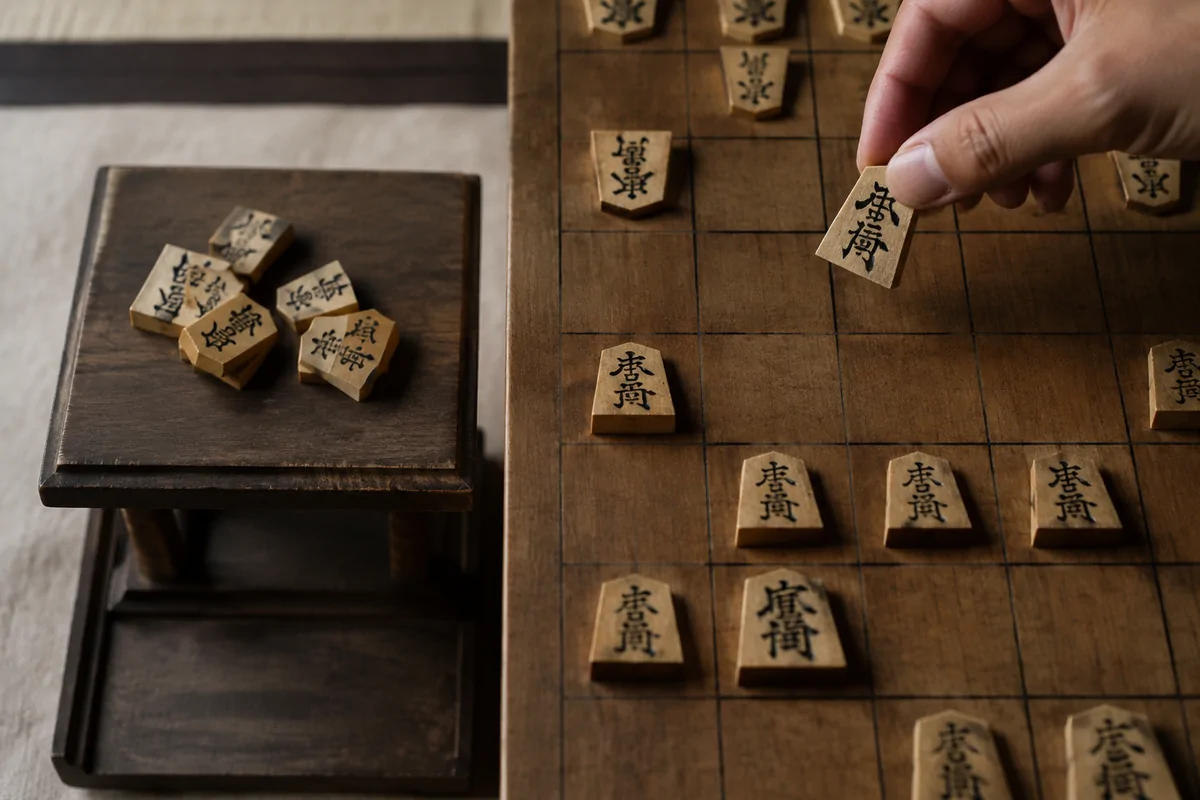
Shogi’s most distinctive board-state idea is that a captured piece can return to play under the capturer’s control. After a capture, the piece becomes part of the capturing player’s hand, a reserve that can later be dropped onto an empty square under the rules. This differs from chess-style elimination, where a captured piece leaves the active position. The Japan Shogi Association’s competition rules provide the formal frame for capture, drops, and promotion. In shogi, material can disappear from the board without disappearing from the game, so every exchange may create a future resource.
That return changes the meaning of an attack. Taking an opponent’s piece reduces their current board presence, but it also gives the capturer a new option. A player evaluating a capture must therefore consider both sides of the exchange: what square is cleared, what threats are removed, and what piece will be held in reserve. A successful attack can strengthen the defender’s future capacity if the captured piece is useful after a drop. This does not make captures bad. It makes capture a transfer, and transfers require a longer horizon than simple subtraction.
The hand is a second board of possibilities
Pieces held in hand are not placed on the board until a legal drop is chosen, but they remain active in strategic planning. A player can use a drop to defend a threatened area, create a new attack, or alter which squares the opponent must protect. Because the reserve is public in standard play, both players can see much of this potential. The uncertainty concerns where and when the piece will be used, not whether it exists. A board position that looks safe against current pieces may change sharply when the opponent can place a piece into a nearby gap.
This makes empty squares more complicated than they appear. A gap can be a route, a defensive weakness, or a landing point for a future drop. Players should not read the board as a static arrangement of pieces alone. They also need to read the inventory waiting beside it. This second layer rewards careful attention to captured material and to the drop restrictions that apply. A powerful idea is not automatically a legal move; rank, piece type, and other rule conditions constrain where a reserve piece can enter. The legal details are what keep possibility from becoming arbitrary.
Promotion gives movement a second life
Shogi also uses promotion zones to change the movement of eligible pieces. Promotion can alter how a piece moves after it reaches the relevant part of the board, adding a temporal layer to the same object. A piece’s identity is not fixed by its original movement pattern alone; its status can change as it advances. Promotion therefore competes with the decision to preserve a piece’s current role. The rules specify when promotion is available and when it is required. The practical question is how that changed movement affects future plans, not whether a promoted piece is always superior in every location.
The interaction between promotion and drops produces a board that carries both forward motion and re-entry. A piece may spend time advancing toward a new role, be captured, and later return under a different player with a different purpose. In this way, the components record a history that is not simply a trail from starting square to destination. A reserve piece has a past on the board, but its next use may be entirely different. For designers, this is a strong example of how changing ownership can make every exchange alter both immediate control and future agency.
Constraint keeps re-entry readable
If pieces could be dropped anywhere without conditions, the reserve might overwhelm the spatial game. Shogi’s drop rules place limits on re-entry, including restrictions tied to the piece and destination. These constraints make the reserve legible: a player can scan available pieces, identify legal squares, and compare the drop with ordinary movement. The exact restrictions deserve to be taught from the current rules rather than from a simplified summary. Particular cases can be easy to misremember, and organized play should follow the Japan Shogi Association’s official text.
Constraints also preserve a useful distinction between threat and inevitability. A player may hold a piece that could attack a vulnerable area, but the drop may not be legal on every tempting square. The defender can reason about a defined set of possibilities instead of an unlimited set. This is one reason the reserve remains tactically rich without making the board unreadable. When teaching, place a captured piece beside the board, name what it can do once dropped, and ask the learner to identify both a promising square and an illegal one. The contrast teaches the boundary as well as the opportunity.
Review the exchange as a transfer of agency
After a capture, review two questions: what changed on the board, and what changed in the players’ reserves? The first question covers immediate control; the second covers future choices. That small habit helps beginners avoid evaluating an exchange only by counting pieces. A captured rook-like piece, for example, is not simply gone. Its value depends on the new player’s ability to use it, the available drop squares, and the timing of the next threat. Analysis becomes more accurate when the reserve is treated as part of the live position.
Shogi’s drops make its board a system of re-entry. A capture can remove a defender and supply an attacker; a promotion can change the movement vocabulary; a vacant point can remain strategically occupied by possibility. Those ideas are enough to appreciate the design without claiming that every match follows the same tactical story. Readers should consult the Japan Shogi Association’s current rules for tournament details and the exact edge cases. The broader lesson is that a game can keep material meaningful after it leaves the board. Re-entry turns what would have been an ending into another choice.