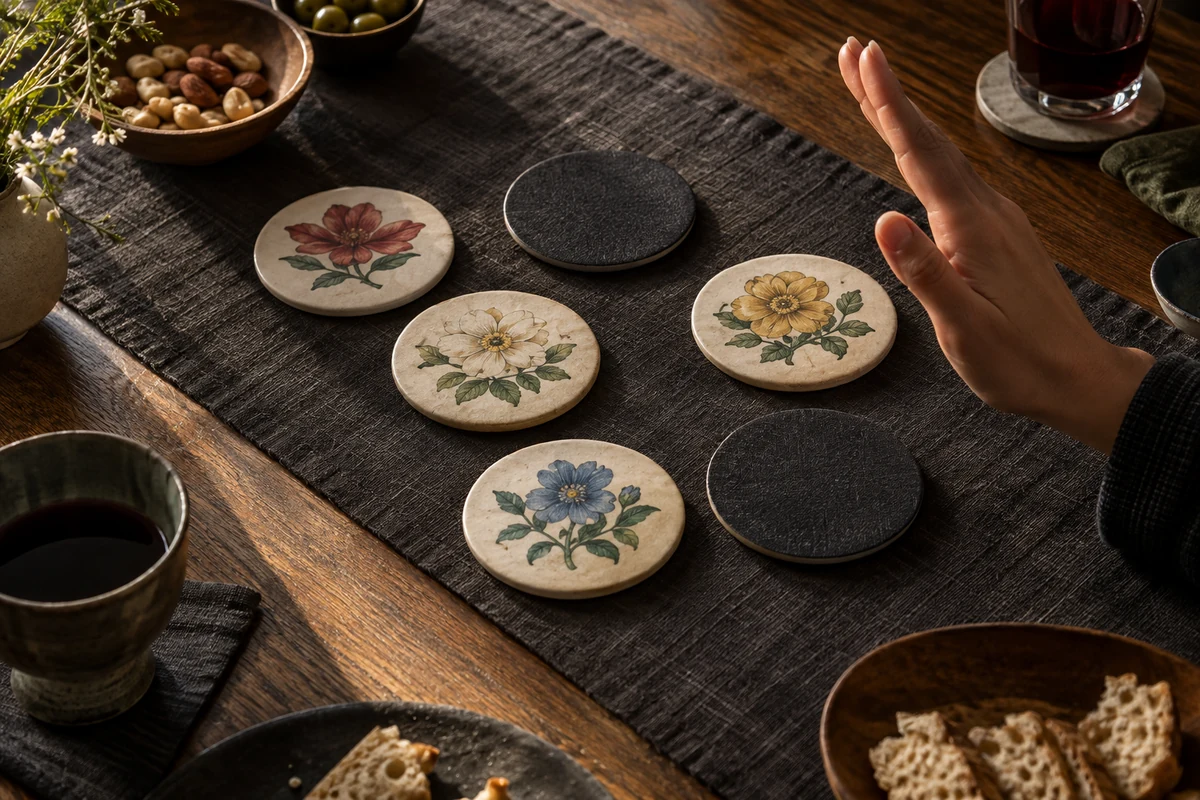
A small set of discs holds unequal possibilities
Space Cowboys describes each player’s set as four discs: three flowers and one skull, with identical backs. On a turn, a player chooses either to place a disc face down on their mat or to launch a challenge by announcing how many discs they believe they can reveal without uncovering a skull. The components are deliberately simple in the publisher’s description. A face-down disc hides a meaningful difference, while its back does not tell opponents which possibility it contains.
That physical equivalence is central to the bluff. A flower and a skull occupy the same kind of place in the public arrangement until someone commits to a challenge and begins revealing discs. The hidden information is local and easy to understand; the social interpretation is not. Players use the order and number of their placements, their bids, and their willingness to continue as evidence, but none of those signals guarantees what is under a disc.
The bid converts uncertainty into a promise
A challenge is more than a guess about the table. It is a promise to reveal a particular number of discs without finding a skull. As bids rise, a player takes on a greater risk and makes a stronger public claim about their confidence. The discs do not change, but the meaning of the arrangement does. Once a bid is active, the face-down objects become a sequence of tests that can resolve the challenger’s claim or expose the bluff beneath it.
The rulebook structure creates a readable moment for the table: players first build a hidden arrangement, then one person decides whether to challenge and how far to push the count. The decision between placing another disc and opening a challenge shapes the pace. A player may want more objects in the arrangement, or may prefer to turn existing uncertainty into a test before an opponent does. This is a design choice about timing as much as risk appetite.
The backs carry almost no information
Identical backs prevent the surface from signaling whether a disc is safe. Players must infer from behavior rather than rely on a printed clue. A player who places a disc may be adding a flower, protecting a skull already present, or trying to persuade others that the arrangement is favorable. The formal information is limited, but the social information grows with each public action. The group watches actions and interprets them through its own history of play.
This is why the game is often better taught with a clear distinction between what is known and what is guessed. Everyone can see which players have placed discs and whether a challenge has begun. No one can see the face of a disc until it is revealed. A host should avoid treating a confident bid as evidence that a player’s claim is true; confidence is a move in the game, not a source of certainty.
Risk is made legible through ritual
Skull uses a familiar tabletop ritual: place an object face down, announce a number, then reveal one at a time. Each step slows the action and makes attention collective. The table can follow the count and see the same reveal. A found skull is not merely a failed probability calculation; it is a visible reversal of the challenger’s announced confidence. The suspense is created by controlled disclosure rather than by a complex board state.
The small mats and discs help maintain a shared record of whose objects are where. Keeping those piles tidy is a practical courtesy, because the challenge depends on players understanding which disc belongs to which player and which objects are eligible to be revealed. A quick, casual session can still benefit from a consistent reveal order. Material clarity protects the psychological uncertainty that the game wants to create.
The game’s simplicity depends on social reading
The publisher lists Skull for three to six players and describes it as a bluffing and risk-taking game. Those details support a modest design observation: the rules define a few possible public actions, then leave players to interpret one another. The game’s depth does not come from a large deck of unique effects. It comes from the gap between an object’s identical back and its hidden face, and from the table’s willingness to assign meaning to choices made under that uncertainty.
A bid is therefore both a mechanical threshold and a social statement. It invites others to decide whether they believe the challenger has read the arrangement correctly or is trying to end the round on a bluff. The flower may be visible in the game’s imagery, but its safety is never guaranteed by appearance alone. Skull’s central design lesson is concise: a very small information channel can support a large amount of interpretation when each player knows the stakes of revealing it.
A host can preserve that uncertainty by making the reveal procedure consistent and by keeping the backs of unchallenged discs visible without accidentally turning them over. Players should understand which objects belong to each mat and what the current bid requires before the first challenge starts. This removes procedural confusion while leaving the intended uncertainty intact. A mistaken reveal is meaningful only if everyone agrees which disc was selected and whose disc it was. The simple component set is not self-managing; a tidy layout lets players concentrate on the people making choices rather than on reconstructing the arrangement after each turn.