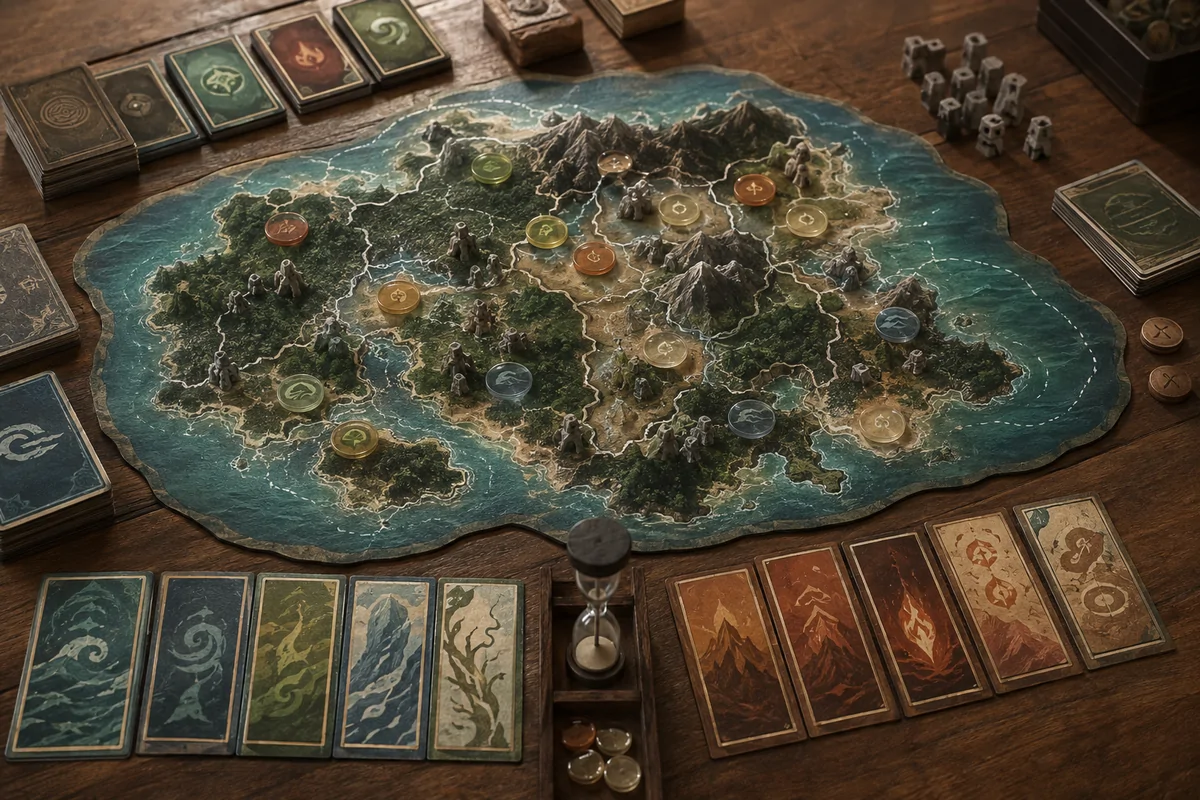
Speed divides intention from consequence
Spirit Island divides powers into Fast and Slow timing categories. Greater Than Games’ rulebook describes when those powers resolve in relation to the invader sequence. The distinction turns a card’s timing into a planning constraint. A Fast power can alter the state before the invaders carry out their next actions; a Slow power resolves later in the turn, after the relevant invader steps. Players therefore choose not only what effect they want but whether it can arrive in time to change the threat they are facing.
This timing creates a cooperative conversation about what must be handled now and what can be prepared for later. A player may know that a Slow power will eventually clear a threat, but the group must decide whether the island can absorb the delay. A Fast power may be weaker or more costly but interrupt an imminent problem. The distinction is not simply a ranking of speed. It frames a question about urgency, tolerance, and the order in which the shared board will change.
The invader sequence is a forecast with limits
The game gives players information about likely invader actions through its board and card sequence, while retaining uncertainty about future draws and the effects of current choices. The island is a forecast that the group can inspect, not a promise that every threat is already known. Players can see which regions may build or ravage under the current rules and choose powers accordingly. The forecast creates room for planning, but the group must remain ready for a new card or unexpected consequence to change the shape of the problem.
Because a Slow power resolves after part of the invader sequence, the table should evaluate the interim state. Will a location be damaged before the power arrives? Can another spirit use a Fast effect to prevent that? Is the delayed benefit still valuable if the threat moves or changes? These questions make coordination concrete. Players can share intentions and identify dependencies without assuming that one person’s card will solve the whole problem. The timing labels provide a common language for those dependencies.
Different spirits change the group’s vocabulary
Each spirit has its own powers and style of interacting with the island. This means that a group’s plan depends on what each player can actually do, not on a generic list of cooperative actions. One spirit may be able to move pieces, another may defend, and another may affect the invader’s plans in a different way. The rulebook and player boards define those capabilities. At the table, players translate the capabilities into a shared plan: who can act quickly, who can address a future threat, and where a combined effect is possible.
That translation is an important part of the game’s social design. A player should explain the timing and target of a power in a way teammates can use, while retaining the ability to choose their own actions. The group benefits from open planning, but too much centralized direction can make one person play every spirit. A good host invites each player to describe what they can contribute, then asks what the group must prioritize. The conversation remains collaborative while individual choices stay meaningful.
Delay is a tool when the board can survive it
Slow powers are not inherently worse because they resolve later. They can be a way to plan against a future state, coordinate several effects, or gain a benefit that is worth waiting for. The important question is what happens before resolution. If the invader sequence causes damage or adds more pressure, the group must determine whether that cost is acceptable. A player can use a Slow power to prepare for a problem that is coming rather than spend a Fast power on a threat that is already manageable.
This is a useful design distinction between urgency and value. Urgent actions need to happen before a threshold is crossed; valuable actions can still be worthwhile even if their effects arrive later. The group can compare the cost of acting now with the consequence of waiting. This type of reasoning avoids a simplistic rule that all danger should be removed immediately. The island may contain more problems than the spirits can solve in one turn. Players must decide which effects can wait and which cannot.
Coordinate with explicit timing language
Before resolving a turn, each player can identify whether a planned power is Fast or Slow and what region it affects. The group can then place those intentions against the invader sequence. This small habit reduces confusion and reveals conflicts: two powers may target the same area, or a Slow effect may arrive after a location is already harmed. When the sequence is clear, players can revise plans while they still have choices. Consult the current rulebook for any effect that changes timing or resolution order, since card text and scenario rules can create exceptions.
Spirit Island makes timing a cooperative resource. Fast powers answer what cannot wait; Slow powers ask whether the group can tolerate delay in exchange for later effect. The official rulebook governs the sequence, and spirit abilities provide the local vocabulary for acting on it. The design lesson is that a shared problem becomes richer when players can plan at different speeds. A delayed action is not merely late. It forces the group to picture an intermediate state together and decide whether that future is acceptable.