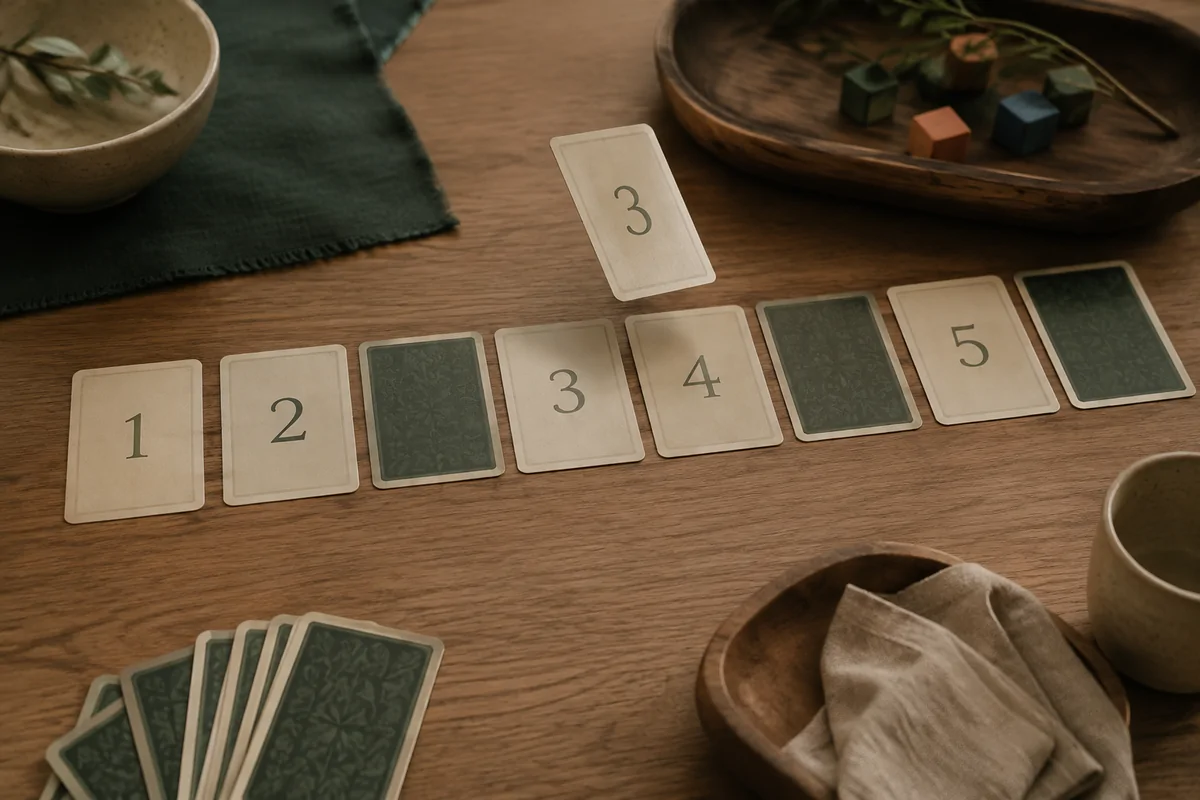
A shared sequence without spoken coordination
The Mind asks players to play numbered cards in ascending order while withholding ordinary discussion about the cards in their hands. Pandasaurus Games describes the game around this quiet coordination and its progression through levels. The group knows the general goal but lacks the normal tool of saying “I have a low number.” Players must attend to one another’s pauses, confidence, and timing while deciding when to contribute a card. Silence is not an absence of interaction. It is the constraint that makes timing itself the shared signal.
The game’s design is intentionally unlike a conventional communication puzzle. Players cannot negotiate an exact order, and the rules limit gestures or signaling according to the current instructions. They have to develop a collective sense of pace from repeated play. That sense is not a reliable code that reveals every hand. It is a temporary agreement about when a card seems ready to be played. The uncertainty remains because each person is estimating where their own card belongs relative to unseen cards held by others.
Timing turns private numbers into public decisions
Each player’s card is private until played, but the moment of play is public. A player who acts early may be correct or may interrupt a lower card held elsewhere. Waiting can preserve order, but waiting too long can make the group miss the right moment. This creates a decision that is both mathematical and social. A player is not only asking how low their number is; they are asking how the group’s current rhythm should be interpreted. The rules create the shared objective, while players create a sense of tempo through attention.
That attention can differ from person to person. Some players naturally wait for a long pause; others act as soon as a card feels plausible. The group can learn each other’s tendencies, but it should not pretend that these tendencies reveal exact values. A gentle debrief can help: when did the group feel ready, and what did a missed sequence teach about its pacing? The answer is not a universal interval or gesture. It is a better collective understanding of how this particular group handles uncertainty.
Silence changes the social texture of a turn
Without ordinary speech, players may become more aware of breathing, eye contact, or the physical act of holding a card. The game’s rules determine what communication is allowed, and groups should follow them rather than introducing a hidden signaling system. Within that boundary, nonverbal timing becomes part of the experience. A pause can feel meaningful, but its meaning is never guaranteed. The design invites players to attend to one another while accepting that another person’s internal estimate may not match theirs.
This can make the game surprisingly accessible to players who prefer not to perform elaborate verbal strategy, while it can challenge groups accustomed to constant discussion. A host should explain the silence constraint before the first round and establish a respectful tone around mistakes. A wrong-order play is information about the group’s timing, not a reason to criticize someone for reacting differently. The game is cooperative precisely because no one can solve the sequence alone. Players share responsibility for deciding when to act.
Levels create a longer arc for trust
The level structure increases the challenge as players progress, using the rules to alter the number of cards or the demands placed on the group. The official rulebook is the source for exact setup, lives, and any special tools such as throwing stars. The broader arc lets players learn a shared rhythm over repeated rounds. Early successes may build confidence, while later demands test whether that confidence is calibrated. Progress is therefore partly a memory of prior coordination: the group has evidence about how it tends to wait and when it tends to rush.
Because confidence can grow faster than accuracy, the group should keep its attention grounded. A strong early round does not guarantee that the next hand will align just as well. Players can continue to use pauses thoughtfully and adjust after a mistake. The levels make the experience feel like a developing practice, not a sequence of unrelated puzzles. Trust is built through repeated attempts, but it remains provisional. The table learns how to coordinate without converting silence into certainty.
Make the first round calm and observable
For a first game, explain the goal and silence rule, then give players time to hold their cards and find a shared pace. Do not rush the first contribution. After the round, ask what made the timing feel right or uncertain. This simple reflection helps players notice their own assumptions without revealing more than the rules permit. As familiarity grows, the group can move faster because it has a better sense of how the others respond, not because it has secretly agreed on a fixed cue.
The Mind turns timing into a communication medium by removing the most obvious one. Players share a goal, keep numbers private, and decide when the room is ready for a card. Pandasaurus Games’ current materials define the precise procedure and progression. The design lesson is that cooperation can depend on restraint. A player contributes not only by acting but by waiting, reading the group, and accepting that silence carries incomplete information. The sequence succeeds when participants build a common rhythm while leaving space for uncertainty to remain part of the game.