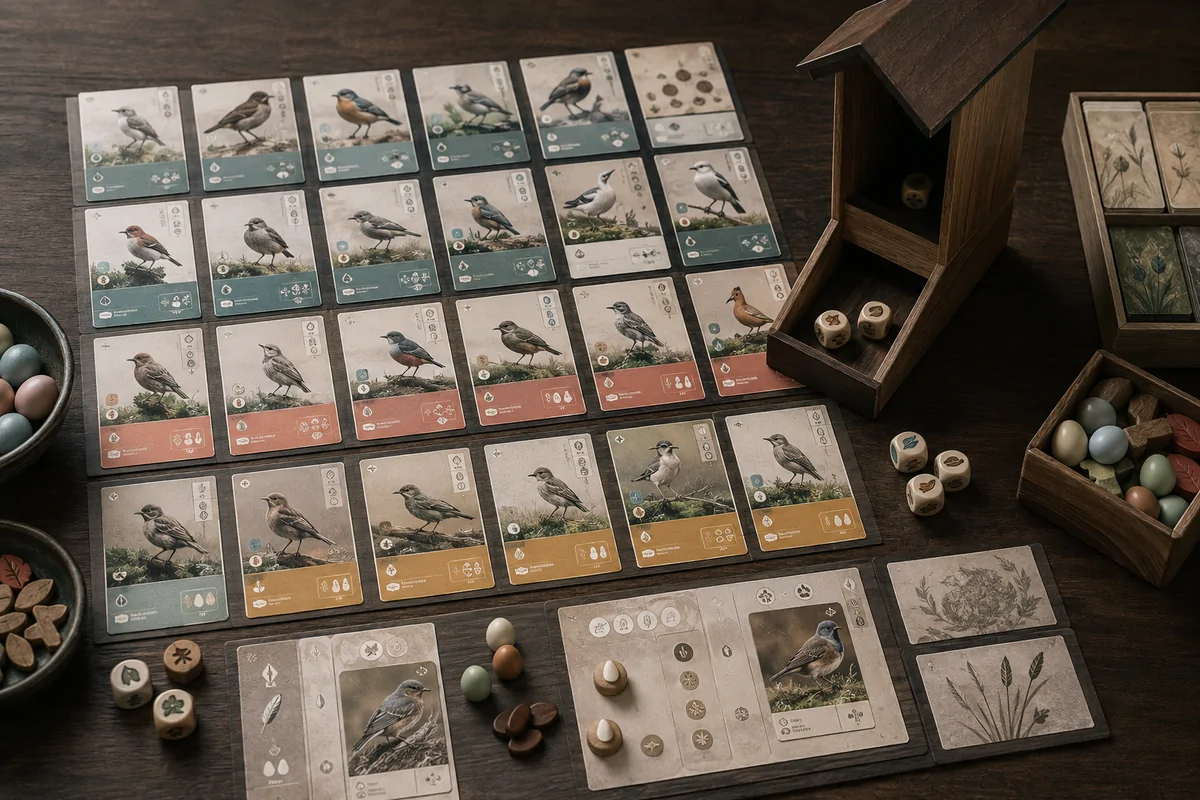
The player board is both engine and field guide
Wingspan places birds into habitat rows and asks players to use actions that gain food, lay eggs, or draw bird cards. Stonemaier Games presents those three actions as the game’s core loop and pairs the cards with natural-history details. The player board therefore serves two roles. It is an engine that changes the value of later actions, and it is an atlas-like display that organizes real bird names and information. This combination gives the game a particular tone: players are optimizing a system while also looking at a catalog of living species.
The two roles can support one another without being confused. The rules govern what a bird power does in play; the printed natural-history details provide context about the subject. A card’s ability is a game effect, not a claim that the bird behaves exactly as the mechanic models. Keeping that distinction clear respects both the game and the animals it represents. A reader can enjoy the tableau as a learning surface while consulting reliable natural-history sources for deeper biological questions. The engine’s abstractions should not be mistaken for a scientific explanation.
Three actions make the engine readable
Each habitat row centers on a different action, and birds placed there can add effects that trigger as the player uses that row. The more the tableau develops, the more a familiar action can produce a chain of benefits. This is engine building made visible: the row itself shows how future turns may gain extra value. Players can scan the board and see which action has been invested in. A new player does not need to memorize an abstract combo list; they can follow the row from the action space through the birds that respond.
The rows also create a meaningful choice about where to invest next. A player may want food to play more birds, eggs to satisfy a scoring need, or cards to find a useful ability. The best action depends on current resources and the tableau’s effects. A row with many powers may be less valuable if it no longer supports the player’s immediate plan. The engine does not automatically improve every turn; its quality depends on timing and whether the player can use what it produces. The board helps players compare potential output with actual need.
Bird facts and game powers have different jobs
The cards’ factual details give the tableau an educational texture. A player may encounter a species name or short fact while deciding where a card belongs. This can spark curiosity, but the game remains selective: each card includes only a small slice of context, and the power is designed for play. A thoughtful site should avoid extending those snippets into unsourced claims about habitat, conservation status, or behavior. The publisher’s materials support the game’s structure and presentation; further natural-history statements should be backed by appropriate ornithological or institutional sources.
This boundary matters because attractive themes can blur the line between metaphor and evidence. A bird power may evoke a behavior, but a mechanic has to work within a scoring system. It cannot stand in for observation or a scientific source. For a family session, the cards can function as prompts: choose one species and look up an authoritative field guide or museum record after the game. That small practice turns a designed fact into a path toward further reading without pretending that the card itself is comprehensive.
The round structure gives the engine a horizon
An engine’s value depends on how many chances remain to use it. Wingspan divides play into rounds, with objectives and end-of-round scoring that make progress measurable at several points. The player board’s powers can become more productive as birds accumulate, but every placement also consumes resources and a turn. A card installed late may trigger only a few times. The design invites players to compare investment with horizon: how many future uses can this ability reasonably provide, and does that justify spending food or a card now?
Round goals also keep the table from reducing the game to a single score engine. Players must consider what the current objective rewards and how their tableau is positioned. A powerful row may help one objective and do little for another. This makes the game’s pace easier to discuss after a session. Ask when a player shifted from building to scoring and which actions were repeated often enough to justify the investment. Those questions are more useful than calling one row “the best,” because the answer changes with the objective and the remaining rounds.
Read the tableau from action to consequence
When teaching, take a single bird card and trace its placement through the action row it joins. Explain what the player spends, what the power changes, and when that power can trigger. Then compare the same action before and after the row develops. This demonstration conveys the engine without requiring a complete card-by-card survey. It also lets the group notice how a card’s habitat placement is a strategic decision, not just a thematic sorting exercise.
Wingspan joins a visible engine to a natural-history presentation. The three actions create an easy-to-follow framework; the bird powers make repeated actions change over time; the factual text invites curiosity beyond the game. The publisher’s rules and product information are the source for mechanics, while external natural-history questions deserve subject-specific evidence. The design lesson is that theme can be both an operating system and a reading surface, provided their roles stay clear. A strong tableau is a plan for future actions; a strong field guide experience is an invitation to learn more than the card can hold.