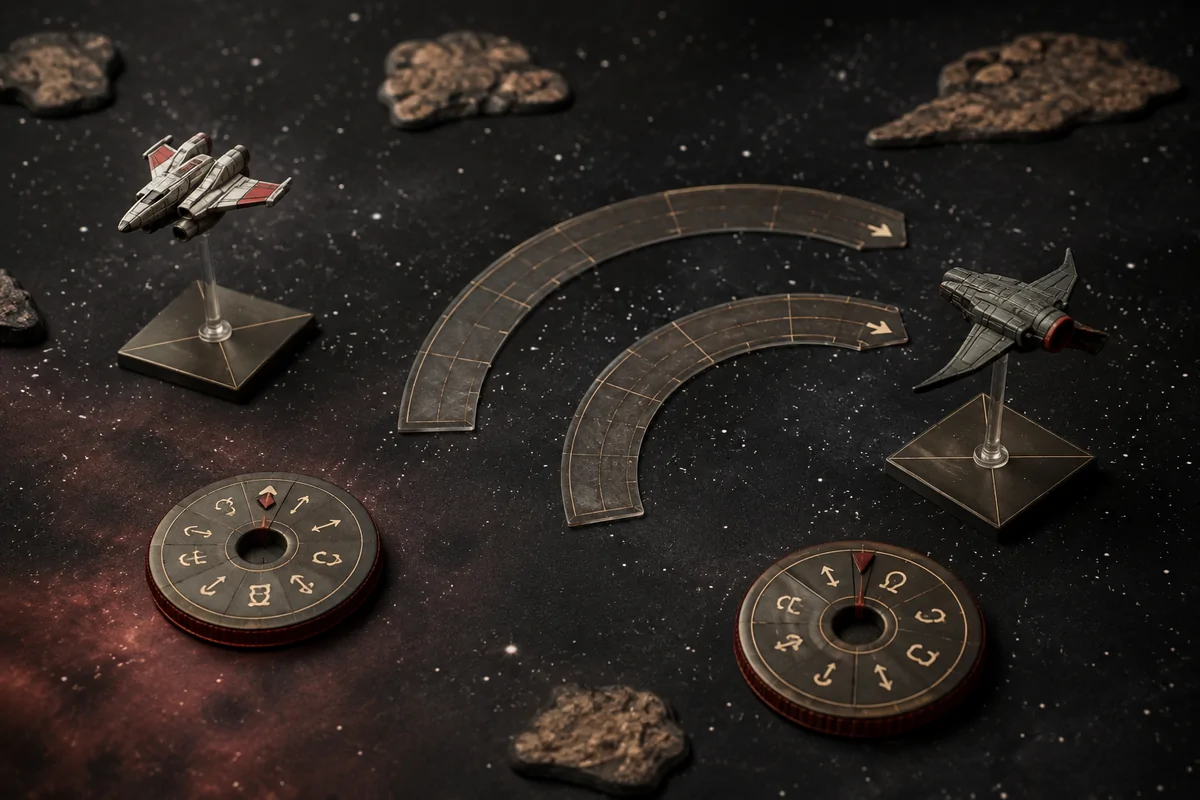
The dial holds a decision until the reveal
X-Wing uses maneuver dials so players can select movement secretly before ships execute their plans. Atomic Mass Games’ current document library provides the rules materials for the game. The dial gives each player a private planning surface and creates a shared reveal moment later. Before the maneuver is known, a ship’s direction is an intention rather than a fact. Once the dial is revealed and movement is carried out under the rules, that intention becomes part of the board state. The small component makes a timing boundary visible and tactile.
This structure changes what it means to predict an opponent. Players can inspect the current formation and the available maneuver patterns, but they cannot know the exact choice until reveal. A good plan therefore considers a range of possible positions. A ship may turn, accelerate, or slow according to its dial options, and obstacles or other ships can affect the outcome. The rules determine the maneuver and its consequences; the player’s job is to estimate what opponents might choose and how much risk the formation can absorb.
Simultaneous planning protects both players’ agency
When players choose dials before revealing them, neither side can fully react to the other’s current maneuver. This creates a small commitment problem. A player must make a decision based on an earlier board state and accept that the opponent is doing the same. The reveal then compares the plans in public. This is different from alternating movement, where the first player’s action can directly determine the second player’s response. X-Wing’s approach produces anticipation and surprise without hiding the entire state of the game.
The system is not an attempt to make movement random. Players choose from defined patterns and can infer from position, objectives, and prior behavior. Still, those inferences are uncertain because each player has independent reasons to change plans. A maneuver that would have been excellent against one expected move can become awkward against another. The design makes that risk part of the fun. Players can review whether their estimate was reasonable, rather than treating a collision or missed target as proof that someone played badly.
Templates turn a plan into a measured path
Movement templates help translate the dial’s choice into a physical path. They let players reproduce a maneuver consistently and make the resulting position inspectable. Without a template, two players might disagree about the angle or distance implied by a dial choice. With one, the table has a shared reference for where the ship should end. The component does not decide whether the maneuver is safe; it shows what the rules mean by executing it. A good host places templates carefully and keeps the play area clear enough to use them without moving unrelated models.
The path can also create interaction with obstacles and nearby ships. A player should consider not just the destination but the route the ship follows and the rules that apply if it crosses or overlaps something. The exact consequences are defined by the current reference and can vary by scenario or updated rules. Teaching should demonstrate the movement procedure with an empty stretch before introducing a crowded board. Once the path is clear, players can focus on the strategic problem: where will this ship end relative to its target and the opponent’s likely reveal?
The formation is a system of predictions
Ships on the board create a changing formation. A player’s dial choice can support an attack, protect an ally, avoid an obstacle, or preserve a future turn. Yet each ship’s plan interacts with the others. Two friendly ships may choose paths that leave them in one another’s way, while an opponent may unexpectedly occupy the space a player expected to use. This makes formation planning less like drawing a single route and more like coordinating several possible trajectories at once.
That coordination can be taught by asking what each ship needs from the next reveal. One may need a firing angle; another may need to avoid crossing a crowded lane. The group should discuss intentions without assuming that every maneuver will succeed. If players explain the goal behind a dial, they can better understand the result afterward. The revealed movement becomes evidence about the plan and about the opponent’s priorities. The design supports analysis because the input was selected in advance and the path can be replayed against the visible board.
Reveal is a social beat as well as a rule step
The moment of reveal changes the table’s attention. Everyone moves from private expectation to a shared result. A short pause before resolving the maneuvers can make that transition clear and exciting. Players can then follow the sequence using the current rules and templates. If an unexpected overlap or obstacle interaction occurs, consult the official reference rather than improvising from a memory of an older edition. Atomic Mass Games’ documents should be checked for the rules set in use, since the game has had revisions and organized-play updates.
The maneuver dial makes planning visible at exactly the point it can no longer be changed. That timing gives players agency without allowing perfect reaction. The official rules define how the chosen maneuvers are revealed and executed; this study interprets the dial as a commitment device and a shared reveal ritual. The design lesson is that simultaneous planning can create tension from public information. Players see the same ships and templates, yet each must choose before knowing how the other will move. The result is a formation built from predictions that everyone can inspect afterward.