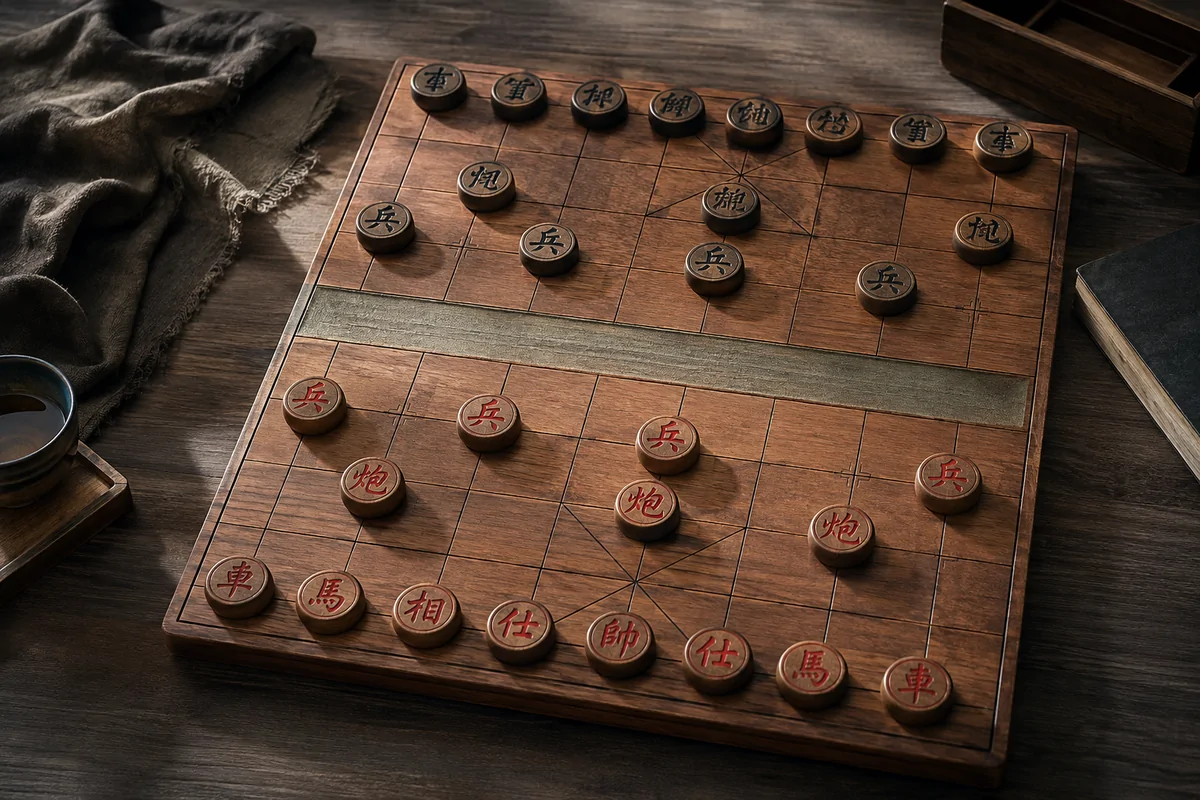
The board is already a map
Xiangqi does not present an empty grid and ask players to imagine every boundary. The river divides the board, and each side’s palace marks a restricted area for important pieces. These features are part of the playing surface rather than scenery placed around it. The World Xiangqi Federation rules describe how the river and palace affect movement alongside the pieces’ other constraints. This makes the board read like a map with built-in zones: lines of travel are visible, but not every piece may use every route in the same way.
That map changes how players understand distance. A piece near the river may be close in geometric terms but far from a useful crossing or target. A palace can concentrate a defensive problem into a compact region, while the river separates forces that might otherwise interact directly. The terrain does not decide the strategy on its own. It gives the strategy a shape that both players can inspect. When a learner asks why a piece cannot simply move to a nearby point, the board itself can answer before a special-case explanation is needed.
The river makes crossing a decision
The river is often described as a dividing line, but it is more useful to consider what a crossing changes. A piece that reaches the other side enters a different relationship with opposing pieces and with the goals of the position. Depending on the piece, its movement or strategic role may be shaped by whether it has crossed. The rules establish those formal limits; players decide when the crossing is worth the exposure. The river therefore operates as both a physical feature and a threshold in the game’s changing distribution of pressure.
Because the river is printed and persistent, it supports a shared vocabulary. Players can point to the near bank, the far bank, or an approach lane without inventing private coordinates. That helps a group discuss a plan even when the players have different levels of experience. It also makes the game teachable through visible landmarks. A teacher can ask which piece can cross, what must be protected during that move, and what the opponent gains access to in response. The terrain turns a broad strategic question into a location-specific conversation.
The palace makes protection spatial
The palace functions as a bounded area with rules for the pieces associated with it. Rather than treating protection as an abstract bonus, Xiangqi locates it on the board. The general’s safety can be discussed by looking at the palace, its lines, and the routes that reach it. This produces a compact defensive diagram. A player may need to preserve an escape square, prevent a direct line, or coordinate the palace pieces with forces elsewhere. The formal geometry gives a group a common picture of what is being defended.
That spatial clarity also creates pressure. When important pieces are confined to a small area, a threat can become urgent without requiring a long sequence of moves. Players can inspect how the available squares interact and whether a defender can reach the threatened line. The palace does not make defense simple; it makes the boundaries of defense easier to see. For design, that distinction matters. A constraint can sharpen a problem when players can understand its edges, even if the right answer remains difficult to calculate.
The cannon gives a line a different meaning
The cannon is a memorable example of movement and capture using the same line in different ways. It travels along open ranks or files like a sliding piece, but its capture requires an intervening screen. The WXF rules specify this relationship, so the board line is not merely a path; it can become an attack channel under a different condition. Players must read what lies between the cannon and its target. A piece that blocks movement may enable a capture, reversing the usual intuition that an obstruction only protects what is behind it.
This rule makes the cannon a lesson in relational geometry. Its threat depends on a three-part alignment: the cannon, a screen, and the target. That structure can be taught by moving a single piece at a time and asking how the relationship changes. The player does not need a special physical component to remember the interaction; the board’s ordinary pieces create the condition. Xiangqi’s design uses a compact movement rule to make the same line carry multiple meanings, inviting players to scan not just destinations but the objects that make a destination reachable.
Explain terrain before asking for tactical calculation
A first introduction can identify the river and palace, then demonstrate one ordinary move and one movement limited by those zones. After that, show the cannon’s screen rule and trace the general’s safety condition using the current official rules. This sequence starts with the stable map before adding tactical combinations. It helps learners understand that the pieces do not operate in a featureless space. When they later analyze an attack, they can name the relevant region and route rather than trying to remember an isolated diagram.
Xiangqi’s board is an argument made of lines, thresholds, and restricted rooms. The river separates and connects; the palace concentrates responsibility; the cannon makes an intervening piece part of an attack. Those are rules first and interpretations second. The World Xiangqi Federation source should be consulted for current competition procedures and exact movement details. The design insight is broader: terrain can teach a game’s central relationships before a player moves. A board that encodes limits in its printed structure reduces ambiguity and gives strategic conversation a shared map.